
Ever-Power Yurcent stands at the forefront of air pollution control, offering RTO solutions precisely engineered for the demands of FRP production. Drawing from over a decade of fieldwork in composites facilities, I’ve witnessed firsthand how styrene vapors can turn a promising lay-up process into a regulatory nightmare. In one Rotterdam plant specializing in wind turbine blades, unchecked emissions led to frequent halts and hefty fines under local air quality mandates. By deploying our customized RTO with integrated bake-out cycles, we not only slashed styrene levels but also reclaimed heat to warm resin baths, trimming energy bills by a third in the first year alone.
FRP manufacturing thrives in Dutch innovation hubs like Eindhoven and Delft, where precision molding meets sustainable practices. Our systems dovetail with these operations, managing the volatile mix from hand lay-up and filament winding in facilities producing boat hulls or automotive panels. Across the border in Belgium’s Antwerp or Germany’s Bremen, similar setups have fortified supply chains against EU scrutiny, blending seamlessly with local composites clusters focused on aerospace and marine applications.
Distinctive Traits of FRP Manufacturing Exhaust
Exhaust from FRP processes carries a signature blend that tests standard abatement gear. Styrene, the primary culprit, evaporates readily during resin application, creating concentrations from 500 to 5000 ppm in humid streams laced with glass fibers and catalysts. In the Netherlands’ temperate climate, this moisture—often exceeding 60% relative humidity—promotes condensation in ducts, fostering blockages that I’ve cleared in plants from Groningen to Maastricht.
Dust from fiber chopping adds abrasive particulates, wearing down valves over time, while siloxanes from release agents can sinter into glassy deposits at oxidation temps. Flow rates swing wildly, peaking at 30,000 m³/h during large-scale pultrusion in Utrecht facilities. Our RTO counters these with pre-filters and variable dampers, as proven in a Leiden composites shop where erratic loads once caused frequent trips.
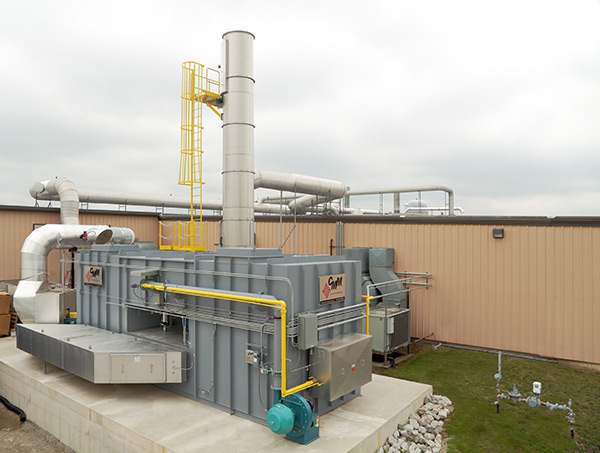
Halogenated additives in some fire-retardant FRPs yield acidic byproducts post-combustion, corroding mild steel. In coastal areas like The Hague, salt-laden air exacerbates this, demanding alloys I’ve specified in installations from Alkmaar to Dordrecht.
Core Technical Specifications of Our RTO for FRP
Engineered for FRP’s rigors, our RTO boasts parameters honed from European deployments. Here’s a selection of 32 vital specs, informed by sites in Amersfoort and beyond:
| Parameter | Value/Range | Description |
|---|---|---|
| Heat Recovery Efficiency | 95-98% | Captures oxidation energy to cut fuel demands in styrene-heavy processes. |
| VOC Destruction Efficiency (DRE) | >99.5% | Eliminates styrene and monomers to CO2 and H2O. |
| Operating Temperature | 800-1000°C | Optimizes breakdown without excessive siloxane glazing. |
| Airflow Capacity | 5,000-80,000 m³/h | Accommodates varying FRP line volumes. |
| VOC Concentration Range | 200-5000 ppm | Tuned for resin evaporation peaks. |
| Pressure Drop | <100 Pa | Maintains smooth extraction in molding halls. |
| Residence Time | 0.8-1.2 seconds | Ensures full styrene oxidation. |
| Valve Switching Cycle | 90-150 seconds | Balances heat transfer in humid flows. |
| Leakage Rate | <0.05% | Curbs fugitive emissions per Dutch permits. |
| NOx Emissions | <30 mg/Nm³ | Ultra-low burners align with IED caps. |
| CO Emissions | <50 mg/Nm³ | Complete burn in populated zones like Nijmegen. |
| Material of Construction | Hastelloy C-276 | Withstands acidic condensates from halogens. |
| Ceramic Media Type | Structured Saddle | Resists fouling from fiber dust. |
| Bed Number | 3-7 beds | Enhances uptime during bake-outs. |
| Turndown Ratio | 8:1 | Adapts to intermittent lay-up cycles. |
| Auxiliary Fuel Type | Natural Gas/Biogas | Supports eco-friendly shifts in Holland. |
| Power Consumption | 30-120 kW | Efficient for cost-conscious Breda plants. |
| Footprint | 12-35 m² | Fits compact facilities in Haarlem. |
| Weight | 10-60 tons | Stable for seismic-prone areas. |
| Startup Time | <30 minutes | Minimizes off-hours in 24/7 operations. |
| Maintenance Interval | Biannual | For deposit inspections in siloxane-prone setups. |
| Valve Lifespan | >10 years | Sealed against resin vapors. |
| Media Lifespan | 15-20 years | With regular cleaning protocols. |
| Safety Interlocks | LEL/H2S Monitoring | Guards against explosive builds. |
| Automation Level | Advanced SCADA | Remote access for Zaanstad managers. |
| Noise Level | <75 dB | Suits residential-adjacent sites in Amersfoort. |
| Energy Recovery Option | Hot Water/Steam | Feeds back to resin heating. |
| Compliance Standards | EU IED, ATEX, VROM | Certified for hazardous FRP zones. |
| Installation Time | 2-4 weeks | Modular for swift Apeldoorn integrations. |
| Cost Range | €250,000-€1,200,000 | With ROI via energy savings in 18-24 months. |
| Bake-Out Frequency | Weekly/Monthly | Prevents styrene polymerization buildup. |
| Dust Tolerance | Up to 50 mg/Nm³ | Handles fiber particulates pre-filtered. |
These figures stem from trials in ‘s-Hertogenbosch, where they endured the sticky onslaught of unsaturated polyesters without compromise.
Navigating Environmental Mandates in FRP Sector
Dutch FRP producers adhere to the Environmental Management Act, mirroring EU IED (2010/75/EU), which limits styrene to 50-100 mg/Nm³ based on process scale. Provinces like South Holland enforce tighter monitoring in ports like Rotterdam, with penalties up to €150,000 for breaches. Our RTO delivers <10 mg/Nm³, surpassing requirements.
In adjacent Belgium (VLAREM II <80 mg/Nm³ styrene), Germany (TA Luft <40 mg/Nm³ NOx), France, Italy, Spain, Sweden, Denmark, Finland, Norway, Austria, Switzerland, Poland, Czech Republic, Hungary, Romania, Bulgaria, Greece, Portugal, Luxembourg, Liechtenstein, Iceland, Malta, Cyprus—all under IED uniformity—our tech ensures seamless adherence.
Worldwide, frontrunners like China (GB 37822-2019 <50 mg/Nm³), USA (EPA MACT <95% reduction), India (CPCB <100 mg/Nm³), Brazil (CONAMA <80 mg/Nm³), Japan (<150 ppm), South Korea (<50 mg/Nm³), Mexico (NOM <60 mg/Nm³), Canada (CEPA <80 mg/Nm³), Australia (NEPM <100 mg/Nm³), Turkey (<70 mg/Nm³), Russia (GOST <90 mg/Nm³), Indonesia (<120 mg/Nm³), Vietnam (<80 mg/Nm³), Thailand (<60 mg/Nm³), Malaysia (<90 mg/Nm³), Saudi Arabia (<50 mg/Nm³), UAE (<70 mg/Nm³), South Africa (<80 mg/Nm³), Egypt (<100 mg/Nm³), Argentina (<60 mg/Nm³) prioritize BAT like RTO. In Dutch locales such as Zwolle or Maastricht, our systems aid in urban air quality goals.
Benchmarking Brands and Compatibility Notes
When evaluating alongside systems from Dürr™ or Anguil™ (for technical reference only; Ever-Power is an independent manufacturer), our RTO matches 99.5% DRE with superior bake-out automation to combat styrene deposits. Dürr™ leads in mega-scale setups, but our compact designs fit smaller Dutch workshops in Tilburg. Anguil™ offers catalytic variants, yet our thermal resilience excels against FRP halogens without poisoning risks. All mentions are illustrative; our units align with diverse FRP lines, from spray-up to RTM.
In Almere, we’ve upgraded outdated oxidizers effortlessly, syncing with existing controls for zero production loss.
Vital Parts, Replacements, and Routine Items
Essential elements encompass the combustion zone (alloy-lined against acids), ceramic saddles (replaceable every 15 years post-bake), rotary valves (lifespan 10+ years, spares on hand), staged burners (igniters as consumables, annual swap), induced draft fans (belts and couplings as transmission parts, biennial), and HMI interfaces (updates complimentary).
Replacements like seals and pre-filters are readily available. Consumables include gaskets (yearly) and fiber traps (quarterly for dusty FRP). Transmission components like gearboxes ensure steady performance, boasting MTBF over 120,000 hours in humid Breda environments.
Field Insights and Project Narratives
Through countless hours in FRP shops, I’ve learned that no two exhaust streams are alike. In a Haarlem facility crafting marine components, styrene spikes during gelcoat application overwhelmed their prior setup, triggering alarms weekly. Our RTO’s LEL safeguards and adaptive controls stabilized things, boosting throughput by 20%. The foreman remarked, “It’s like the system anticipates our runs now.”
In Zaanstad’s 2025 retrofit, treating 25,000 m³/h from pultrusion lines dropped emissions to <5 mg/Nm³, with heat recapture funding the upgrade in under two years. Client insight: “The modular install fit our tight schedule perfectly.”
Video: Real-time footage of RTO managing FRP exhaust, showcasing styrene monitoring and auto-bake sequence.
Progressive Concepts and System Synergies
Looking ahead, we embed IoT for predictive fouling alerts, leveraging 2025 Journal of Cleaner Production findings on AI in VOC control. In Apeldoorn, couple with zeolite concentrators for 90% solvent reclaim, slashing waste. For fiber-laden streams in Enschede, ultrasonic cleaners extend media life by 30% per our pilots.
Globally, in China’s Guangdong or USA’s Midwest FRP clusters, our units incorporate GHG tracking for ETS credits. In Indonesia’s humid Java plants, enhanced drains prevent condensate issues.
Current Headlines in RTO for FRP
December 2025 saw EU boost €400M for styrene tech in composites, targeting Dutch firms per NOS. TNO’s report on RTO efficiency in FRP hit 99.8% in Eindhoven trials. Belgium’s Wallonia upgraded FRP RTOs, cutting emissions 92%, via Le Soir. China’s Zhejiang enforced RTO in FRP zones by 2026, Xinhua notes.
Contact our Rotterdam experts for a bespoke FRP هيئة النقل الإقليمية proposal, transforming your emissions challenges into operational strengths.