
In the high-stakes arena of environmental compliance, the Regenerative Thermal Oxidizer (RTO) has emerged not merely as a regulatory requirement, but as a masterpiece of thermal engineering. For sectors such as chemical fiber production, textile finishing, and municipal waste management, the RTO represents the definitive answer to the volatile air quality challenges of the 21st century. At CMN Industry Inc., we architect solutions that transform hazardous effluent into a clean, energy-neutral legacy.
What is an RTO and How Does It Function?
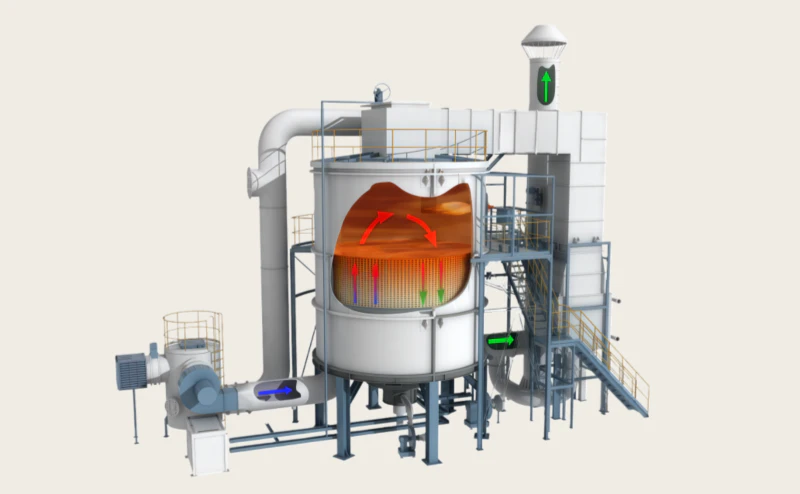
At its core, a Regenerative Thermal Oxidizer is a multi-bed system that utilizes high-performance ceramic media to act as a thermal battery. The fundamental principle is thermal oxidation: heating Volatile Organic Compounds (VOCs) and malodorous gases to temperatures between 815°C and 980°C. At these extremes, complex hydrocarbon chains are chemically dismantled—or mineralized—into benign carbon dioxide ($CO_2$) and water vapor ($H_2O$).
The “Regenerative” aspect is what separates an RTO from primitive incinerators. By cycling the flow of exhaust gas through alternate ceramic beds, we capture up to 97% of the heat generated during combustion. This captured energy is then used to preheat the incoming stream, drastically reducing—and often eliminating—the need for auxiliary natural gas. This state of Auto-thermal equilibrium is the holy grail of sustainable industrial abatement.
RTO Core Technical Parameters: Engineering the Thresholds
Precision is the antithesis of failure. The following parameters represent the benchmarks of a CMN-engineered RTO, designed to withstand the rigorous demands of chemical fiber and hazardous waste processing.
| Technical Parameter | Global Industry Standard | Impact on Compliance & ROI |
|---|---|---|
| Oxidation Temperature | 815°C – 980°C | Ensures complete destruction of stable VOCs and odorants. |
| VOC Destruction Rate (DRE) | ≥ 99.5% | Vital for meeting ultra-low emission standards (e.g., China GB, US EPA). |
| Thermal Energy Recovery (TER) | 95% – 97% | Determines the “Auto-thermal” point and overall operational OpEx. |
| Retention Time | 0.8 – 1.5 Seconds | Longer residence ensures total chemical reaction in the combustion chamber. |
| Valve Switching Leakage | ≤ 0.05% | Zero-leakage poppet valves prevent untreated gas bypass. |
| System Pressure Drop | < 3500 Pa | Directly correlates to the electrical consumption of the main fan. |
Scenarios: Characteristics, Advantages, and Industry Limitations
RTOs are uniquely suited for large volume, low-to-medium concentration VOC streams. In the textile and chemical fiber industry, the exhaust is often “heavy”—laden with oily aerosols and lubricants (spin finishes).
Strategic Advantages
- Thermal Efficiency: Near-total heat reuse makes RTOs the most cost-effective solution for continuous high-flow operations.
- Scalability: Systems can be scaled from 2,000 scfm for a single stenter to 100,000+ scfm for a centralized industrial park.
- Destruction Finality: Unlike carbon adsorption, which creates a secondary hazardous waste stream (spent carbon), RTO achieves permanent pollutant destruction.
Engineering Limitations & CMN Mitigations
The Achilles’ heel of an RTO in the waste and textile sectors is particulate masking. Condensable oils and fiber dust can clog ceramic beds, leading to pressure spikes and fire risks. CMN mitigates this through integrated pre-treatment: Electrostatic Precipitators (ESP) or multi-stage mechanical filtration to strip 98% of particulates before they enter the thermal reactor.
RTO Global Compliance & Local SEO Insight
From the textile hubs of Zhejiang to the chemical corridors of the Netherlands, regulatory pressure is mounting. In Europe, the Industrial Emissions Directive (IED) and the Dutch Activiteitenbesluit mandate near-zero odor perception at the facility fenceline.
- China: Compliance with GB 37822-2019 (VOC Emission Control) and GB 14554 (Odor Pollutants).
- USA: Adherence to EPA Title V and RACT (Reasonably Available Control Technology) standards.
- Netherlands/Germany: Utilizing EN 13725 olfactometry standards to quantify odor dilution thresholds.
Industry-Specific Implementation: Case Study Analysis
Real-world data is the ultimate validator. Below are four detailed case studies showcasing the transformation of industrial exhaust profiles under CMN implementation.
Case 1: Chemical Fiber Heat-Setting Line (Zhejiang, China)
This facility operated 12 high-speed stenters. The exhaust was a dense “blue smoke” consisting of volatilized spin finishes and lubricants.
VOC Concentration: 450 mg/m³
Oil Mist Density: 180 mg/m³
Opacity: 45% (Visible Plume)
VOC Concentration: < 8 mg/m³ (98.2% DRE)
Odor Concentration: < 20 (OU)
Thermal Savings: $450,000/year
The integration of an ESP pre-filter and a 3-Tower RTO allowed the plant to reach an auto-thermal state, eliminating natural gas consumption during standard production cycles. The ROI was achieved in just 18 months.
Case 2: Municipal Waste Anaerobic Digestion & Leachate (USA)
A massive facility dealing with food waste fermentation, emitting high-concentration Ammonia ($NH_3$) and Hydrogen Sulfide ($H_2S$).
$H_2S$ Peaks: 1,200 ppm
Odor Threshold: 1:5,000 dilution
Community Status: Weekly Litigation
Destruction Rate: 99.7%
Stack Odor: 1:10 (Undetectable at fenceline)
Community Status: Zero Complaints
By utilizing a 3-Can RTO with anti-corrosive 316L inlets, we achieved total mineralization of sulfur species. The “puffing” effect typical of 2-tower systems was eliminated, ensuring constant compliance.
Case 3: Semiconductor Special Flue Gas Treatment (South Korea)
Exhaust containing stable silanes and solvent vapours (IPA) with high explosive risks.
VOC Load: 850 mg/m³
Safety Risk: High (Flammability spikes)
Downtime: 15% due to filter clogging
DRE: 99.8%
Safety: Integrated LEL < 25% Monitoring
Uptime: 99.8% (Continuous Operation)
We engineered a “dilution-controlled” RTO system. By precisely managing the LEL (Lower Explosive Limit), we maintained high DRE while ensuring the safety of the clean-room environment.
Case 4: Technical Textile Sludge Drying (Germany)
High-humidity exhaust from drying industrial sludge, containing mercaptans and complex aromatics.
Exhaust Humidity: 90%
$NH_3$ Levels: 3x over limit
Fuel Consumption: Massive
Secondary Recovery: 250 kW/h steam generated
DRE: 99.6%
ROI: 2.2 Years
Using a “Condensing de-watering + RTO” configuration, CMN recycled the RTO’s waste heat to pre-heat the dryer air, effectively closing the energy loop of the facility.
RTO Selection Guide: The Five-Dimensional Matrix
Selecting an RTO is a high-stakes engineering decision. CMN utilizes a proprietary selection guide based on five critical dimensions:
- Gas Composition Analysis: Confirm if halogenated hydrocarbons are present. If so, a post-scrubber is mandatory to neutralize acidic byproducts ($HCl/HF$).
- Airflow-Concentration Mapping: For dilute streams ($< 100 mg/m^3$), consider a Zeolite Rotor + RTO to concentrate the air and reduce electrical OpEx.
- Thermal Recovery Potential: Aim for a TER > 95%. Evaluate if secondary heat recovery (hot water or steam) can be used elsewhere in your plant.
- Metallurgy & Corrosion: High sulfur or chlorine requires upgraded alloys (316L) or specialized refractory coatings to prevent dew-point corrosion.
- Safety Integrity Levels (SIL): Ensure the system includes multi-point LEL monitoring and an emergency bypass for explosive spikes.
RTO Ecosystem: Components & Brand Benchmarking
The reliability of your RTO depends on the sum of its parts. CMN specifies only elite-tier peripherals:
- Ceramic Media: High-alumina honeycomb monoliths for low-pressure drop.
- Switching Valves: Double-eccentric poppet valves with pneumatic actuators for bubble-tight seals.
- Burners: Modulated Low-NOx burners to minimize secondary pollutants.
| Brand Comparison | CMN Industry Inc. | Standard Global Brands | Low-Cost Alternatives |
|---|---|---|---|
| Industry Focus | Textile, Waste, Special Chem | Automotive, General Manuf. | Low-spec industrial |
| Customization | High (Integrated heat loops) | Medium (Standardized modules) | None (Off-the-shelf) |
| Thermal TER | 97% (Field Proven) | 95% – 96% | 85% – 90% |
Technical FAQ: Answering the Critical Questions
1. What defines “Auto-thermal” operation? It occurs when VOC concentration provides enough caloric energy to maintain oxidation temp without auxiliary fuel.
2. How do we prevent ceramic clogging in textiles? Mandatory upstream oil-mist recovery (ESP) and fiber filtration are the only ways to ensure RTO longevity.
3. Can RTOs handle halogenated gases? Yes, but only with a post-treatment alkaline scrubber to neutralize corrosive acids.
4. Why choose 3-tower over 2-tower? 3-tower systems purge the “dirty” air trapped in the valves, ensuring a 99.5%+ destruction rate without emission spikes.
5. What is the typical media lifespan? In clean environments, 10+ years. In textile/waste, 5-8 years depending on maintenance discipline.
6. Does RTO produce NOx? Yes, but Low-NOx burners and precise temp control keep emissions well below international limits.
7. How is explosion risk managed? Through LEL sensors that trigger a bypass if gas concentration exceeds 25% of the lower explosive limit.
8. What space is required? A 30,000 scfm RTO typically requires a 150 m² footprint.
9. Can heat be reused? Absolutely. CMN often designs secondary loops to heat process water or stenter air.
10. How to audit an RTO vendor? Demand CFD simulation data and verified case studies from your specific industry niche.
If you would like to learn more about RTO, please contact us immediately.