
In the contemporary landscape of volatile organic compound (VOC) abatement, the 재생 열 산화 장치(RTO) stands as the pinnacle of thermodynamic engineering and ecological stewardship. At CMN Industry Inc., we recognize that industrial emissions—particularly those emanating from high-volume coating and surface treatment lines—are not merely a regulatory hurdle but a significant energy management challenge. The core mechanism of an RTO involves the thermal oxidation of hazardous air pollutants (HAPs) at temperatures typically exceeding 815°C, effectively dissociating complex hydrocarbons into benign CO₂ and H₂O. The “regenerative” aspect is facilitated by high-density ceramic honeycomb media that sequester and liberate thermal energy with staggering efficiency, often reaching 95-97% Thermal Energy Recovery (TER).
What is an RTO? Beyond the technical nomenclature, it is a safeguard for sustainable industrial growth. For facilities grappling with “What exhaust is suitable for RTO?”, the answer typically encompasses dilute to mid-concentration solvent streams found in automotive painting, coil coating, and chemical manufacturing. By leveraging the Destruction Removal Efficiency (DRE) of >99%, operators not only adhere to stringent EPA or EU IED standards but also achieve “autothermal” or “self-sustaining” operation, where the caloric value of the VOCs themselves fuels the oxidation process, drastically reducing auxiliary fuel consumption and the overall carbon footprint.

RTO Core Technical Parameters
Precision in RTO sizing and configuration is the differentiator between operational excellence and prohibitive utility costs. Below is a granular breakdown of the parameters governing high-performance systems:
| Parameter | Standard Range / Specification | Impact on Performance |
|---|---|---|
| Operating Temperature | 815°C – 980°C (1500°F – 1800°F) | Determines the kinetics of hydrocarbon oxidation; higher temps ensure DRE for refractory molecules. |
| VOC Destruction Efficiency (DRE) | ≥ 99% (Custom designs up to 99.9%) | Ensures compliance with local environmental permits (e.g., China GB37822-2019). |
| Thermal Energy Recovery (TER) | 95% – 97% | Directly correlates to fuel savings; higher TER minimizes the need for supplemental natural gas. |
| Retention Time | 0.5 – 1.0 Seconds | The “Goldilocks” zone for complete oxidation; prevents the formation of CO and partial oxidation products. |
| Flow Capacity | 2,000 – 80,000+ SCFM | Scalability to accommodate multi-line painting operations or centralized factory exhaust. |
| Valve Leakage Rate | < 0.1% (Zero-leak Poppet Valves) | Critical for multi-tower systems to prevent raw VOC bypass during switching cycles. |
Utilizing high-temperature thermal oxidizer VOC treatment efficiency as a benchmark, CMN Industry Inc. integrates low-pressure drop ceramic media to mitigate electrical consumption by the primary system fan. By referencing industry benchmarks such as the EPA-452/B-02-001 Section 6, we ensure that our systems are not just robust but scientifically validated for long-term endurance in corrosive or particulate-laden environments.
Scenario Analysis: Traits, Merits, and Constraints
RTO technology is exquisitely suited for large-volume, low-to-medium concentration air streams. In the coating industry, where spray booths generate massive amounts of air containing dilute solvent concentrations, the RTO excels through its sheer thermal inertia.
Advantages: The “Autothermal” Advantage
The primary merit lies in operational cost attenuation. When VOC concentrations reach approximately 3-5% of the Lower Explosive Limit (LEL), the RTO enters a self-sustaining mode. This energy-neutral state is a paradigm shift for industries like Flexible Packaging or Automotive Assembly. Furthermore, modern RTOs boast high reliability with mean time between failures (MTBF) exceeding 8,000 hours.
Constraints and Mitigation
The Achilles’ heel of an RTO is often particulate matter (PM) and high-concentration “spikes.” If the exhaust contains silicones or heavy resins, these can “glaze” the ceramic media, leading to pressure drop escalation. At CMN, we resolve this through advanced multi-stage pre-filtration and “Bake-out” cycles that thermally decompose accumulated organic deposits without dismantling the unit.
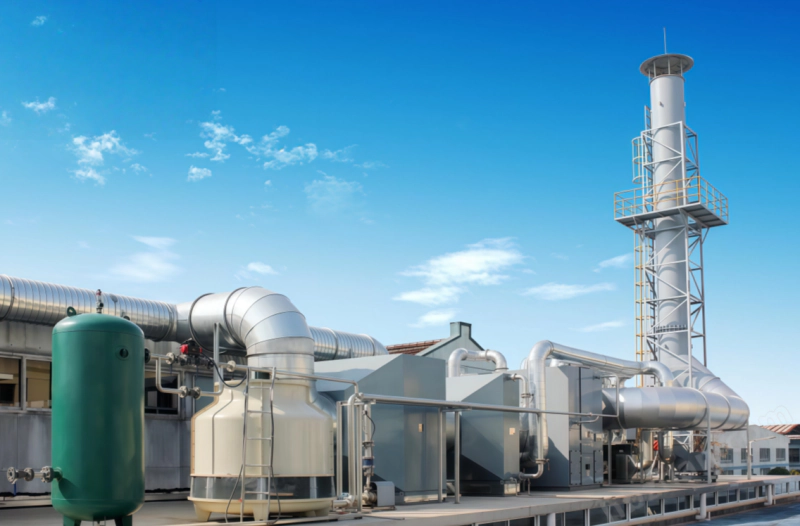
RTO Ecosystem: Parts and Ancillary Support
An RTO is only as reliable as its weakest component. We recommend the following high-tier ecosystem integrations:
- Ceramic Heat Exchange Media: We prioritize Monolith Honeycomb structures for low pressure drop or Random Saddle Packing for applications prone to thermal shock.
- Switching Valves: Hydraulic or pneumatic Poppet Valves with machined seats are mandatory for achieving >99% DRE. Butterfly valves are often relegated to non-critical bypass lines.
- Burner Systems: Low-NOx modulated burners that interface seamlessly with the PLC to maintain precise combustion chamber setpoints.
- Zeolite Rotor Integration: For ultra-low concentration streams (< 500 mg/m³), we pair the RTO with a Zeolite Concentration Rotor to “concentrate” the waste gas, drastically shrinking the RTO size requirement.
Global RTO Brand Comparative Analysis
| Brand | Flagship Series | Core Strength | Global Footprint |
|---|---|---|---|
| Dürr | Ecopure® RTO | Highest TER (up to 97.5%); robust automotive heritage. | Global leader; high capital expenditure (CAPEX). |
| Epcon | Custom Thermal | Exceptional handling of high-particulate/sticky exhaust. | North America focused; heavy-duty industrial builds. |
| Anguil | Model 75 / 100 | Versatile design; excellent remote monitoring capabilities. | Strong mid-market presence; reliable service. |
| CMN Industry | Opti-Therm Series | Cost-performance ratio; localized EU/Asia support; specialized for coating. | Rapid expansion; custom integration experts. |
Local SEO: Global Application and Regulatory Compliance
The European & Dutch Landscape (NL/EU)
In the Netherlands, the Activiteitenbesluit milieubeheer and the NeR (Nederlandse Emissierichtlijn) dictate stringent VOC limits. Our RTO systems are engineered to surpass the Best Available Techniques (BAT) conclusions under the EU Industrial Emissions Directive (IED). Whether you are operating in the Port of Rotterdam or an industrial park in Eindhoven, compliance with Koolwaterstoffen (C) limits is non-negotiable.
Global Compliance Matrix
- USA: Strict adherence to EPA Method 25A and Title V permits.
- China: Compliance with GB37822-2019 (Volatile Organic Compounds Unorganized Emission Control Standard).
- Germany: Meeting TA Luft requirements (Technical Instructions on Air Quality Control).
Deep Dive: RTO Implementation Case Studies
Case Study 1: Automotive Tier-1 Plastic Coating Line (Germany)
A major automotive component manufacturer faced closure due to exceeding VOC limits for Benzene and Xylene. The existing carbon adsorption system was saturated and inefficient. We installed a 35,000 Nm³/h Three-Tower RTO.
- VOC Concentration: 1,200 mg/m³
- Emission Compliance: Failed (Peak > 150 mg/m³)
- Monthly Fuel Cost: $12,500 (Old Incinerator)
- VOC Concentration: < 10 mg/m³
- DRE: 99.4%
- Monthly Fuel Cost: $1,100 (96% Heat Recovery)
Expert Insight: The transition from a traditional flare to an RTO reduced their carbon footprint by 65 tons of CO₂ equivalent per month, primarily through the elimination of constant natural gas support.
Case Study 2: High-Speed Gravure Printing & Lamination (China, Jiangsu)
The client struggled with high-volume ethanol and ethyl acetate emissions. The “spiky” nature of their production meant standard oxidizers would overheat. We implemented an RTO with a Hot Bypass Valve and integrated heat exchange for factory space heating.
- Airflow: 50,000 m³/h
- Waste Gas Heat: Wasted via stack
- VOC Concentration: Variable (400-3500 mg/m³)
- Heat Recovery: Captured for drying ovens
- Operational State: 100% Autothermal
- Payback Period: 18 months via energy savings
Technical Challenge: We faced significant “solvent popping” which led to LEL alarms. We redesigned the intake plenum with a dilution air damper controlled by ultra-fast LEL sensors to stabilize the RTO inlet.
Case Study 3: Pharmaceutical API Synthesis (USA, New Jersey)
A pharmaceutical plant emitting chlorinated solvents required a corrosion-resistant solution. We utilized 316L Stainless Steel for the cold-face plenum and acid-resistant ceramic media.
- HCl Byproducts: Corroded previous ductwork
- Emission Compliance: Marginal (90% DRE)
- Odor Complaints: Frequent from neighboring area
- Corrosion Resistance: Zero degradation in 2 years
- DRE: 99.9% (Verified by 3rd party)
- Community Impact: Odor complaints reduced to zero
Case Study 4: Wood Furniture Finishing (Italy, Brianza)
Dealing with high-solid lacquers and particulate-heavy exhaust. We installed a 20,000 SCFM RTO preceded by a dry-scrubber to capture overspray particles that could clog the ceramic beds.
- Maintenance: Weekly cleaning of fans
- Production Down-time: 15% monthly
- VOC Output: 800 mg/m³
- Maintenance: Quarterly inspection only
- Production Up-time: 99.8%
- VOC Output: < 20 mg/m³
FAQ: Frequently Asked Questions about RTO
Emerging Trends & Sustainable Future
The next frontier for RTO technology involves Hydrogen-fueled burners to achieve zero-carbon oxidation and the integration of Carbon Capture and Storage (CCS) modules. At CMN Industry Inc., we are also pioneering the use of AI-driven predictive maintenance, where vibration sensors on the main fan and thermal imaging of the shell detect potential failures weeks before they occur. The synergy between RTO and Zeolite Concentration Rotors remains the most potent tool for factories aiming for “Net Zero” while maintaining heavy industrial output.