
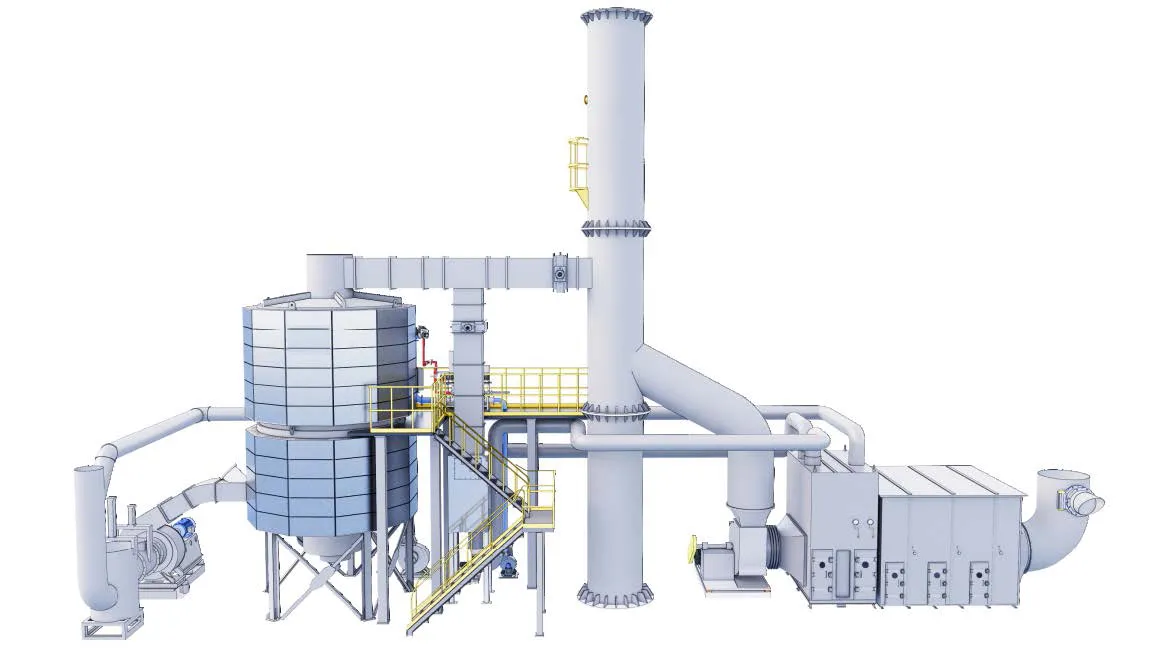
Based on our practical experience serving more than 50 coating and painting companies in the Yangtze River Delta and Pearl River Delta regions, RTO technology, with its excellent heat recovery efficiency and processing stability, has become the optimal choice for solving the industry’s VOCs treatment problem, with an average investment payback period of only 18-30 months.
RTO System Core Parameters and Performance Indicators
| RTO System Technical Parameter Standard (For Coating & Painting Industry) </ |
|||||
|---|---|---|---|---|---|
| Treatment Efficiency | VOCs Removal Rate ≥99.5% | Non-methane Total Hydrocarbon Emission ≤60mg/m³ | Odor Removal Rate ≥98% | ||
| Heat Recovery Performance | Heat Recovery Efficiency ≥95% | Self-sustaining Concentration ≥1.8g/m³ | Exhaust Gas Temperature ≤150°C | ||
| Operating Parameters | Operating Temperature 760-850°C | Residence Time ≥1.0s | System Pressure Drop ≤2500Pa | ||
| Safety Standard | Explosion-proof Grade Exd IIB T4 | LEL Monitoring Points ≥3 | Safety Interlocks ≥12 | ||
| Energy Consumption | Rated Power 0.8-1.2kW/1000m³ | Fuel Consumption 0-15m³/h | Noise Level ≤85dB(A) | ||
Technical Comparison: Advantages and Disadvantages of RTO Compared with Other Governance Solutions
| Comparison Dimension</ | RTO System</ | Activated Carbon Adsorption</ | Catalytic Combustion</ | Biological Treatment</ |
|---|---|---|---|---|
| Treatment Efficiency | High (>99.5%) | Medium-Low (70-90%) | High (95-98%) | Medium (80-95%) |
| Energy Consumption | Low (Heat recovery >95%) | Low (Fan power only) | Medium (Preheating energy) | Low (Mainly fan power) |
| Operating Cost | Low (Self-sustaining operation) | High (Replacement cost) | Medium (Catalyst replacement) | Medium (Microorganism maintenance) |
| Applicable Concentration | Wide (0.5-10g/m³) | Low (<1g/m³) | Medium (1-5g/m³) | Low (<1.5g/m³) |
| Component Adaptability | Strong (Benzene, esters) | Poor (Easy to saturate) | Medium (Sensitive to S/P) | Poor (Hard-to-degrade components) |
| Floor Area | Medium | Small | Medium | Large |
| Safety Risk | Low (Multiple protections) | High (Flammable) | Medium (High temperature) | Low |
| Payback Period | 1.5-2.5 years | No payback | 2-3 years | 3-4 years |
Key configuration recommendations
- Model Selection: For intermittent coating lines, a rotary RTO is recommended; for continuous paint synthesis workshops, a three-tower RTO is recommended.
- Safety Configuration: Must be equipped with LEL online monitoring, an automatic dilution system, explosion-proof pressure relief devices, and an emergency cooling system.
- Control Strategy: Utilize frequency converter control to automatically adjust the RTO operating mode according to the production line’s operating status.
- Heat Utilization: Recovered heat is prioritized for drying room heating, followed by workshop heating or hot water systems.
📊 Success Story: RTO Retrofit Project for an Automotive Painting Company
Project Overview: Processing air volume of 80,000 m³/h, VOCs concentration of 1.5-4.5 g/m³, containing multiple components including benzene compounds, esters, and ketones.
Solution: Utilizing a three-tower RTO + zeolite rotary concentrator system to achieve efficient treatment of large-volume, low-concentration waste gas.
Operational Results:
• VOCs Removal Rate: 99.7% (Measured)
• Annual Natural Gas Savings: 420,000 m³
• Annual VOCs Emission Reduction: 380 tons
• Investment Payback Period: 22 months
• Heat Recovery: Generates 3.2 tons/hour of 0.6 MPa steam
Economic Analysis: Calculation of Return on Investment for RTO
| Economic Benefit Analysis of RTO Project for Typical Coating Enterprises (10,000m³/h Treatment Capacity) </</ |
||
|---|---|---|
| Item</ | Traditional Incineration Technology</ | RTO System</ |
| Equipment Investment (10,000 CNY) | 120-150 | 180-220 |
| Annual Operating Cost (10,000 CNY) | 45-60 | 15-25 |
| Annual Fuel Cost (10,000 CNY) | 30-40 | 2-8 (Zero during self-sustaining operation) |
| Heat Recovery Value (10,000 CNY) | 0 | 10-20 |
| Annual Comprehensive Cost (10,000 CNY) | 45-60 | 5-15 |
| Payback Period (Months) | N/A | 18-30 |
| 10-Year Total Cost (10,000 CNY) | 500-700 | 250-350 |
💰 Expert Advice
Based on data analysis from the paint companies we serve, when choosing an RTO system, one should not only focus on the initial investment but also prioritize evaluating the total lifecycle cost. For companies with more than 4,000 hours of annual operation, the energy-saving benefits of an RTO typically cover the incremental investment within 2 years, with continued net returns over the following 8-10 years.
Conclusions and Outlook
Against the backdrop of increasingly stringent environmental standards and continuously rising energy costs, RTO (Regenerative Thermal Oxidizer) technology provides the coatings and painting industry with an efficient, economical, and reliable VOCs treatment solution. By optimizing system design, rationally configuring parameters, and fully utilizing heat recovery, companies can not only achieve stable emissions compliance but also transform environmental protection investments into economic benefits.
In the future, with advancements in intelligent control, materials science, and comprehensive heat energy utilization technologies, the performance of RTO systems will be further improved, and operating costs will be further reduced. For coatings and painting companies, planning and implementing RTO treatment projects as early as possible is not only a necessary measure to meet compliance requirements but also a strategic choice to enhance core competitiveness and achieve sustainable development.
If you would like to learn more about regenerative thermal oxidation, please contact us.