
🏭 Category: Chemical Engineering
⏱️ Reading Time: 8-10 minutes
📊 Word Count: 850+
VOCs Treatment
Chemical Safety
Energy Recovery
Process Optimization
🚀 Executive Summary
Modular Regenerative Thermal Oxidizer (RTO) technology represents a transformative advancement in chemical industry VOCs treatment, offering 99%+ destruction efficiency with 95% energy recovery. This comprehensive guide explores how modular RTO systems address the unique challenges of chemical manufacturing while delivering superior safety, flexibility, and return on investment compared to traditional technologies.
💰 2-3 Year ROI
⚡ 92-96% Energy Recovery
🛡️ SIL3/ATEX Certified
Introduction: The Evolving Chemical Industry Challenge
The chemical manufacturing sector faces increasingly complex environmental challenges in volatile organic compounds (VOCs) treatment. Unlike other industries, chemical processes generate exhaust streams characterized by:
🧪 Complex Chemistry
Multiple solvents, halogenated compounds, and reactive species requiring specialized treatment approaches
⚠️ Safety Imperatives
Flammable and explosive compounds demanding ATEX-certified equipment and multiple safety layers
📈 Variable Operations
Batch processes with dramatic concentration fluctuations (50-8000 mg/m³) and flow variations
💡 The Modular RTO Solution: Unlike traditional monolithic systems, modular RTO technology addresses these challenges through scalable, safety-focused design that adapts to chemical industry requirements while delivering unprecedented efficiency and flexibility. The building-block approach allows facilities to start with essential capacity and expand as production grows, minimizing initial investment while maximizing long-term value.

Understanding Modular RTO Technology: Beyond Traditional Thermal Oxidation
Modular RTO represents a paradigm shift from conventional thermal oxidizer design. While traditional RTO systems operate as single, fixed-capacity units, modular RTO employs standardized, interconnected modules that work together as an integrated system. This innovative approach offers several key advantages for chemical applications:
🔧 Core Technology Principles
Thermal Oxidation Process
VOCs are oxidized at 760-850°C in ceramic-packed chambers, achieving 99%+ destruction efficiency through optimal temperature control and residence time.
Regenerative Heat Recovery
Ceramic media captures and recycles thermal energy, achieving 92-96% heat recovery efficiency – significantly higher than traditional systems.
Modular Architecture
Independent modules can operate, be maintained, or expanded without shutting down the entire system, providing unprecedented operational flexibility.
The modular design philosophy extends beyond physical structure to include modular control systems, modular safety features, and modular energy recovery options. This holistic approach allows chemical plants to customize their RTO systems precisely to their specific process requirements, safety protocols, and energy integration needs.
Technical Comparison: Modular RTO vs Conventional Technologies
| Technical Parameter | Modular RTO | Traditional RTO | Catalytic Oxidizer | Adsorption Systems |
|---|---|---|---|---|
| Optimal Concentration Range | 50-8000 mg/m³ (Wide range capability) |
100-3000 mg/m³ (Limited range) |
200-4000 mg/m³ (Medium range) |
<500 mg/m³ (Low concentration) |
| Destruction Efficiency | 99.0-99.8% (Highest available) |
95-99% (Good performance) |
90-95% (Catalyst degradation) |
85-92% (Breakthrough occurs) |
| Energy Recovery Rate | 92-96% (Maximum efficiency) |
85-90% (Standard efficiency) |
50-70% (Limited recovery) |
N/A (No recovery) |
| Safety Certification | SIL3/ATEX Zone 1 (Highest safety level) |
SIL2 (Standard safety) |
SIL1 (Basic safety) |
SIL1 (Basic safety) |
| Maintenance Requirements | Modular replacement (Minimal downtime) |
Complete shutdown (Production impact) |
Catalyst replacement (Regular expense) |
Media replacement (Hazardous waste) |
📈 Why Modular RTO Excels in Chemical Applications
The modular RTO advantage extends beyond basic performance metrics. For chemical plants, the ability to scale capacity incrementally, perform maintenance without complete shutdown, and integrate advanced safety systems makes modular RTO the optimal choice for modern chemical manufacturing. The technology’s flexibility allows it to adapt to changing production requirements, new regulations, and evolving safety standards without requiring complete system replacement.
Chemical Industry Applications: Real-World Modular RTO Success Stories
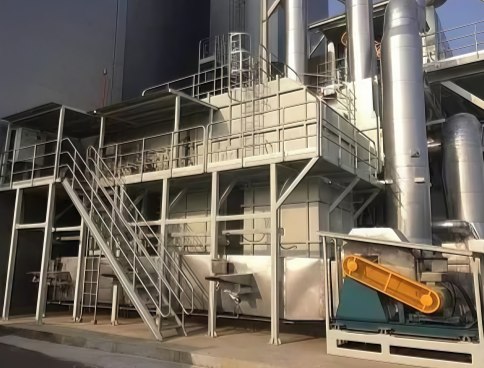
🏭 Case Study: Fine Chemicals Manufacturing Plant
Challenge: Multi-product facility with 12 different production lines generating complex solvent mixtures. Batch operations caused dramatic concentration fluctuations (100-6000 mg/m³). Traditional RTO struggled with turndown ratio and safety compliance.
Modular RTO Solution: Installed 4-module RTO system with AI-powered control algorithms. Each module handles specific production lines, allowing independent operation during maintenance or low production periods.
Results:
🏗️ Case Study: Petrochemical Complex
Challenge: Continuous process plant with high-volume exhaust (80,000 Nm³/h) containing sulfur compounds. Needed to meet stringent NOx limits while recovering energy for steam generation.
Modular RTO Solution: Six-module RTO system with corrosion-resistant materials and integrated waste heat boiler. Advanced temperature staging minimizes NOx formation while maximizing energy recovery.
Results:
Economic Analysis: Modular RTO Investment and ROI
💰 Investment Breakdown
45-55%
25-30%
10-15%
8-12%
📈 Return on Investment Factors
- Energy Savings: 60-70% of total ROI from heat recovery
- Regulatory Compliance: Avoidance of fines and penalties
- Carbon Credits: Additional revenue from emission reductions
- Operational Efficiency: Reduced maintenance and downtime
- Production Uptime: Modular maintenance preserves production
🧮 ROI Calculation Example
Note: Based on typical 40,000 Nm³/h system for medium-sized chemical plant. Actual ROI varies based on local energy costs, regulatory environment, and specific process conditions.
Frequently Asked Questions: Modular RTO in Chemical Industry
If you are interested in us, please visit our homepage for the latest information.