
In den Niederlanden, von der Leiden Bio Science Park zu den pharmazeutischen Clustern in Oss, the management of Volatile Organic Compounds (VOCs) has become a cornerstone of business continuity. As the Dutch government tightens enforcement of the Aktivittenbesluit milieubeheer (Activities Decree), the Regenerativer thermischer Oxidator (RTO) has emerged as the premier technology for softgel and injectable manufacturers due to its unparalleled energy recovery and destruction efficiency.
Was ist ein RTO? (Regenerativer thermischer Oxidator)
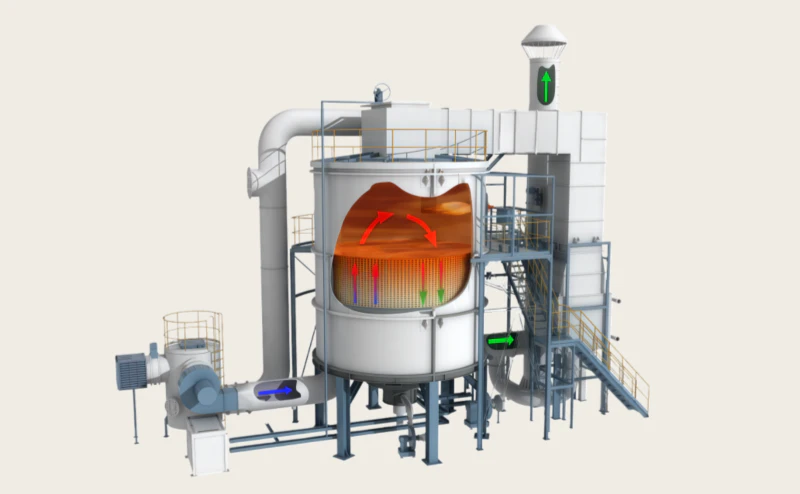
An RTO is an advanced industrial environmental system designed to oxidatively decompose organic pollutants (VOCs) at high temperatures, typically between 815 °C und 980 °C.
Kernfunktionsprinzip
The operational logic of an RTO centers on “High-Temperature Oxidation + High-Efficiency Thermal Regeneration“:
- Oxidationsphase: VOCs enter the combustion chamber where thermal energy breaks down organic molecules into harmless Carbon Dioxide ($CO_2$) Und Water Vapor ($H_2O$).
- Regenerationsphase: The system utilizes specialized keramische Wärmeaustauscher. As purified hot gas exits, the heat is absorbed by the ceramics; when cold raw gas enters the next cycle, the stored heat preheats the incoming stream.
- Zyklischer Betrieb: Precise valve switching maintains thermal efficiency, often allowing the system to achieve “auto-thermal operation” (sustaining oxidation without auxiliary fuel) at specific VOC concentrations.
Technische Kernparameter der RTO
The performance of an RTO is defined by several critical engineering metrics. These parameters determine compliance with Dutch NeR (Netherlands Emission Guidelines) or US EPA Standards.
Vergleichstabelle der wichtigsten Parameter
| Technische Kennzahl | Parameterbereich | Auswirkungen auf die Leistung | Referenzstandard |
|---|---|---|---|
| Betriebstemperatur | 815 – 980 °C (1500 – 1800 °F) | Dictates the thermodynamic integrity of VOC destruction. | EPA 452/B-02-001 |
| VOC-Zerstörung (DRE) | ≥ 99% (up to 99.9%) | Ensures emissions stay below the strict 20mg/m³ limit. | EU-Richtlinie 2010/75/EU |
| Thermische Rückgewinnung (TER) | 95% – 97% | Directly reduces natural gas/auxiliary fuel consumption. | Industry Energy Whitepapers |
| Gasverweilzeit | 0,5 – 1,0 Sekunden | Ensures complete molecular breakdown in the hot zone. | Chemical Kinetic Modeling |
| Durchflusskapazität | 2.000 – 80.000+ scfm | Defines the physical processing throughput of the unit. | Engineering Design Codes |
| Systemwiderstand (ΔP) | 2500 – 4500 Pa | Affects the power consumption of the main fan. | Fluiddynamik-Berechnung |
| Ventilleckrate | < 0,1% | Prevents untreated bypass gas from entering the stack. | Dichtheitsventil-Design |
Technical Deep Dive
- Zerstörungseffizienz: For pharmaceutical solvents like Isopropanol oder Ethanol, 99%+ DRE is mandatory. Dropping below 760°C significantly reduces efficiency and can lead to incomplete combustion byproducts like Carbon Monoxide.
- Energierückgewinnung: A TER of 95%+ means the temperature delta between inlet and outlet gas is minimal (typically 30-50°C), which is crucial in high-energy-cost markets like the EU.
Application Characteristics, Advantages, and Limitations
1. The Ideal Use Case: High Volume, Low-to-Mid Concentration
RTOs excel in pharmaceutical environments with airflows above 5,000 $m^3/h$. Because GMP requirements mandate high ventilation rates, the resulting exhaust is often “large volume but dilute,” which perfectly suits the RTO’s regenerative logic.
2. Core Strategic Advantages
- Exceptional Energy ROI: At the “auto-thermal point,” the VOCs act as the primary fuel, making the process nearly self-sustaining.
- Lower OPEX: Long-term operating costs are 60-80% lower than traditional Thermal Oxidizers (TO).
- Decarbonization: By minimizing fossil fuel use, RTOs align with the Dutch Klimaatakkoord (Climate Agreement) goals.
3. Limitations & Mitigation
- Risiken hoher Konzentration: If concentrations exceed 25% LEL, the system risks overheating. Lösung: Use Hot Gas Bypass or fresh air dilution.
- Particulate Fouling: Pharmaceutical dust or oil mists can clog ceramics. Lösung: Install high-efficiency pre-filtration (e.g., G4+F7+H13).
Kritische Komponenten und Ökosystemunterstützung
- Keramische Medien: High-density honeycomb ceramics or Mullite. High surface area is key for heat transfer.
- Switching Valves (Poppet Valves): Must be pneumatic zero-leakage valves to prevent untreated gas “slips.”
- Brenner: Modulating burners (e.g., Maxon or Eclipse) provide precise control during start-up.
- Sekundäre Wärmerückgewinnung: Redirecting residual heat to factory HVAC or water pre-heating systems for maximum efficiency.
Mainstream RTO Brand Comparison
| Marke | Rumpfmuskulatur | TER / DRE | Entscheidungslogik |
|---|---|---|---|
| Dürr (Ecopure) | German engineering; ultra-stable. | 97% / 99.9% | Best for high-budget, high-risk pharma clusters. |
| Ever-Power | Starke Integration; niche expert in Softgel/Injectables. | 96% / 99.5% | Am besten geeignet für Kosten-Leistungs-Verhältnis & specialized industrial skids. |
| Anguil | Expertise in corrosive/halogenated exhaust. | 95% / 99% | Ideal for complex chemical synthesis/purification. |
Global Regulatory Context & Local SEO (Netherlands)
1. Netherlands & EU Market
In den Niederlanden, ILT (Human Environment and Transport Inspectorate) enforces strict VOC management plans.
- EinhaltungEU-IED (Richtlinie über Industrieemissionen).
- Subsidies: Dutch companies can leverage EIA (Energieinvestitionssicherheit) for significant tax deductions on RTO investments.
2. Global Benchmarks
- USA: Governed by EPA Method 25A.
- China: GB 37822-2019 standards make RTOs a prerequisite for chemical park entry.
Praxiserfahrung & Fallstudien
Field Insight: The “Clogging” Lesson
In a project in Nordbrabant, we observed a pressure drop spike within three months.
- The Issue: Trace oil mists from softgel production were carbonizing on the ceramic surface.
- Die Lösung: Retrofitting a three-stage filtration system and an automatic “bake-out” cycle.
- Lesson: Pre-treatment is the “heart” that determines the life of your RTO.
Case Study: Dutch Pharma Major (50,000 $m^3/h$)
- Hintergrund: High OPEX from carbon beds and unstable ethanol emissions.
- Lösung: 3-Tower RTO + Secondary Energy Recovery.
- Ergebnisse: DRE stabilized at 99.5%; annual natural gas savings exceeded €120,000.
Future Trends: The Next Generation of RTOs
- RTO + CO2-Abscheidung (CCUS): Capturing clean $CO_2$ for use in Dutch greenhouses.
- Wasserstofffähige Brenner: Transitioning to zero-carbon auxiliary fuels.
- AI Maintenance: Using machine learning to predict load fluctuations and optimize valve cycles.
Abschluss: For Dutch and global pharma enterprises, a high-spec RTO is not just an environmental cost—it is a strategic asset for achieving a “Green Factory” vision.