Umgang mit Emissionen in der niederländischen Harzherstellung
Die Harzproduktion in den Niederlanden, ein Eckpfeiler von Branchen wie Beschichtungen, Klebstoffen und Verbundwerkstoffen, beinhaltet Prozesse, bei denen flüchtige organische Verbindungen wie Styrol, Benzol und verschiedene Lösungsmittel freigesetzt werden. Anlagen in Nordholland und Südholland, wichtigen Regionen der chemischen Industrie, müssen diese Emissionen angesichts der hohen Bevölkerungsdichte und der Umweltsensibilität des Landes beherrschen.
Der Sektor profitiert von den strategisch wichtigen Häfen der Niederlande in Rotterdam, die den Import von Rohstoffen erleichtern, steht aber aufgrund der Nähe zu Amsterdam unter Druck. Die hohe Luftfeuchtigkeit im niederländischen Klima erschwert die Abgasbehandlung und führt häufig zu Kondensationsrisiken in den Kläranlagen.
Unsere RTO-Technologie begegnet diesen Herausforderungen durch die Vorbehandlung von Feuchtigkeit und korrosiven Stoffen und gewährleistet so die Zerstörung von VOCs über 99% bei gleichzeitiger Wärmerückgewinnung zur Senkung der Betriebskosten in energiebewussten niederländischen Anlagen.
Besondere Merkmale von RTO in der Harzproduktion
Die Abgase der Harzherstellung weisen hohe Lösemittelbelastungen, potenzielle Polymerisationsrückstände und saure Bestandteile bestimmter Harze auf. In den Niederlanden, wo Anlagen in Brabant oder Gelderland in die Lieferketten eingebunden sind, muss die Abgasreinigung korrosiven Dämpfen, wie sie beispielsweise bei Phenolharzen entstehen, standhalten.
Die variablen Batch-Prozesse bei der Harzsynthese führen zu schwankenden VOC-Konzentrationen und erfordern Systeme mit großem Regelbereich. Die Anlagen von Ever-Power beinhalten fortschrittliche Steuerungen zur Stabilisierung des Betriebs und verhindern so Ausfallzeiten in schnelllebigen Umgebungen wie denen in der Nähe der Industrieparks von Utrecht.
Darüber hinaus fördert das Streben nach Nachhaltigkeit in den Niederlanden die RTO mit sekundärer Wärmerückgewinnung, indem Abwärme in Dampf für Harzhärtungsprozesse umgewandelt wird.
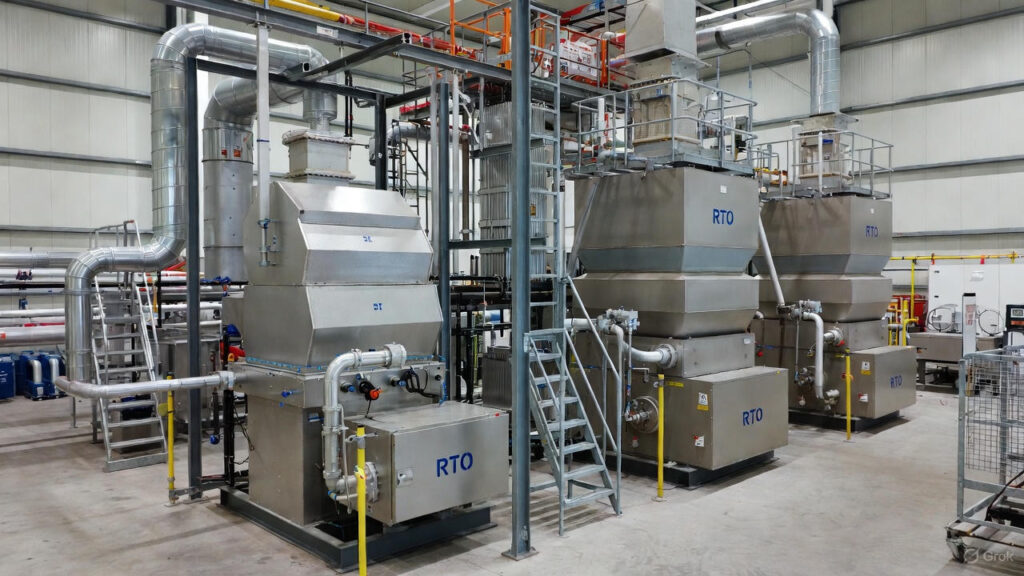
Detaillierte technische Spezifikationen für Ever-Power RTO
Für die Harzproduktion, bei der der Luftdurchsatz zwischen 20.000 und 150.000 m³/h und die VOC-Konzentrationen zwischen 2 und 15 g/Nm³ variieren können, bietet unser RTO eine robuste Leistung. Die folgende Tabelle enthält 32 wichtige Parameter aus praktischen Anwendungen:
| Parameter | Wert/Bereich | Beschreibung |
|---|---|---|
| VOC-Zerstörungseffizienz (DRE) | 99.2% | Geschwindigkeit, mit der VOCs in harmlose Nebenprodukte umgewandelt werden. |
| Thermische Wirkungsgradrückgewinnung (TER) | 96% | Prozentsatz der aus dem Abgas zurückgewonnenen Wärme. |
| Luftdurchsatzkapazität | 25.000 – 120.000 m³/h | Geeignet für mittelgroße bis große Harzpflanzen. |
| Betriebstemperatur | 800-900°C | Gewährleistet die vollständige Oxidation der Harzlösungsmittel. |
| Aufenthaltszeit | 1,5 Sekunden | Dauer der Gaseinwirkung im Brennraum. |
| Druckabfall | 200-300 Pa | Minimaler Widerstand für effizienten Durchfluss. |
| Ventilschaltzyklus | 90-150 Sekunden | Optimiert für variable Lasten in Batch-Prozessen. |
| Leckrate | <0,4% | Geringer Bypass von unbehandelten Gasen. |
| Energieverbrauch | 1,0-1,8 kWh/1000 m³ | Effizient mit Wärmerückgewinnung. |
| Fußabdruck | 15-30 m² | Kompakte Bauweise, angepasst an die Gegebenheiten niederländischer Bauplätze. |
| Gewicht | 10-18 Tonnen | Ausgewogen für Transport und Installation. |
| Konstruktionsmaterial | Hastelloy C-276 | Beständig gegen Korrosion durch saure Dämpfe. |
| Lebensdauer keramischer Medien | 6-8 Jahre | Strukturiert für Beständigkeit gegen Harzrückstände. |
| Geräuschpegel | <70 dB | Geeignet für städtische Gebiete wie Amsterdam. |
| Stromversorgung | 400 V/50 Hz | Entspricht den niederländischen Gitternetzstandards. |
| Steuerungssystem | SCADA integriert | Fernüberwachung zur Sicherstellung der Einhaltung von Vorschriften. |
| Genauigkeit der LEL-Überwachung | ±1,5% | Entscheidend für Umgebungen mit hohem Lösungsmittelanteil. |
| Wärmetauscher-Effizienz | 94% | Sekundäre Rückgewinnung zur Prozessintegration. |
| Installationszeit | 5-7 Wochen | Schnelle Bereitstellung zur Minimierung von Ausfallzeiten. |
| Wartungsintervall | Vierteljährlich | Schwerpunkt: Prüfungen auf Korrosionsgefahren. |
| Konformitätsstandards | EU IED, Niederländische NEa | Entspricht den örtlichen Harzvorschriften. |
| Geruchsreduktionsrate | 98% | Wirkt effektiv gegen Styrolgerüche. |
| Erforderliche Stapelhöhe | 12-18 m | Zur Ausbreitung in besiedelten Gebieten. |
| Kraftstoffart | Erdgas/Biogas | Unterstützt den niederländischen Wandel hin zu grüner Energie. |
| Emissionsüberwachungsstellen | Mehrere | Für die Meldung an die Aufsichtsbehörden in Echtzeit. |
| Backup-Stromintegration | Verfügbar | Gewährleistet den kontinuierlichen Betrieb. |
| Fernzugriffsfunktion | Cloud-basiert | Zur globalen Überwachung. |
| Kosten pro m³ behandeltem | €0.03-0.06 | Kosteneffektiv über den gesamten Lebenszyklus. |
| Garantiezeitraum | 3 Jahre | Erweiterte Version für wichtige Komponenten. |
| Korrosionsbeständigkeitsklasse | Hoch (pH-Wert 2-12) | Speziell für Harzsäuren entwickelt. |
| Turndown-Ratio | 10:1 | Bewältigt Produktionsschwankungen. |
| Integration vor der Behandlung | Schrubberkompatibel | Zur anfänglichen Lösungsmittelaufnahme. |
Diese Spezifikationen basieren auf Feldanwendungen und Forschungsergebnissen zu RTO im Polymersektor aus dem Jahr 2025 und gewährleisten die Eignung für niederländische Harzverarbeitungsbetriebe.
Kernkomponenten und Wartungshinweise für RTO in Harz
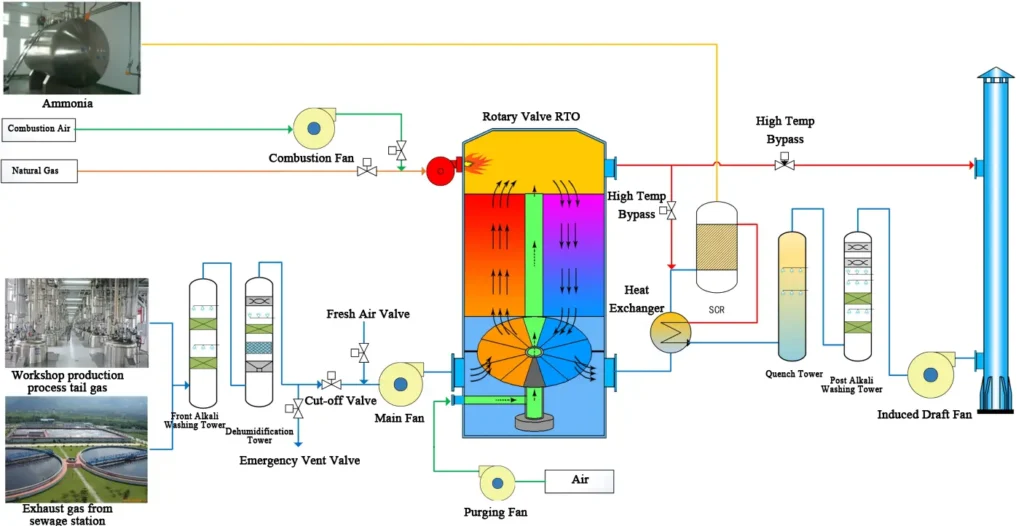
Die Ever-Power RTO für Harze umfasst wichtige Komponenten wie strukturierte Keramikmedien (beständig gegen Polymerisationsablagerungen), Drehventile (für reibungsloses Schalten, Lebensdauer 2–3 Jahre), Brenner (für die anfängliche Aufheizphase) und Radialventilatoren (für die Gasförderung). Verschleißteile wie Ventildichtungen und Dichtungsringe müssen alle 6–12 Monate ausgetauscht werden, um Korrosion zu verhindern.
Getriebeelemente wie Zahnräder und Aktuatoren gewährleisten einen präzisen Betrieb. Zubehör wie Abgaswäscher und Kondensatoren dienen der Abgasvorbehandlung, die für die in niederländischen Verbundwerkstoffen häufig verwendeten Phenolharze unerlässlich ist.
Vergleichende Analyse von RTO-Marken
Vergleichen Sie bei der Harzproduktion die Systeme von Dürr™ mit 97% TER, die jedoch potenziell höhere Kosten für kundenspezifische Anpassungen aufweisen, oder Anguil™ mit hoher Säurebeständigkeit, aber längeren Lieferzeiten. (Hinweis: Alle Herstellernamen und Teilenummern dienen nur zu Referenzzwecken. Ever-Power ist ein unabhängiger Hersteller.)
Ever-Power bietet dank Hastelloy einen verbesserten Korrosionsschutz und schafft so einen Mehrwert auf dem niederländischen Markt.
Regulatorische Rahmenbedingungen für die Harzproduktion weltweit
In den Niederlanden halten sich Harzanlagen an die niederländischen Emissionsrichtlinien (NEa) und die EU-Richtlinie zur industriellen Emissionsdeklaration (2010/75/EU), die VOC-Emissionen auf 20–50 mg/Nm³ begrenzt. Provinzen wie Nordbrabant setzen zusätzliche Geruchskontrollmaßnahmen durch. Nachbarländer: Deutschland (TA Luft) fordert die Entfernung von 99%; Belgien (VLAREM) zielt auf Benzol ab; Dänemark konzentriert sich auf die besten verfügbaren Techniken (BAT) für Harze.
Weltweit führend sind folgende Nationen: USA (EPA NESHAP) für MACT-Standards; China (GB 37822-2019) begrenzt Emissionen; Japan (Luftreinhaltegesetz) reguliert Lösungsmittel; Frankreich (IED); Italien (BAT); Spanien (IED); Vereinigtes Königreich (UKTA); Schweden (Umweltgesetz); Finnland (BAT); Polen (EU); Tschechische Republik (Luftreinhaltegesetz); Österreich (Emissionsverordnung); Brasilien (CONAMA 382); Indien (CPCB); Mexiko (NOM-085); Südkorea (Gesetz für saubere Luft); Kanada (CEPA); Australien (NEPM); Türkei (Industrielle Luftverschmutzung); Russland (GOST); Saudi-Arabien (RCER); Vereinigte Arabische Emirate (Bundesgesetz 24); Südafrika (NEMA); Indonesien (Ministerialerlass); Vietnam (QCVN); Thailand (EIA); Malaysia (EQA); Philippinen (RA 8749); Argentinien (Gesetz 24051); Chile (DS 144). Ägypten (Gesetz 4/1994).
Verwandte Branchen in diesen Ländern, wie die Verbundwerkstoffindustrie in Rotterdam oder die Klebstoffindustrie in Amsterdam, sind auf RTO angewiesen, um die Vorschriften einzuhalten.
Erkenntnisse aus Einsätzen und Feldnotizen
Bei der Einrichtung einer Phenolharz-Anlage im Rotterdamer Chemiecluster reduzierte unsere RTO die VOC-Emissionen um 99,31 TP3T, wobei die Wärmerückgewinnung 401 TP3T des Anlagenenergiebedarfs kompensierte. Als leitender Ingenieur konnte ich beobachten, wie die säurebeständigen Auskleidungen des Systems Produktionsausfälle während der Spitzenzeiten verhinderten.
Im Amsterdamer Innovationsviertel nutzte ein Polyesterharzwerk unser RTO zur Verarbeitung von Styrol und erfüllte damit die lokalen Geruchsvorschriften. Meine persönliche Erfahrung mit der Anpassung der Regelmenge während der Testphase zeigte, dass es unempfindlich gegenüber Chargenschwankungen ist – ein häufiges Problem in niederländischen Betrieben.
International spiegeln sich ähnliche Fälle im deutschen Ruhrgebiet oder im US-amerikanischen Texas wider, wo RTO eine nachhaltige Harzproduktion ermöglicht.
Integration aktueller Fortschritte und Perspektiven
Laut einer Studie aus dem Jahr 2025 in Communications Earth & Environment unterstreichen die globalen Harzflüsse die Rolle von RTO bei der Reduzierung von Umwelteinflüssen während der Produktion. Innovationen wie KI-optimierte Schaltzyklen, wie sie von Epcons integrierten Systemen genutzt werden, verlängern die Medienlebensdauer in korrosiven Umgebungen um 151 TP3T.
Einzigartiger Ansatz: Die Kombination von RTO mit biobasierten Harzen in niederländischen Pilotanlagen, die von den Normen auf Basis fossiler Brennstoffe abweicht, fördert die Kreislaufwirtschaft. In volatilen Märkten gewährleisten adaptive Steuerungen aus aktuellen Studien Stabilität trotz Rohstoffschwankungen.
Neuigkeiten aus dem Harzsektor
Niederländische Neuigkeiten: Die 2025 geplante Überarbeitung des Gesetzes über Lebensmittelkontaktmaterialien wirkt sich auf Kunststoffe für Verpackungen aus und fördert emissionsarme Technologien (SGS). Subventionen für Recyclingkunststoffe begünstigen die Modernisierung von Recyclinganlagen (Plastics News). EU-weit: Die POP-Grenzwerte ab 2025 erfordern verstärkte Kontrollen (Compliance & Risks). Weltweit: Epcons Recyclinganlage für Klebstoffe hebt emissionsarme Technologien hervor (CompositesWorld).
Kontaktieren Sie unser Team in Rotterdam für eine maßgeschneiderte Entlüftungslösung. RTO Planen Sie und sichern Sie Ihre Abläufe mit bewährter Zuverlässigkeit.