
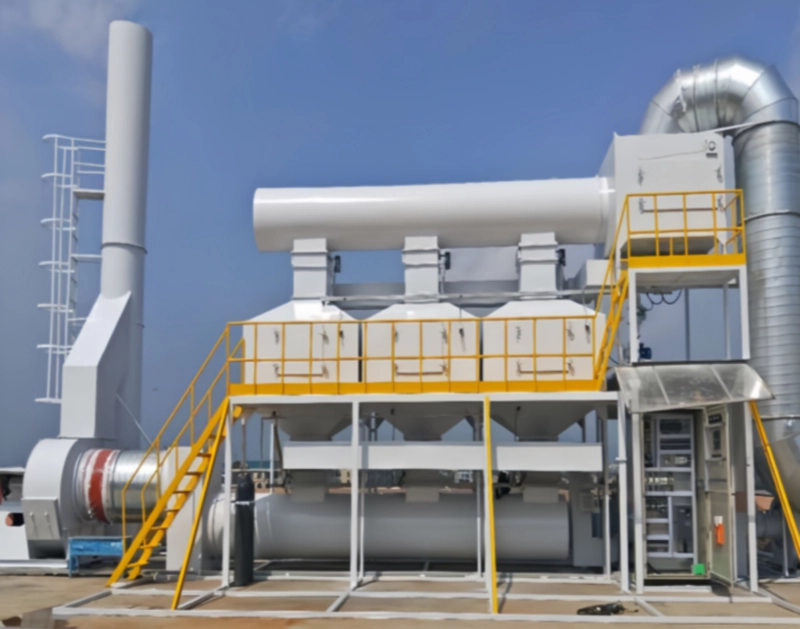
RCO
Facing increasingly stringent Dutch emission standards (BAT, Omgevingsdienst) and soaring energy costs, traditional RTOs tend to have high energy consumption, while conventional catalytic oxidizers offer limited treatment efficiency? Our RCO system perfectly resolves this contradiction.
-
✅ 95% heat recovery efficiency + 300-500°C low-temperature catalytic oxidation
-
✅ 30-50% more energy efficient than traditional RTOs, and handles a wider concentration range than catalytic oxidation furnaces
-
✅ Designed specifically for the Dutch market, with a built-in compliance monitoring and reporting system
-
✅ Modular intelligent design, adaptable to future regulatory upgrades
| Parameter | Standard Model | High-Performance Model | Compliance Requirements |
|---|---|---|---|
| Treatment Airflow Range | 5,000-100,000 Nm³/h | 100,000-300,000 Nm³/h | Dutch BAT Applicable |
| VOCs Removal Efficiency | ≥98% | ≥99% | Omgevingsdienst Limits |
| Operating Temperature | 300-500°C | 300-450°C | Catalyst Optimal Activity Zone |
| Heat Recovery Efficiency | ≥90% | ≥95% | Dutch Energy Efficiency Directive |
| Pressure Drop | < 1,500 Pa | < 1,000 Pa | Fan Energy Consumption Optimization |
| Fuel Consumption | 30-50% lower than RTO | 40-60% lower than RTO | Carbon Tax Optimization |
Definition and Parameters of RCO
Principio de funcionamiento
Phase 1: Preheating and Heat Storage Stage
The exhaust gas first enters the preheating regenerative bed. The core of this stage is maximizing heat recovery
Phase Two: Catalytic Oxidation Phase
The preheated exhaust gas enters the catalytic reaction chamber, where deep oxidation occurs on the catalyst surface:
- CnHm + (n + m/4)O₂ → nCO₂ + (m/2)H₂O + heat
- CO + ½O₂ → CO₂ + heat
Phase 3: Heat Storage and Switching Phase
The oxidized high-temperature gas (400-600°C) enters the cooling regenerator bed:
- Heat Transfer: The high-temperature gas transfers heat to the ceramic regenerator.
- Temperature Change: The gas decreases from 400-600°C to 80-150°C and is discharged.
- Heat Storage: The ceramic bed is heated to 400-600°C to prepare for preheating in the next cycle.

Core Advantages
Comparison with traditional techniques
| Technology | Operating Temperature | Heat Recovery Rate | Energy Consumption Level | Applicable Concentration | Investment Cost |
|---|---|---|---|---|---|
| RCO | 300-500°C | >90% | 30-50% lower than RTO | 200-5,000 ppm | Medio |
| RTO | 760-950°C | >95% | High (auxiliary fuel required) | Wide range | High |
| Catalytic Oxidation | 300-500°C | 70-85% | Low | 100-3,000 ppm | Low |
RCO Operation and Maintenance Considerations
Daily Operation
- Startup Time: 30-60 minutes (cold start)
- Automatic Operation: Fully automatic control, no dedicated personnel on duty required
- Energy Consumption Monitoring: Real-time display of energy-saving data
Maintenance Requirements
Regular Maintenance Items:
- Daily: Instrument inspection, pressure difference monitoring
- Weekly: Filter cleaning and inspection
- Monthly: Catalyst activity assessment
- Quarterly: Valve system inspection
- Annual: Comprehensive overhaul and performance testing
Catalyst Management
- Lifespan: 3-5 years (under normal operating conditions)
- Regeneration Service: Can restore over 90% of activity
- Replacement Cost: Approximately 10-15% of the system investment
- Recovery Plan: Precious metal recovery rate >95%
Special Considerations for the Dutch Market
Regulatory Compliance
- BAT Requirements: Must comply with the latest BREF documents
- Emission Limits:
- VOCs: 20 mg/Nm³
- CO: 50 mg/Nm³
- NOx: Determined according to thermal power
- Monitoring Requirements: CEMS system, data retention for 5 years
Economic Incentives
Applicable Dutch Subsidies:
- MIA Environmental Investment Subsidy: Up to 36% tax incentive
- VAMIL Free Depreciation: Accelerated depreciation
- Local Subsidies: Vary by province, up to 30%
- Energy Investment Subsidy (EIA): Subsidy for energy-saving equipment
Carbon Tax Optimization
- Carbon Tax Advantages of RCO:
- 30-50% reduction in CO₂ emissions compared to RTO
- Annual savings of €30,000-€75,000 when carbon tax is €150/ton in 2025
- Eligible for carbon credit applications
Application Scenarios
Recommended Conditions for RCO Implementation
- VOCs Concentration: 200-5,000 ppm
- Exhaust Gas Composition: Mixtures containing multiple VOCs
- Operation Mode: Continuous or semi-continuous production
- Energy Costs: High, requiring maximum energy savings
- Space Constraints: Medium space available
Highly Recommended Industries
Coating Industry: Automotive, furniture, metal coating lines
Printing & Packaging: Gravure printing, lamination processes
Electronics Manufacturing: Semiconductor, circuit board production
Pharmaceutical Industry: Solvent recovery tail gas
Case Studies
Case Study: Successful Application of RCO System in Dutch Automotive Coating Industry
Project Overview: A model for complying with the 2024 Dutch environmental protection regulations
Client Background
- Company Name: Dutch high-end automotive component manufacturing company (anonymous at client's request)
- Industry: Automotive component manufacturing, mainly supplying coated components to German luxury automotive brands
- Location: Eindhoven Industrial Park, North Brabant Province
- Project Timeline: April 2023 - March 2024 (design to commissioning)
Challenges and Drivers
- Regulatory Pressure: The Netherlands implemented the new BAT conclusion document on January 2024, tightening VOCs emission limit from 50 mg/Nm³ to 20 mg/Nm³
- Cost Pressure: Natural gas prices increased by 85% (2021-2023), carbon tax increased to €125/ton (2024)
- Production Demand: New orders require 30% capacity increase, existing RTO system has reached processing limit
- Sustainable Development Goals: Parent company requires carbon neutrality in production by 2030
Technology Evaluation and Solution Selection
Existing System Problem Diagnosis
- Original System: Traditional two-chamber RTO (installed in 2018)
- Main Issues:
- Excessive energy consumption: 450 Nm³/h natural gas consumption (full load)
- Insufficient processing capacity: designed air volume 40,000 Nm³/h, actual demand up to 52,000 Nm³/h
- Emission fluctuations: intermittent production leads to concentration fluctuations, slow RTO response
- Maintenance costs: annual maintenance cost €65,000+, increasing failure rate
Technology Solution Comparison
| Solution | Investment Cost | Annual Operating Cost | Volatility Adaptability | Dutch Compliance | ROI Period |
|---|---|---|---|---|---|
| RTO Expansion | €980,000 | €285,000 | Medio | Good | 4.2 years |
| Catalytic Oxidation + Zeolite Rotor | €1,150,000 | €195,000 | Excellent | Excellent | 3.8 years |
| RCO System | €1,050,000 | €165,000 | Excellent | Excellent | 3.1 years |
| Biological Treatment | €850,000 | €220,000 | Poor | Medio | 4.5 years |
Key Factors for Choosing RCO:
- Energy efficiency: 35-45% fuel savings compared to RTO
- Processing flexibility: adapts to intermittent production characteristics of coating lines
- Investment balance: €100,000 lower than zeolite rotor combination
- Future compatibility: reserved hydrogen blending interface, compliant with Dutch 2030 energy roadmap
RCO System Design and Implementation
Customized Design Parameters
- System Model: ECO-RCO-NL-55
- Processing Capacity: 55,000 Nm³/h (peak)
- Waste Gas Characteristics:
- VOCs composition: Xylene 35%, Butyl acetate 25%, Solvent gasoline 20%, Others 20%
- Concentration range: 800-3,500 mg/Nm³ (high fluctuation)
- Temperature: 25-40°C (including waste heat from drying oven)
- Humidity: 30-70% RH
- Siloxane content: < 5 mg/Nm³ (from sealant)
- Designed Emission Guarantee Values:
- VOCs: < 15 mg/Nm³ (better than new regulation of 20 mg/Nm³)
- CO: < 25 mg/Nm³
- NOx: < 35 mg/Nm³
- Heat recovery efficiency: > 92%
Core Technical Configuration
- Heat Storage System:
- Three-chamber design (two heat absorption, one heat release) for continuous stability
- Cordierite honeycomb ceramic, 600 CPSI, specific surface area 550 m²/m³
- Ceramic filling volume: 18 m³, heat storage capacity 4.5 MWh
- Catalytic System:
- Catalyst type: Pt-Pd-CeO₂/Al₂O₃ (silicon-resistant formula)
- Precious metal loading: 2.1 g/ft³ (Pt:Pd = 3:1)
- Reaction temperature: 320-450°C (intelligent adjustment)
- Catalyst volume: 3.6 m³, designed lifespan >40,000 hours
- Intelligent Control System:
- Siemens S7-1500 PLC + SCADA system
- Concentration prediction algorithm (based on production plan)
- Energy consumption optimization model (real-time calculation of most economical operating point)
- Remote diagnosis interface (direct connection to Dutch service center)
Special Design Highlights
- Dutch Local Adaptability:
- Carbon tax optimization module: real-time calculation of CO₂ emissions and tax burden, automatic adjustment of operation strategy
- Peak-valley electricity price response: reduce frequency during peak electricity price (€0.45/kWh), heat storage during valley period (€0.18/kWh)
- Winter operation package: -15°C anti-freezing design, fast cold start <45 minutes
- Compliance package: built-in Omgevingsdienst report template, automatic generation of quarterly compliance documents
Implementation Timeline Key Milestones
- Permit breakthrough: through pre-communication with Omgevingsdienst, permit approval shortened from standard 12 weeks to 6 weeks
- Installation innovation: modular design achieved zero production interruption, key installation completed on weekends and holidays
- Commissioning efficiency: digital twin technology for pre-commissioning, on-site commissioning time reduced by 40%
Operational Performance and Benefit Analysis
Performance Data (March-August 2024 Operation Statistics)
| Indicator | Design Value | Actual Operation | Compliance Requirement | Achievement Rate |
|---|---|---|---|---|
| VOCs Removal Rate | >98% | 99.2% | >95% | 104% |
| Emission Concentration | <15 mg/Nm³ | 8.6 mg/Nm³ (avg) | <20 mg/Nm³ | 57% |
| Heat Recovery Efficiency | >92% | 93.5% | - | 102% |
| Energy Consumption Index | 0.85 | 0.78 | - | 108% |
| System Availability | >98% | 99.6% | - | 102% |
Quantitative Economic Benefit Analysis
1. Direct Energy Savings:
- Natural gas consumption: Original 450 → Current 265 Nm³/h
- Energy savings: 185 Nm³/h × 6,000 h/year = 1.11 million Nm³/year
- Energy cost savings: €0.85/Nm³ × 1.11M = €943,500/year
2. Carbon Tax Optimization:
- CO₂ emission reduction: 1.11M Nm³ × 1.96 kg/Nm³ = 2,176 tons/year
- Carbon tax savings: 2,176 × €125 = €272,000/year
- 2025 forecast: 2,176 × €150 = €326,400/year
3. Reduced Maintenance Costs:
- Original system: €65,000/year
- RCO system: €38,000/year (including service contract)
- Savings: €27,000/year
4. Government Subsidy Benefits:
- MIA Environmental Investment Subsidy: 36% × €1.05M = €378,000
- VAMIL Depreciation Incentive: Additional depreciation of €210,000 in the first year
- North Brabant Local Subsidy: €75,000
5. Capacity Increase Value:
- Processing capacity increase: 40,000 → 55,000 Nm³/h
- Supports 30% capacity increase, new annual output value €8.5M
- Avoided production loss: original system failures caused 3-5 days of production shutdown annually
Total Annual Economic Benefits:
- Energy savings: €943,500
- Carbon tax savings: €272,000
- Maintenance savings: €27,000
- Subtotal: €1,242,500
- Less annual service fee: €38,000
- Net annual benefit: €1,204,500
Investment Payback Period:
- Net investment = €1,050,000 - €453,000 (subsidies) = €597,000
- ROI = €597,000 ÷ €1,204,500 = 0.5 years (6 months)
Environmental Benefits
- Pollutant Emission Reduction:
- VOCs: Reduced from 168 tons/year to 1.3 tons/year (99.2% reduction)
- CO: Reduced from 12.5 tons/year to 0.3 tons/year (97.6% reduction)
- CO₂: Reduced by 2,176 tons/year (equivalent to annual emissions of 450 cars)
- Sustainable Development Contribution:
- Supports 15% of the client's 2030 carbon neutrality goal
- Achieved BREEAM-NL Excellent certification (score 85.2)
- Selected into the Dutch Industrial Energy Transition Best Practice Case Library