
Many business managers believe that environmental protection is a purely costly investment. But do you realize that the VOCs control technology you choose could be a hidden profit black hole, quietly eroding your profits daily?
In industrial manufacturing, VOCs (volatile organic compounds) control has become a rigid requirement. However, faced with the pressure to meet emission standards, many companies hastily choose traditional technologies that appear economical, overlooking a crucial cost: the “lifecycle cost.”
Today, we’ll set aside the complex environmental jargon and conduct a thorough financial analysis from the perspective of profit, which is paramount to business operators.
I. The Invisible Profit Killer: The True Cost of Conventional Technologies
1. Activated Carbon Adsorption: A Drain of Persistent “Low-Efficiency” Consumption
Surface-Level Cost: Low equipment investment; the procurement cost of activated carbon appears manageable.
The Overlooked Points of Profit Erosion:
Continuous Material Input: Activated carbon reaches saturation quickly, requiring frequent replacement. This is not just an ongoing procurement cost. More critically, spent carbon is classified as hazardous waste, and its disposal fees can be several times the original purchase price, constituting a massive, recurring “hidden cost.”
Production Efficiency Loss: Replacing activated carbon necessitates downtime and operational labor. This process consumes manpower and directly impacts production continuity, leading to capacity loss.
Instability Risk: The adsorption efficiency of activated carbon declines over time, creating a risk of non-compliant emissions. If discovered by authorities, the resulting fines and potential production shutdowns could deal a devastating blow to profits

2. Direct-fired thermal oxidizers (TO): Blatant “fuel waste”
Surface costs: The equipment features a simple structure and a relatively low initial investment.
Overlooked profit erosion points:
Large energy bills: TOs operate on the principle of “direct combustion.” Regardless of the VOC concentration in the exhaust gas, they consume large quantities of natural gas (or other fuels) to maintain temperatures exceeding 760°C. They act like a “gas-eating beast,” directly converting your precious profits into fuel costs. In today’s world of high energy prices, this is undoubtedly the biggest profit loophole.
Zero Energy Recovery: TO technology inherently has extremely low heat recovery efficiency (typically less than 70%). The enormous amount of heat energy generated by oxidizing VOCs is simply released into the atmosphere through the chimney. This means not only is the fuel you purchased wasted, but also the recoverable chemical energy in the exhaust gas.
II. RTO: The Revolution from “Cost Center” to “Profit Engine”
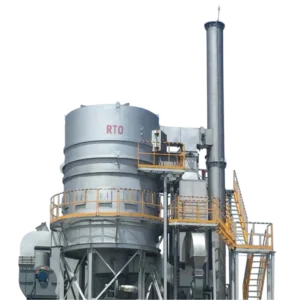
Unlike the traditional technologies mentioned above, the core design philosophy of the regenerative thermal oxidizer (RTO) is “energy recycling,” fundamentally changing the cost structure of exhaust gas treatment.
1. Core Advantage: Up to 95% Heat Recovery
RTO uses ceramic heat storage elements to capture the heat from the high-temperature flue gas after oxidation and use it to preheat the low-temperature exhaust gas entering the system. This revolutionary design delivers disruptive economic benefits:
Extremely Low Fuel Consumption: When the exhaust gas concentration reaches a certain level (approximately 2-4 g/m³), the preheated exhaust gas temperature approaches the oxidation temperature, allowing the system to achieve “self-sustaining combustion.” At this point, the RTO’s operating costs shift from hefty “fuel costs” to remarkably low “electricity costs” (only the electricity required to power the fans and other equipment).
Converting VOCs into “Free Fuel”: For the RTO, VOCs in exhaust gas are no longer simply “processing targets” but valuable “alternative fuels.” The heat released by their oxidation is recycled by the system, significantly reducing or even eliminating reliance on external fuels.
2. Advanced Profit Creation: Waste Heat Utilization
For operating conditions with higher VOC concentrations, the waste heat generated by the RTO can even exceed its own needs. This elevates the RTO from a “cost-saving” device to a “profitable” one.
Integrating a waste heat boiler can generate steam for production processes.
Using an air-to-air heat exchanger, hot air can be generated for drying materials.
This recovered heat directly replaces the steam, natural gas, or electricity you would otherwise have purchased, resulting in tangible “positive returns” on your financial statements.
