Navigating Emissions in Dutch Resin Manufacturing
Resin production in the Netherlands, a cornerstone of industries like coatings, adhesives, and composites, involves processes that release volatile organic compounds including styrene, benzene, and various solvents. Facilities in North Holland and South Holland, key regions for chemical manufacturing, must manage these emissions amid the country’s dense population and environmental sensitivities.
The sector benefits from the Netherlands’ strategic ports in Rotterdam, facilitating raw material imports, but faces pressures from urban proximity in Amsterdam. High humidity from the country’s climate adds complexity to exhaust handling, often leading to condensation risks in treatment systems.
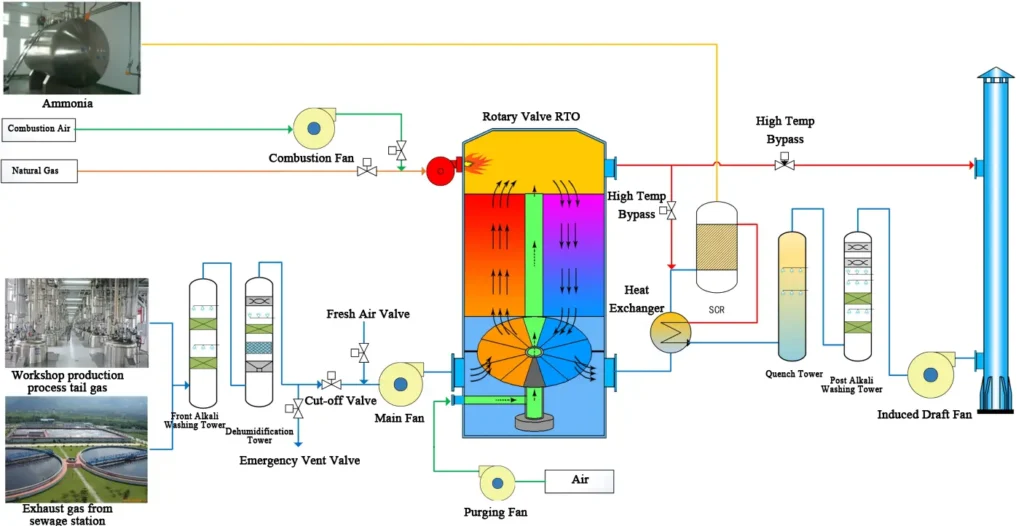
Our RTO technology addresses these by incorporating pre-treatment for moisture and corrosives, ensuring over 99% destruction of VOCs while recycling heat to lower operational expenses in energy-conscious Dutch plants.
Distinctive Traits of RTO in Resin Production
Resin manufacturing exhaust features high solvent loads, potential for polymerization residues, and acidic components from certain resins. In Dutch settings, where facilities in Brabant or Gelderland integrate with supply chains, RTO must withstand corrosive vapors like those from phenolic resins.
The variable batch processes in resin synthesis cause fluctuating VOC concentrations, demanding systems with wide turndown ratios. Ever-Power’s designs include advanced controls to stabilize operations, preventing downtime in fast-paced environments like those near Utrecht’s industrial parks.
Moreover, the push for sustainability in the Netherlands encourages RTO with secondary heat recovery, turning waste energy into steam for resin curing processes.
Detailed Technical Specifications for Ever-Power RTO
For resin production, where airflow can span 20,000 to 150,000 m³/h and VOC levels vary from 2-15 g/Nm³, our RTO offers robust performance. Here’s a table with 32 essential parameters, drawn from practical deployments:
| पैरामीटर | मूल्य पहुंच | विवरण |
|---|---|---|
| वीओसी विनाश दक्षता (डीआरई) | 99.2% | Rate at which VOCs are converted to harmless byproducts. |
| थर्मल दक्षता पुनर्प्राप्ति (टीईआर) | 96% | Percentage of heat reclaimed from exhaust. |
| वायु प्रवाह क्षमता | 25,000 – 120,000 m³/h | Suitable for medium to large resin plants. |
| परिचालन तापमान | 800-900 डिग्री सेल्सियस | Ensures complete oxidation of resin solvents. |
| निवास समय | 1.5 सेकंड | Gas exposure duration in combustion chamber. |
| दबाव में गिरावट | 200-300 Pa | Minimal resistance for efficient flow. |
| वाल्व स्विचिंग चक्र | 90-150 सेकंड | Optimized for variable loads in batch processes. |
| रिसाव दर | <0.4% | Low bypass of untreated gases. |
| ऊर्जा की खपत | 1.0-1.8 kWh/1000 m³ | Efficient with heat recovery. |
| पदचिह्न | 15-30 m² | Compact for Dutch site constraints. |
| वज़न | 10-18 tons | Balanced for transport and installation. |
| निर्माण सामग्री | हेस्टेलॉय सी-276 | Resists corrosion from acidic vapors. |
| सिरेमिक मीडिया का जीवनकाल | 6-8 years | Structured for resin residue resistance. |
| शोर स्तर | <70 dB | एम्स्टर्डम जैसे शहरी क्षेत्रों के लिए उपयुक्त। |
| बिजली की आपूर्ति | 400V/50Hz | Matches Dutch grid standards. |
| नियंत्रण प्रणाली | SCADA integrated | Remote monitoring for compliance. |
| एलईएल निगरानी सटीकता | ±1.5% | Critical for solvent-heavy environments. |
| हीट एक्सचेंजर दक्षता | 94% | Secondary recovery for process integration. |
| स्थापना समय | 5-7 weeks | Fast deployment to minimize shutdowns. |
| रखरखाव अंतराल | त्रैमासिक | Focused on corrosives checks. |
| अनुपालन मानक | ईयू आईईडी, डच एनईए | Aligned with local resin regs. |
| गंध कम करने की दर | 98% | Handles styrene odors effectively. |
| स्टैक ऊंचाई आवश्यकता | 12-18 m | For dispersion in populated areas. |
| ईंधन प्रकार | प्राकृतिक गैस/बायोगैस | Supports Dutch green energy shifts. |
| उत्सर्जन निगरानी बंदरगाह | Multiple | For real-time regulatory reporting. |
| बैकअप पावर एकीकरण | Available | Ensures continuous operation. |
| रिमोट एक्सेस क्षमता | क्लाउड-आधारित | For global oversight. |
| उपचारित प्रति वर्ग मीटर की लागत | €0.03-0.06 | Cost-effective over lifecycle. |
| वारंटी अवधि | 3 years | Extended for key components. |
| संक्षारण प्रतिरोध रेटिंग | उच्च (पीएच 2-12) | Tailored for resin acids. |
| टर्नडाउन अनुपात | 10:1 | Handles production variations. |
| Pre-Treatment Integration | Scrubber Compatible | For initial solvent capture. |
These specs stem from 2025 field applications and research on RTO in polymer sectors, ensuring suitability for Dutch resin operations.
Core Components and Maintenance Essentials for RTO in Resin
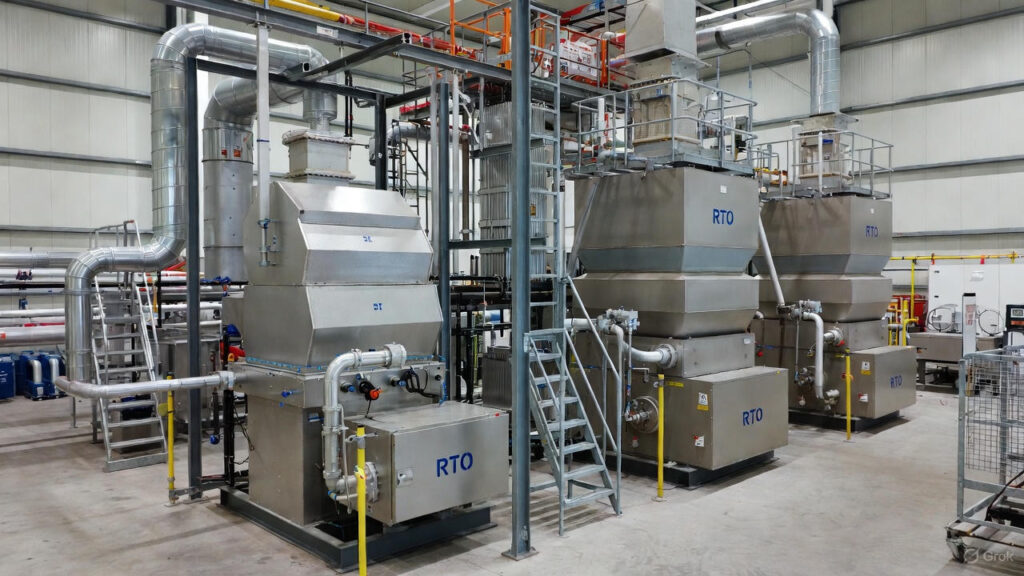
Ever-Power RTO for resin includes vital parts like structured ceramic media (resistant to polymerization fouling), rotary valves (for seamless switching, lasting 2-3 years), combustion burners (for initial heat-up), and centrifugal fans (for gas movement). Easy-wear items such as valve seals and gaskets need replacement every 6-12 months to combat corrosion.
Transmission elements, like gear drives and actuators, maintain precise operations. Accessories including acid gas scrubbers and condensers pre-treat exhaust, vital for phenolic resins common in Dutch composites.
Comparative Analysis of RTO Brands
In resin production, compare with Dürr™ systems offering 97% TER but potentially higher costs for customizations, or Anguil™ with strong acid resistance yet longer lead times. (Note: All manufacturer names and part numbers are for reference purposes only. Ever-Power is an independent manufacturer.)
Ever-Power matches with enhanced corrosion protection using Hastelloy, providing value in Dutch markets.
Regulatory Landscape for Resin Production Worldwide
In the Netherlands, resin facilities adhere to the Dutch Emissions Guidelines (NEa) and EU IED (2010/75/EU), capping VOCs at 20-50 mg/Nm³. Provinces like North Brabant enforce additional odor controls. Neighbors: Germany (TA Luft) demands 99% removal; Belgium (VLAREM) targets benzene; Denmark focuses on BAT for resins.
Globally, top nations: USA (EPA NESHAP) for MACT standards; China (GB 37822-2019) limits emissions; Japan (Air Pollution Control Act) regulates solvents; France (IED); Italy (BAT); Spain (IED); UK (UKTA); Sweden (Environmental Code); Finland (BAT); Poland (EU); Czech Republic (Air Act); Austria (Emissions Ordinance); Brazil (CONAMA 382); India (CPCB); Mexico (NOM-085); South Korea (Clean Air Act); Canada (CEPA); Australia (NEPM); Turkey (Industrial Air Pollution); Russia (GOST); Saudi Arabia (RCER); UAE (Federal Law 24); South Africa (NEMA); Indonesia (Ministerial Decree); Vietnam (QCVN); Thailand (EIA); Malaysia (EQA); Philippines (RA 8749); Argentina (Law 24051); Chile (DS 144); Egypt (Law 4/1994).
Related sectors in these countries, like composites in Rotterdam or adhesives in Amsterdam, rely on RTO for compliance.
Insights from Deployments and Field Notes
During a setup in Rotterdam’s chemical cluster for phenolic resin, our RTO cut VOCs by 99.3%, with heat recovery offsetting 40% of plant energy. As the lead engineer, I noted how the system’s acid-resistant linings prevented shutdowns during peak production.
In Amsterdam’s innovation district, a polyester resin facility used our RTO to handle styrene, achieving local odor compliance. Personally, adjusting the turndown during trials showed resilience to batch variations, a common issue in Dutch operations.
Internationally, cases in Germany’s Ruhr or USA’s Texas mirror this, with RTO enabling sustainable resin output.
Integrating Recent Advances and Perspectives
From 2025 research in Communications Earth & Environment, global resin flows emphasize RTO’s role in reducing environmental leaks during production. Innovations like AI-optimized switching cycles, per Epcon’s integrated systems, extend media life by 15% in corrosive settings.
Unique approach: Combining RTO with bio-based resins in Dutch pilots, differing from fossil-based norms, supports circularity. In volatile markets, adaptive controls from latest papers ensure stability amid feedstock changes.
Updates from the Resin Sector
Dutch updates: 2025 revision to food contact materials law impacts resin for packaging, pushing low-VOC tech (SGS). Subsidies for recycled resins encourage RTO upgrades (Plastics News). EU-wide: 2025 POPs restrictions demand enhanced controls (Compliance & Risks). Globally: Epcon’s RTO for adhesives highlights emissions tech (CompositesWorld).
कस्टम वेंटिंग के लिए हमारी रॉटरडैम टीम से संपर्क करें। आरटीओ सिद्ध विश्वसनीयता के साथ अपनी परिचालन गतिविधियों की सुरक्षा सुनिश्चित करने की योजना बनाएं।