
As the core component of the baghouse dust collector, the filter bag directly determines the performance of the baghouse dust collector[cite: 99]. Whether the choice of filter material is appropriate will directly determine the performance and cost of the dust collector[cite: 100]. In extreme industrial environments—ranging from corrosive chemical plants to high-temperature cement kilns—selecting the correct polymer or membrane is the difference between achieving years of ultra-low emissions and suffering catastrophic, expensive system failures.
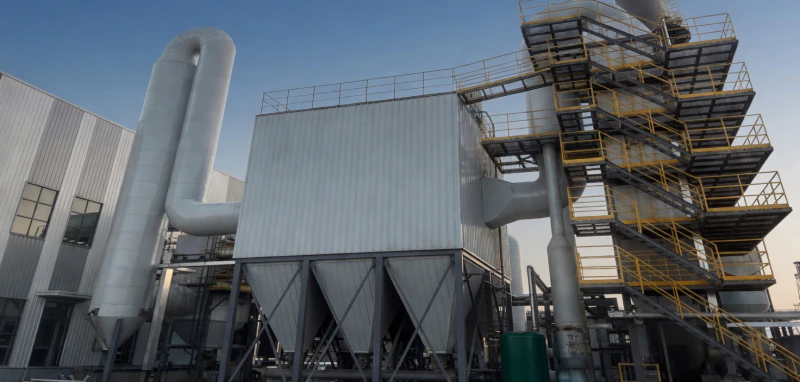
1. Why Filter Media Matters
Filter material is the main material used to make filter bags, and its performance and quality are important factors promoting the advancement of baghouse dust removal technology, directly influencing the application range and service life of the dust collector[cite: 78].
During operation, dust is retained on the outer surface of the filter bags due to the inertia, diffusion, interception, and electrostatic effects of the filter material fibers and fabric[cite: 73]. If the material degrades due to temperature excursions, acid dew point corrosion, or alkaline attacks, the fabric matrix breaks down. This leads to immediate emission spikes and necessitates complete facility shutdowns for replacement.
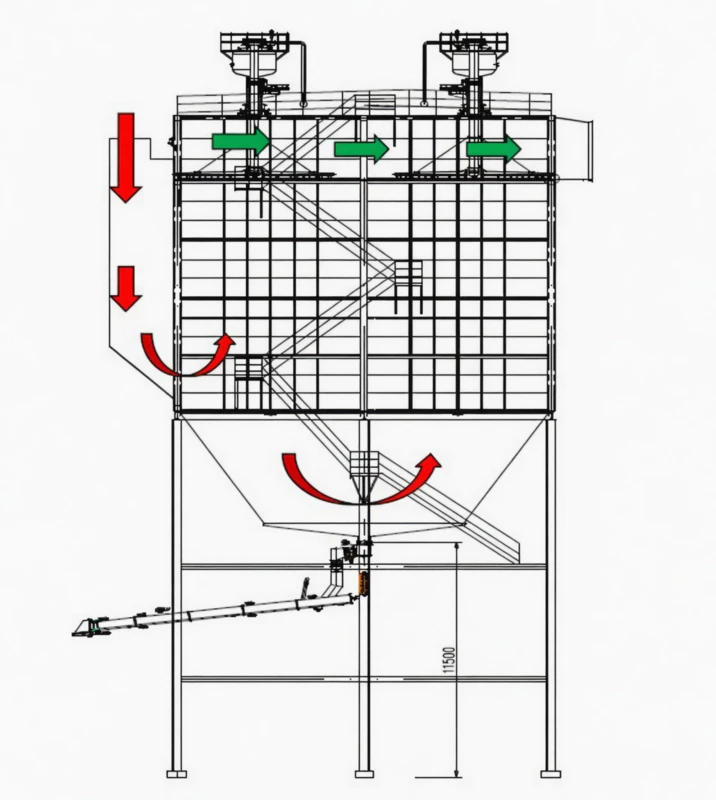
Bag Filter Airflow Schematic
2. PPS (Polyphenylene Sulfide) Filter Bags
PPS, commercially known as Ryton, is the workhorse of the power generation industry. It offers a stellar combination of thermal stability and chemical resistance, particularly against sulfur compounds found in coal-fired exhausts.
Technical Specifications:
- Weight (Gram weight): 500g [cite: 98]
- Thickness: 1.8mm [cite: 98]
- Operating Temperature: $\le 160^\circ C$ [cite: 98]
- Instant Temperature: $190^\circ C$ [cite: 98]
- Acid Resistance: Excellent [cite: 98]
- Alkali Resistance: Excellent [cite: 98]
Best Application: Ideal for coal-fired power plant boilers where continuous operating temperatures remain under $160^\circ C$. Its excellent acid resistance makes it highly immune to sulfuric acid dew-point corrosion[cite: 98]. However, it is sensitive to high oxygen content (above 10%) and NOx, which can lead to oxidative degradation.
3. PTFE (Polytetrafluoroethylene) Filter Bags
Often referred to as the “King of Plastics” (Teflon), PTFE offers the ultimate chemical resistance across the entire pH scale. It is completely immune to oxidative degradation, hydrolysis, and chemical attacks from aggressive exhaust streams.
Technical Specifications:
- Weight (Gram weight): 750g [cite: 92]
- Thickness: 1.1mm [cite: 92]
- Operating Temperature: $\le 240^\circ C$ [cite: 92]
- Instant Temperature: $260^\circ C$ [cite: 92]
- Acid Resistance: Excellent [cite: 92]
- Alkali Resistance: Good [cite: 92]
Best Application: Due to its high operating temperature of up to $240^\circ C$[cite: 92], PTFE is heavily utilized in Waste-to-Energy (WTE) incinerators, chemical processing plants, and corrosive smelting exhausts. While the upfront capital expenditure is higher, its near-indestructible nature guarantees long-term compliance.
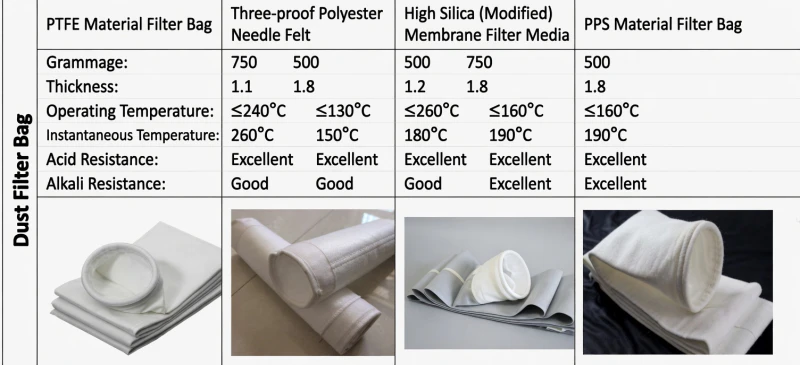
Premium Industrial Filter Bags
4. High-Silica (Modified) Membrane Filter Media
When temperatures exceed the melting points of standard polymers, inorganic fibers like High-Silica are required. Modified high-silica membrane filter media combines extreme heat tolerance with specialized surface treatments to enhance fine particle capture and facilitate pulse-jet cleaning.
Technical Specifications:
- Weight (Gram weight): 750g [cite: 96]
- Thickness: 1.2mm [cite: 96]
- Operating Temperature: $\le 260^\circ C$ [cite: 96]
- Acid Resistance: Excellent [cite: 96]
- Alkali Resistance: Excellent [cite: 96]
Best Application: Engineered for extreme-heat scenarios, this material is widely used in metallurgical furnaces, steel mills, and high-temperature cement kilns where operating temperatures push up to $260^\circ C$[cite: 96]. It provides unmatched structural integrity against thermal shrinkage and high-dust abrasion.
5. The Skeleton: Filter Bag Support Cages
A premium filter bag will fail rapidly if placed on a poorly manufactured support cage. The bag cage is made of carbon steel treated with anti-corrosion[cite: 103]. The material of the bag cage is #20 steel[cite: 103].
To facilitate logistics and rapid on-site assembly for large installations, the bag cage is designed in three sections, making installation very easy[cite: 106]. Critically, to prevent the sharp edges of the metal from puncturing the expensive PTFE or High-Silica bags during pulse-jet cleaning, the cages are produced on an automatic assembly line, with firm welds and no burrs[cite: 110]. After spot welding the filter bag frame, the weld points are smooth and burr-free[cite: 111].
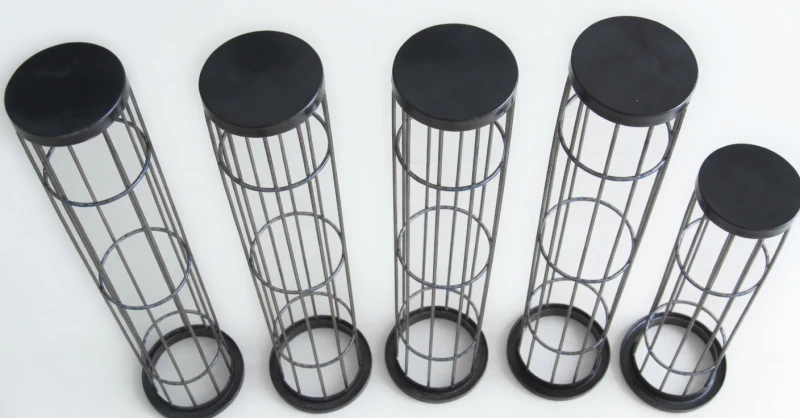
#20 Carbon Steel Support Cages
6. Comparative Selection Matrix
A quick-reference guide to matching the right polymer to your facility’s thermal and chemical exhaust profile.
| Material | Max Op. Temp | Chemical Resistance | Best For |
|---|---|---|---|
| PPS | $\le 160^\circ C$ [cite: 98] | Excellent Acid/Alkali [cite: 98] | Coal-Fired Boilers |
| PTFE | $\le 240^\circ C$ [cite: 92] | Ultimate Spectrum | WTE Incinerators |
| High-Silica | $\le 260^\circ C$ [cite: 96] | Excellent Acid/Alkali [cite: 96] | Cement Kilns, Metallurgy |
7. Full Baghouse System Integration
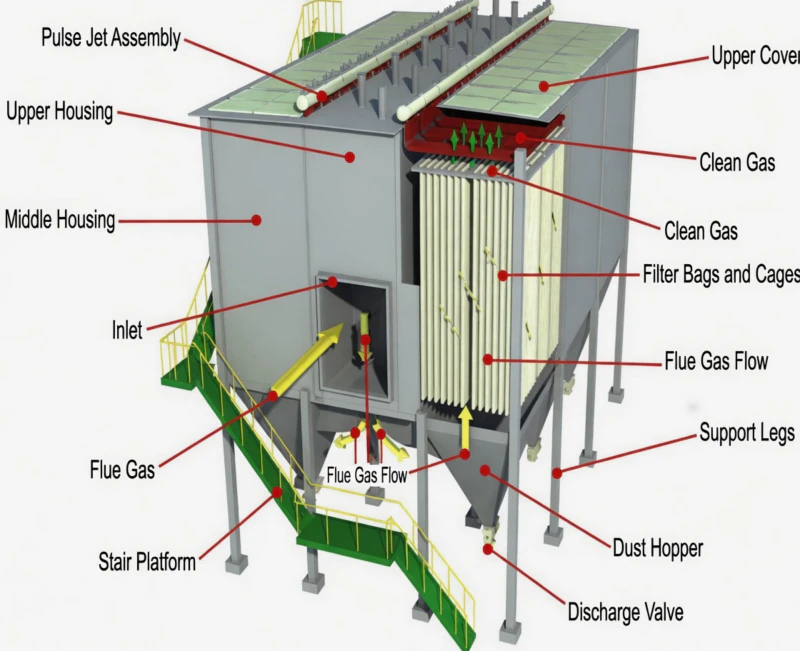
Engineering Schematic: Integrated Baghouse Facility
While the filter bags and cages form the internal filtration matrix, they must be securely housed within a perfectly sealed, pressure-rated steel casing. Our designs ensure that the connection between the plate and the bag cage prevents any raw gas bypass, guaranteeing ultra-low emission compliance at the stack[cite: 112]. With processing volumes capable of reaching up to 2,300,000 m³/h[cite: 38], the structural integration of the hopper, tube sheet, and pulse-jet blowpipes completes the holistic environmental protection system.
Need Help Selecting Your Filter Media?
Our application engineers will analyze your specific flue gas temperature, dust density, and chemical composition to recommend the optimal baghouse configuration. Let’s ensure your plant stays compliant and online.