In the pursuit of ultra-low and near-zero emission requirements, BAOLAN’s Limestone-Gypsum Flue Gas Desulfurization (FGD) systems provide the most robust and reliable solution for massive industrial infrastructures. Specifically engineered for large-capacity units, high-flow conditions, and extreme sulfur concentrations, this technology is a technical benchmark in the environmental protection industry. Capable of processing up to 2,300,000 cubic meters of flue gas per hour per single tower, it ensures that heavy industrial operations in steel, power, and metallurgy remain compliant with the world’s most stringent environmental standards while simultaneously producing construction-grade recyclable gypsum.
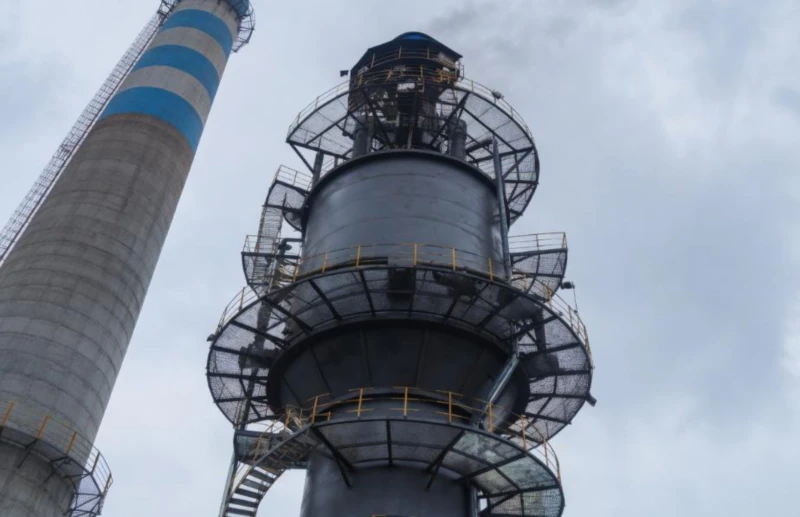
Integrated Limestone-Gypsum Desulfurization Infrastructure for Mega-Scale Industrial Parks
1. Performance Parameters at the Industrial Limit
The BLSHSTL series represents a quantum leap in structural rationality and operational stability. Designed to handle the most demanding industrial loads, these systems feature advanced anti-corrosion absorber bodies constructed from heavy carbon steel. To handle the corrosive nature of sulfurous and sulfuric acids formed during the process, the internal shell is fortified with a specialized glass flake lining.
Global Technical Benchmarks
- Gas Volume: Up to 2,300,000 cubic meters per hour.
- Sulfur Loading: Handles inlet sulfur from 1 up to 5,000 mg/Nm³.
- Emissions Compliance: Guarantees outlet emissions below 35 mg/Nm³.
- Temperature Resilience: Sustains continuous gas temperatures up to 180°C.
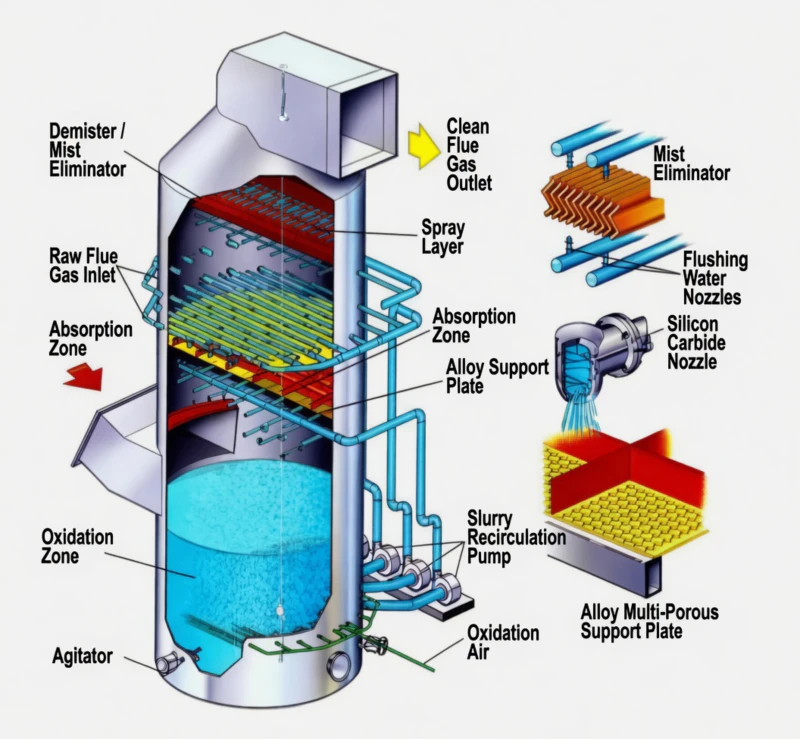
Fig 1: Precision Counter-Current Absorption Tower Architecture
2. High-Performance Internal Machinery
Operating an ultra-large capacity desulfurization tower requires mechanical components that can withstand constant chemical abrasion and high static pressures. BAOLAN integrates internationally advanced machinery designed for zero-downtime industrial cycles.
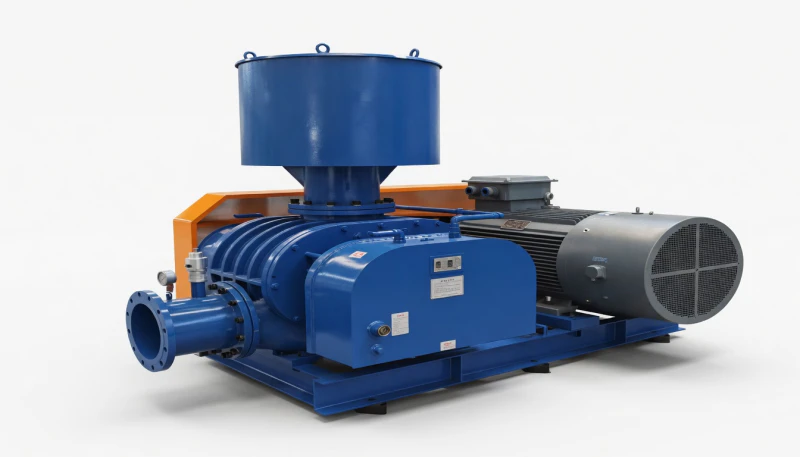
Oxidation Power
Precision Roots blowers continuously supply filtered, dust-free air into the absorber’s slurry tank. This ensures the rapid conversion of calcium sulfite into stable calcium sulfate crystals, keeping the suspension uniform and preventing scaling.
Mechanical Agitation
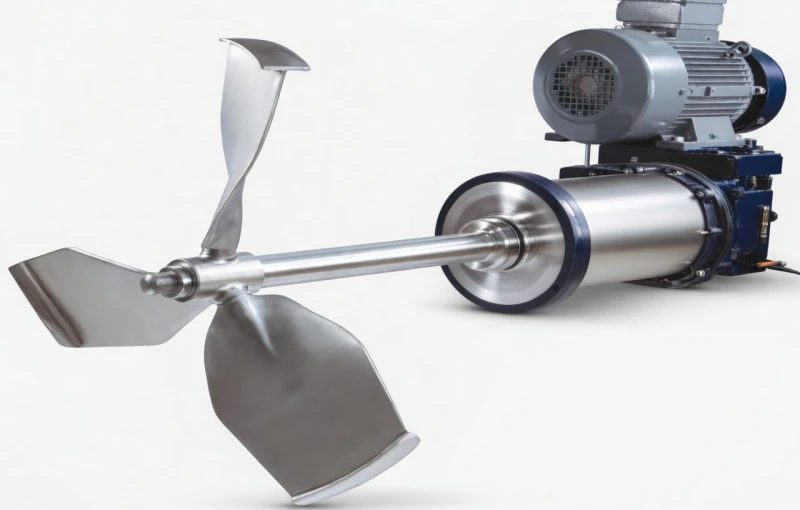
Side-entry agitators create constant mechanical turbulence within the slurry pool. This homogenization prevents desulfurization residue from settling and guarantees a uniform chemical surface area for maximum SO₂ absorption.
Aerosol Control
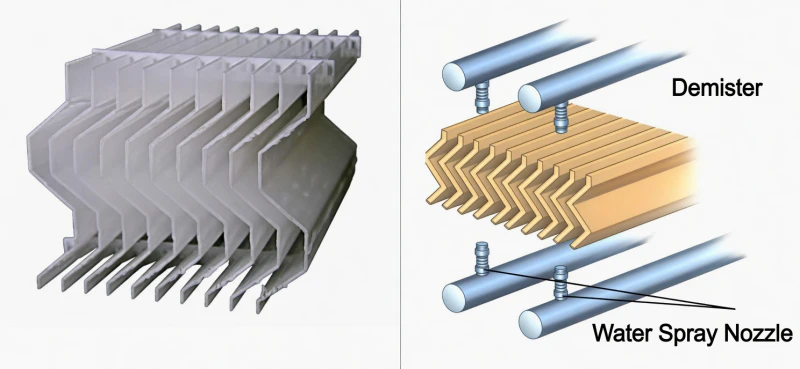
Inertial separation at the tower apex removes liquid carryover. Two stages of corrugated blades force rapid direction changes, trapping droplets which are then recycled back into the slurry tank via a precision flushing system.
3. High-Velocity Liquid-Gas Interaction
The efficiency of a massive desulfurization project is won in the “Spray Zone.” Flue gas enters from the bottom, rising through a downward rain of atomized limestone slurry. To maximize contact, the spray droplets are calibrated to a diameter of 200–500 microns. This creates a massive liquid specific surface area that allows SO₂ to be absorbed almost instantaneously.
Three-Phase Ionic Neutralization
1. Ionic Absorption: SO₂ and SO₃ are absorbed by the slurry water, forming ions that rapidly react with dissolved limestone ($CaCO_3$) to form calcium sulfite ($CaSO_3$).
2. Forced Aeration: Injected oxygen converts the settleable calcium sulfite into stable calcium sulfate dihydrate crystals—otherwise known as industrial gypsum.
3. Exhaust Discharge: The purified gas is stripped of acidity and moisture, entering the stack in a state that meets or exceeds near-zero emission mandates.
Synergistic Multi-Pollutant Control
Beyond SO₂, the limestone slurry simultaneously removes traces of Hydrogen Chloride (HCl) and Hydrogen Fluoride (HF), which are common in waste incineration and kiln flue gases. All resulting reaction products are solid powders, collected efficiently by downstream bag filters or integrated into the gypsum discharge, achieving true multi-pollutant collaborative control.
4. Integrated Resource Recovery & Slurry Management
One of the hallmark features of the limestone-gypsum process is its ability to turn waste into a resource. For large industrial projects, handling the volume of waste generated by desulfurization can be an operational burden. BAOLAN’s system solves this by integrating a high-automation dewatering loop.
The slurry containing calcium sulfate crystals is pumped to a hydrocyclone for high-speed centrifugal separation and concentration. Following this, the concentrated gypsum undergoes vacuum dewatering to produce industrial-grade gypsum ($CaSO_4 \cdot 2H_2O$), ready for recycling in the construction industry. Most of the filtrate water is then pumped back into the FGD system, ensuring zero wastewater discharge and minimizing industrial water consumption.
Dewatering System Synergy
Utilizing bin pumps and compressed air, the fly ash and byproduct handling system conveys solid materials through closed pipelines to circulating ash silos. This prevents fugitive dust and ensures a pollution-free discharge process for the entire facility.
5. Heavy-Duty Fluid Dynamics: The Muscle of the System
To maximize the efficiency of the desulfurizing agent, the BL series employs dedicated, heavy-duty circulation pumps. These are not general-purpose pumps; they are specialized desulfurization units configured in a unit system where one pump corresponds directly to one spray layer in the tower.
Mechanical Durability Features
Every pump features a carbon steel casing internally lined with resilient polymer materials. The impeller is cast from high-grade corrosion-resistant and wear-resistant alloys to survive the continuous impact of limestone particles.
With large flow rates and unshakeable stable heads, these pumps ensure the spray pattern remains consistent across the entire tower diameter. Integrated filter screens at every inlet prevent large solids from entering the spray grid, protecting the high-precision silicon carbide nozzles from clogging and ensuring years of high-efficiency operational cycles.
Full-Service Integration
BAOLAN integrates research and development, design, precision manufacturing, engineering installation, and intelligent commissioning into a unified full-service system. This holistic approach ensures that each mechanical component, from the oxidation fan to the agitator, is perfectly synchronized with the tower’s aerodynamic and chemical requirements.
Lead the Global Standard in Clean Industrial Emissions
Choosing the right desulfurization partner for mega-scale industrial projects is a decision that impacts operational safety for decades. BAOLAN’s BL series provides internationally advanced levels of stability, efficiency, and material durability. Contact our senior technical engineering team today to architect a Limestone-Gypsum FGD solution strictly custom-tailored to your facility’s volumetric and sulfur concentration targets.