
Case Study · VOC Abatement
How a specialist waterproof bitumen products manufacturer achieved 99.2% VOC removal from 30,000 m³/h of asphalt production off-gas — solving the uniquely challenging combination of high VOC concentration (3,000 mg/Nm³), high humidity (50%), highly viscous sticky particulates (coal dust, bitumen fumes), and variable-concentration emission profiles through a dual series-connected dry filter pre-treatment system with online replacement capability, upstream LEL monitoring with fresh-air dilution, and a three-bed RTO operating at zero natural gas cost in normal production.
Sticky Particulate Pre-Treatment
Three-Bed RTO
Online Filter Replacement
LEL Dilution Safety
01 — Industry Background
Bitumen Industry VOC: The Unique Challenge of Viscous, Sticky Off-Gas That Blocks Standard Treatment Equipment
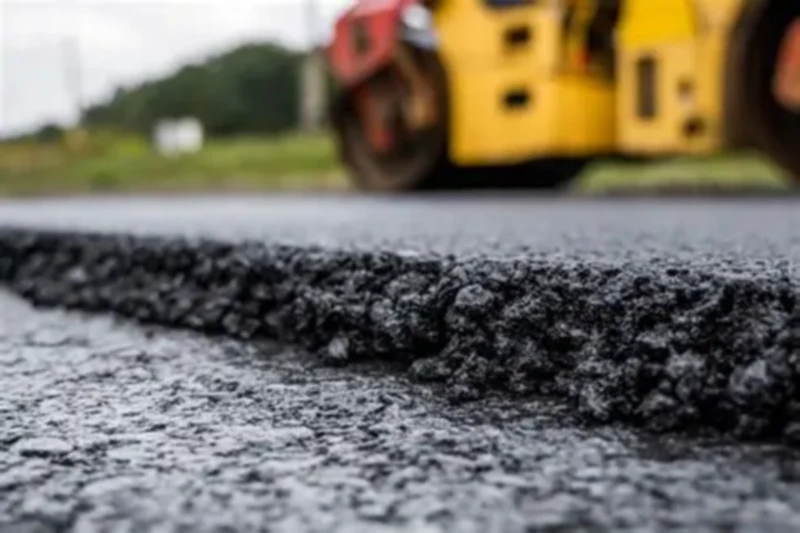
Bitumen (asphalt) is a complex dark-coloured mixture of high molecular weight hydrocarbons and non-metallic derivatives, with waterproofing and anti-corrosion properties that make it indispensable in construction, road surfacing, bridge waterproofing, ship hull protection, pipeline coatings, and oil field applications. The three main bitumen types — coal tar bitumen, petroleum bitumen, and natural bitumen — are processed in hot oxidation and blending equipment that generates off-gas with a unique emission profile not encountered in any other VOC abatement application.
Bitumen production off-gas is characterised by the simultaneous presence of three challenging components that are individually manageable but together create exceptional engineering complexity:
- High VOC concentration at 3,000 mg/Nm³: Bitumen processing generates VOC by volatilisation of lighter hydrocarbon fractions from the hot bitumen mass. The dominant species are benzene-series compounds (benzene, toluene, xylene) and aliphatic hydrocarbons, with no other species (no halogenated compounds, no acid gases, no water-soluble organics). The 3,000 mg/Nm³ concentration is above the RTO autothermal threshold, enabling zero-fuel operation once the system reaches steady state.
- Highly variable concentration and high VOC activity: Bitumen processing is batch-dependent: different production stages (heating, oxidation, blending, filling) generate different VOC loads at different times. The total exhaust VOC concentration fluctuates significantly even on a single production line. Multiple production lines contributing to a common exhaust manifold create additional variability. This variability makes LEL monitoring and concentration management a critical safety requirement, not just a performance optimisation.
- Sticky viscous particulates (coal dust, bitumen fumes, fume aerosol): Bitumen off-gas carries a heavy loading of condensed bitumen aerosol, coal dust from feedstock handling, and bitumen fume particulates. These particles are characteristically sticky and viscous at the off-gas temperature (50°C), meaning they adhere to filter media, duct walls, and equipment surfaces with unusual persistence. Standard fabric bag filters or ceramic media beds used in other VOC applications will rapidly block with these sticky deposits, requiring very frequent replacement. The dual series-connected dry filter pre-treatment in this installation is the engineering solution specifically developed for bitumen’s sticky particulate problem.
The enterprise in this case study was established in 2011, with registered capital of 100 million RMB, occupying 120 acres (approximately 80,000 m²). It produces 10-number solid bitumen, 10-number liquid bitumen, SBS and SBR modified bitumen products, with annual production capacity of 180,000 t of specialised waterproof bitumen, and air oxidation production equipment qualified for 600,000 t/year. Products serve building construction, bridge, road, marine, pipeline, and oil field waterproofing applications. The facility operates 4 production lines, each generating 4,000 m³/h of off-gas; the asphalt tail-gas from the electrostatic collector of the oxidation equipment contains 1–7% oxygen, requiring supplement air (560 m³/h) to maintain stack oxygen at 6–10% and dilution to keep concentration below the explosive limit. The total design treatment volume is 22,500 m³/h (4 lines) plus fresh air dilution, plus unorganised emission collection, totalling 30,000 m³/h.
02 — Pollution Profile
Bitumen Off-Gas: High VOC, No Aromatics (Only Benzene-Series), Sticky Particulates, 50% Humidity, Variable Concentration
The off-gas composition is distinctive in its simplicity compared with pharmaceutical or fine chemical VOC streams: the only species present are benzene-series hydrocarbons (benzene, toluene, xylene), with no halogenated compounds, no acid gases, and no other VOC classes. This clean chemistry profile means the RTO combustion products are simply CO₂ and H₂O, with no HCl, HF, or SO₂ requiring downstream scrubbing. Standard gas volume: 30,000 Nm³/h; process volume: 35,495 Nm³/h at 50°C. Fan power: 75 kW; fan pressure: 5,000 Pa; duct diameter: φ1,000 mm. O₂: 21% actual/baseline. Humidity: 50%.
The primary emission challenge for the RTO design is not the VOC chemistry — which is simple — but the highly variable concentration. Bitumen production varies in VOC output depending on processing temperature, batch composition, and production stage. The manifold concentration can range from near-zero (during cleaning intervals) to high peaks (during oxidation reactions). This variability creates an LEL safety concern at the high end and an RTO temperature instability concern at the low end.
| Parameter | Initial Concentration | Actual Outlet | EU IED / NER Limit |
|---|---|---|---|
| NMHC (total VOCs) | 3,000 mg/Nm³ | 25 mg/Nm³ | IED ≤60 mg/Nm³ |
| Benzene | Present (dominant species) | 0.5 mg/Nm³ | IED ≤2 mg/Nm³ |
| Toluene | Present | 3 mg/Nm³ | IED ≤5 mg/Nm³ |
| Xylene | Present | 6 mg/Nm³ | IED ≤8 mg/Nm³ |
| Sticky particulates | Bitumen fumes, coal dust (sticky, viscous) | Removed by dual dry filters | — |
| Standard gas volume | 30,000 Nm³/h | — | — |
| Process gas volume | 35,495 Nm³/h at 50°C | — | — |
| Humidity | 50% | — | — |
| Annual VOC reduction | ~583.2 t/year | Verified | — |
Key design insight: Bitumen off-gas at 3,000 mg/Nm³ is above the autothermal threshold for a three-bed RTO (>2,500 mg/Nm³), enabling zero natural gas cost during normal production. This means the total annual operating cost is driven primarily by electricity (133,700 RMB) and compressed air (15,000 RMB) — not fuel. The bitumen industry’s high-concentration off-gas is simultaneously its most challenging (variable, sticky, potentially explosive) and most economically advantageous feature for RTO-based VOC abatement.
03 — Treatment Solution
LEL Monitoring → Dual Series Dry Filters → Three-Bed RTO: A System Designed Around Bitumen’s Unique Sticky Particulate Challenge
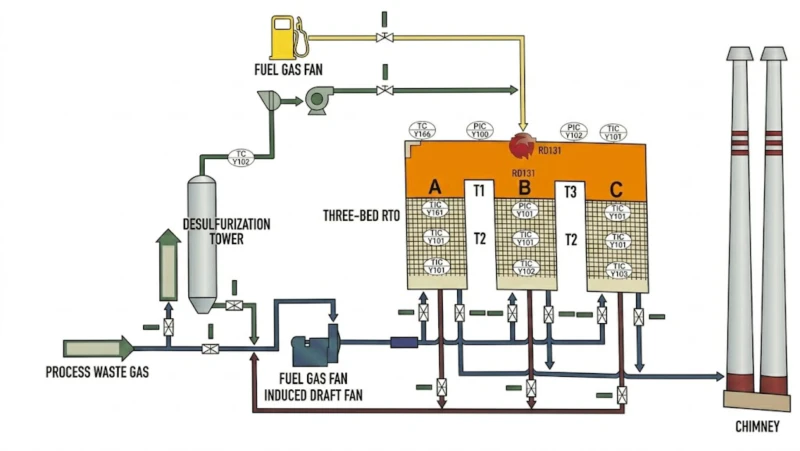
The treatment system architecture prioritises two design goals simultaneously: (1) safety management of variable-concentration flammable bitumen vapour (LEL monitoring + fresh air dilution valve); (2) protection of the RTO ceramic heat storage bed from sticky particulate blockage (dual series-connected dry filters with online replacement capability). The RTO itself is a standard three-bed configuration; the innovation is in the pre-treatment system designed specifically for bitumen’s sticky particulates.
Stage 1: Gas Collection and LEL Monitoring at the Manifold
Bitumen off-gas (organic and inorganic fractions) from all production lines is combined at the collection manifold. On the manifold, LEL concentration monitoring is installed continuously. When the measured concentration exceeds the threshold level, a fresh air supply valve opens automatically at the waste gas fan inlet, introducing dilution air to bring the mixture below the explosive limit. If the concentration exceeds the secondary alarm threshold, the emergency bypass procedure activates, opening fresh air supply for dilution and routing the gas to the emergency bypass chimney until the concentration stabilises within the safe operating range. Fan pressure differential gauges on both sides of the fan enable fault detection; variable-frequency drive (VFD) on the fan accommodates different operating loads. A fresh air supplementary port is installed before the waste gas fan, with a regulating valve for oxygen demand management. The high-temperature discharge port on the RTO provides a waste heat recovery connection for future use.
Stage 2: Dual Series-Connected Dry Filters (1 Operating + 1 Standby, Online Replaceable)
This is the most technically distinctive feature of the bitumen application. The off-gas enters two sets of series-connected two-stage dry filters (two stages in series, 1 operating + 1 standby, total four filter vessels). The dual series arrangement achieves two independent objectives: (1) capturing 93% of the sticky bitumen particulates and aerosol droplets in the filter media before the gas enters the RTO; (2) enabling online (while-operating) filter replacement without interrupting the treatment process. When one filter set becomes saturated and requires replacement, the standby set is activated while the saturated set is changed — no production shutdown, no permit compliance interruption. This online replacement capability is essential for the bitumen application because filter replacement frequency is high (bitumen sticky particulates load the filters much faster than dry dust) and production cannot be interrupted for maintenance windows.
Stage 3: Three-Bed RTO (30,000 m³/h; >760°C)
After the dry filters, the pre-cleaned gas (sticky particulates removed, concentration confirmed below LEL) enters the three-bed RTO through the fresh air supplementation port and the waste gas makeup inlet. The RTO combustion chamber completes the thermal oxidation of remaining VOCs at >760°C, decomposing all organic species to CO₂ and H₂O. The hot combustion gas flow is regulated through the ceramic heat storage bed, storing thermal energy in the ceramic and pre-heating the next cycle of incoming gas. Thermal recovery efficiency ≥95% ensures minimal supplementary fuel requirement. At the design VOC concentration of 3,000 mg/Nm³, the exothermic heat of combustion sustains the 760°C chamber temperature without supplementary natural gas, making the normal-operation gas consumption 0 m³/h. The RTO outlet hot gas provides a high-temperature waste heat recovery connection for future steam or hot water generation. Post-treatment, the cleaned flue gas is discharged to atmosphere through the stack, meeting all permit limits.
Lines 4,000
m³/h each
Monitor
+Fresh Air
Dry Filter
Online Swap
>760°C
0 gas cost
25 mg VOC
99.2%
⭐ Key equipment items. Unorganised emissions (5,000 m³/h) and supplement air (1,500 m³/h) also enter the manifold. Emergency bypass activated when LEL exceeds threshold.
Equipment Specification Summary
| Item | Specification |
|---|---|
| RTO processing flow | 30,000 m³/h; inlet ≤100°C; >99% VOC; 95% thermal; >760°C; footprint 25×8.7 m; 127 t |
| Combustor rating | 900,000 kcal/h |
| Natural gas (normal operation) | 0 m³/h (autothermal at 3,000 mg/Nm³ NMHC) |
| Natural gas (idle) | 40 m³/h (P: 0.03–0.06 MPa) |
| Cold start gas consumption | 10 m³ per cold start |
| RTO fan | 75 kW |
| Combustion-assist fan | 5.5 kW |
| Other electrical | 5 kW |
| Total installed power | 85.5 kW (380 V, 50 Hz, 3-phase) |
| Natural gas burner | 130 m³/h (P: 20–50 kPa; heating value ≥8,500 kcal/Nm³) |
| Compressed air | 10 m³/h (0.6–0.8 MPa; dew point ≤−20°C) |
| Annual electricity cost | 133,700 RMB (55.7 kW at 1 RMB/kWh) |
| Annual compressed air cost | 15,000 RMB (31.35 m³/h at 0.2 RMB/m³) |
| Annual natural gas cost | 0 RMB (autothermal; gas cost is 0 at normal operation) |
| Total annual operating cost | 149,000 RMB/year |
.webp)
04 — Core Advantages
Five Reasons This Architecture Is Purpose-Built for Bitumen Industry VOC Challenges
- ✓
Dual Series Dry Filters With Online Replacement Solve Bitumen’s Sticky Particulate Problem Without Production Interruption: The experience summary explicitly identifies bitumen off-gas sticky particulates as the defining engineering challenge: “bitumen industry off-gas contains many sticky substances, which are extremely easy to cause heat accumulator blockage; to address this difficult problem, this project set up front-end dry filters, 1 operating + 1 standby, for simultaneous online replacement.” The dual series arrangement with online swap capability converts what would otherwise be a frequent production-interrupting maintenance event (filter replacement) into a seamless swap during normal operation. For a production facility where production downtime has significant commercial cost, online filter replacement is not a luxury upgrade — it is an operational necessity. - ✓
Fresh Air Dilution Valve at the Fan Inlet Provides the Primary Concentration Management Tool for Highly Variable Bitumen VOC: When bitumen processing generates a peak VOC concentration event, the direct response is to open the fresh air supply valve, introducing dilution air at the fan inlet to bring the mixture below the LEL threshold. This approach is faster and more reliable than increasing process ventilation (which takes time to propagate through large ducts) and simpler than activating the full emergency bypass (which would require investigation and restart procedures). The fresh air valve is the first-line response to LEL alarm; the emergency bypass is the second-line response when fresh air dilution alone is insufficient. The fan VFD simultaneously accommodates the increased total airflow when fresh air is introduced. - ✓
3,000 mg/Nm³ NMHC Enables Fully Autothermal RTO Operation — The Annual Natural Gas Cost is Zero: At 3,000 mg/Nm³ NMHC (predominantly benzene-series compounds with high heat of combustion), the exothermic heat from VOC oxidation in the RTO combustion chamber is more than sufficient to maintain >760°C without supplementary fuel. The 0 m³/h natural gas at normal operation translates directly to 0 fuel cost in the annual operating budget. With total annual operating cost of only 149,000 RMB (electricity + compressed air only), this bitumen industry RTO installation has by far the lowest operating cost of any of the 26 case studies reviewed. The bitumen industry’s high VOC concentration — its most challenging safety attribute — simultaneously provides its greatest economic benefit for RTO-based treatment. - ✓
No Post-RTO Scrubbing Required: Bitumen VOC Chemistry Produces Only CO₂ and H₂O on Combustion: Unlike pharmaceutical off-gas (which generates HCl from chlorinated solvents requiring a caustic wash) or petrochemical off-gas (which generates SO₂ from H₂S requiring FGD), bitumen off-gas is entirely composed of benzene-series hydrocarbons. Complete thermal oxidation at >760°C produces only CO₂ and H₂O — no acid gases, no halogenated combustion products, no secondary pollution. This clean combustion chemistry means no downstream scrubbing stages are required, making the treatment system simpler and less expensive than pharmaceutical or petrochemical RTO installations of comparable scale. - ✓
Waste Heat Recovery Port on the High-Temperature RTO Outlet Enables Future Steam or Hot Water Generation: The RTO design includes a high-temperature discharge port for waste heat recovery connection. At 3,000 mg/Nm³ NMHC, the RTO generates more exothermic heat than is needed to sustain autothermal operation. This surplus heat is available for extraction via steam generation, hot air supply, or hot water production. While not utilised in the initial commissioning, the provision for waste heat recovery means the enterprise can add a heat recovery system as a second-phase investment to offset energy costs elsewhere in the facility (bitumen heating, drying, facility heating) without modifying the core RTO system.
05 — Operational Results
Verified Performance: 99.2% VOC Removal, 583.2 t/yr Reduction, 149,000 RMB/yr Total Cost
.webp)
Annual operating cost breakdown: electricity at 55.7 kW actual (1 RMB/kWh) = 133,700 RMB; compressed air at 31.35 m³/h (0.2 RMB/m³) = 15,000 RMB; natural gas 0 m³/h normal operation = 0 RMB; total 149,000 RMB/year. This is the lowest annual operating cost of all case studies in this collection in absolute terms — the combination of zero fuel cost (autothermal) and small installed power (85.5 kW) at moderate gas volume (30,000 m³/h) produces exceptional operating cost performance.
06 — Implementation Cautions
Critical Engineering and Safety Lessons for Bitumen Industry RTO Applications
- ⚠️
Variable concentration is the primary operational challenge — the LEL monitoring system must respond within seconds to prevent dangerous accumulation: The experience summary identifies VOC concentration variability as the defining operating challenge for bitumen industry off-gas treatment: “bitumen industry off-gas has the characteristics of high concentration and large variability; install LEL monitoring on the manifold; once gas concentration exceeds the report value, immediately open fresh air valve for dilution; when concentration exceeds the secondary alarm, start the emergency bypass procedure.” The LEL monitoring response time must be verified during commissioning: from sensor trigger to fresh air valve fully open must be less than 5 seconds. Install the LEL sensor at a point in the manifold where concentration peaks are detected as early as possible (as close to the most variable source as feasible), not just at the manifold header where concentration has already been averaged by mixing from multiple lines. - ⚠️
Dry filter replacement frequency for sticky bitumen particulates will be higher than for standard dust applications — plan maintenance intervals from actual operating data, not from generic filter specifications: Standard dry filter specifications (G4, F5, F9) are based on pressure drop vs airborne dust loading relationships calibrated for non-sticky dry particulates. Bitumen aerosol and coal dust deposits are viscous and adhesive; they fill filter media pores and form a surface cake that increases pressure drop much faster per unit mass deposited compared with dry dust. The result is that filter replacement frequency for bitumen applications may be 3–5× higher than for standard industrial dust. Monitor filter pressure drop continuously from commissioning day and record the actual time-to-replacement for the first three replacement cycles. Use this data to establish the actual maintenance schedule — not the manufacturer’s generic specification. - ⚠️
The RTO ceramic heat storage bed must be inspected for sticky bitumen deposit accumulation every 6 months in the first year of operation: Despite the dual series dry filter pre-treatment capturing 93% of sticky particulates before the RTO, the remaining 7% passes through the filters and enters the RTO ceramic bed channels. Unlike dry dust (which can be blown out with pulsed air cleaning), sticky bitumen deposits adhere to ceramic channel surfaces and progressively narrow the channel cross-section. The first 6-month ceramic bed inspection should include visual inspection and pressure drop measurement across the ceramic bed to establish the baseline deposit accumulation rate. If deposit accumulation is faster than expected, the filter specification should be upgraded (to a higher-efficiency stage) or the filter replacement frequency increased to reduce the ceramic bed loading. - ⚠️
Fresh air supply valve sizing must accommodate the maximum required dilution ratio, not just the nominal operating condition: The fresh air supply valve at the fan inlet provides emergency dilution when LEL exceeds the threshold. The valve flow capacity must be sized to deliver sufficient fresh air to reduce the manifold concentration from the maximum peak concentration (not the average) to below the LEL threshold within the response time window. If the valve is undersized for the maximum peak concentration event, it will not achieve the required dilution rate and the concentration will remain above the safe threshold even with the valve fully open. Calculate the worst-case dilution requirement (maximum peak concentration event divided by the LEL threshold, applied to the maximum manifold gas volume) and size the valve to deliver this flow rate within the pressure drop available from the fan. - ⚠️
The high-temperature waste heat recovery port should be designed with appropriate materials from commissioning, even if the heat exchanger is not installed immediately: The RTO high-temperature discharge port will carry gas at approximately 150–200°C immediately after the ceramic outlet bed, with bitumen combustion products (primarily CO₂ and H₂O, but with potential trace carryover of bitumen aerosol from incomplete ceramic bed filtration). The duct between the RTO outlet and the future heat exchanger connection must be specified in materials adequate for this temperature and gas composition from the initial installation — retrofitting a different duct material when the heat exchanger is added later is more expensive than specifying correctly at the outset.
07 — Engineering Takeaways
Four Lessons from This Bitumen Industry RTO Project
- 1
Sticky particulate management is the unique engineering challenge in bitumen applications — the dual series dry filter with online replacement is the solution, and it must be designed from the start, not retrofitted. Every bitumen RTO project must address the sticky particulate problem before the system is commissioned. An RTO designed for standard dry dust (using a single upstream filter) will experience ceramic bed blockage within weeks of commissioning if the bitumen aerosol loading is not adequately intercepted. The dual series filter with online replacement capability represents the minimum viable pre-treatment specification for bitumen applications. Do not accept a single-stage filter design for bitumen VOC abatement. - 2
At 149,000 RMB/year for 30,000 m³/h at 99.2% efficiency, bitumen RTO is the lowest-cost-per-cubic-metre abatement of any case study in this collection. The unit cost of approximately 0.49 RMB per hour per 1,000 m³/h treated is achieved by the combination of zero fuel cost (autothermal at 3,000 mg/Nm³), low installed power (85.5 kW), and simple post-RTO discharge (no scrubbing required). This demonstrates that when the VOC chemistry is simple (hydrocarbons only), the concentration is high (above autothermal threshold), and the pre-treatment is adequately designed (online-replaceable filters), the three-bed RTO delivers exceptionally low unit operating cost. This is why bitumen industry facilities with adequate technical support for the sticky particulate challenge can justify RTO investment without detailed financial modelling: the payback period at 149,000 RMB/year versus permit non-compliance penalties is typically less than 2 years. - 3
LEL monitoring with two-level response (fresh air dilution at level 1; emergency bypass at level 2) is the correct safety architecture for variable-concentration bitumen VOC applications. A single-level LEL interlock (bypass only) is both too conservative (triggering full bypass for manageable concentration spikes that could be handled by dilution) and insufficient (if bypass alone cannot dilute the concentration fast enough). The two-level response provides: (1) a proportionate response to moderate spikes (dilution, production continues); (2) a definitive response to severe events (bypass, production assessment required). Design the two threshold levels from the actual measured concentration variability profile of the specific production process, not from generic guidelines. - 4
Bitumen VOC chemistry (hydrocarbons only; no fluorine, chlorine, or sulfur) means no post-RTO scrubbing is required — this fundamentally simplifies the system compared with pharmaceutical or petrochemical applications at similar scale. The comparison with Case 22 (pharmaceutical, 120,000 Nm³/h, requires water wash + RTO + caustic wash + acid wash) and Case 23 (petrochemical, 16,000 m³/h, requires alkali wash + buffer + RTO) illustrates why bitumen VOC abatement at 30,000 m³/h can be achieved at only 149,000 RMB/year while those more complex applications cost 3.385 million RMB/year and 384,000 RMB/year respectively. The VOC chemistry drives the system complexity and cost as much as the volume does. For any VOC application where the combustion products are only CO₂ and H₂O (pure hydrocarbon streams), the RTO can operate without any downstream treatment beyond stack dispersion.
08 — Frequently Asked Questions
Bitumen Industry RTO VOC Abatement: Ten Questions Answered
Questions from environmental permit managers, production engineers, and HSE teams at bitumen processing, waterproof membrane manufacturing, and asphalt products facilities planning RTO VOC abatement systems under EU IED / Dutch Activities Decree requirements.
Ready to Solve Your Bitumen Facility VOC Challenge at Zero Fuel Cost?
Explore Dry Filter + Three-Bed RTO Solutions for Bitumen Industry VOC
From dual series-connected dry filter pre-treatment for sticky bitumen particulates to three-bed regenerative thermal oxidizers operating at zero natural gas cost with high-concentration bitumen off-gas, our engineering team delivers EU IED–compliant systems for the most demanding asphalt production VOC abatement requirements.