
Fallstudie · Industrielle Emissionskontrolle
Wie ein führendes Unternehmen im Bereich der Feststoffabfallverwertung eine Entschwefelung von 99,851 TP3T, eine SCR-Denitrifikation von 501 TP3T und eine Staubentfernung von 98,41 TP3T aus 48.000 Nm³/h stark schwankendem Abgas aus einem Drehrohrofen aus verschiedenen Quellen erreichte – durch den Einsatz von SDS-Natriumbicarbonat-Trockenentschwefelung, Niedertemperatur-SCR und einer an die anspruchsvolle Zusammensetzung von kontaminiertem Boden und Abgas aus der Verbrennung industrieller Feststoffabfälle mit hohem HCl-, hohem HF- und hohem SO₂-Gehalt angepassten Pulsstrahl-Schlauchfiltertechnologie.
SDS-Trockenentschwefelung
Niedertemperatur-SCR-Denitrifikation
Pulsstrahl-Beutelfilter
Thermische Behandlung kontaminierter Böden
01 — Branchenhintergrund
Umfassende Verarbeitung von Festabfällen im großen Maßstab: Ein wachsender Sektor mit komplexen Herausforderungen hinsichtlich der Emission mehrerer Schadstoffe
Die Entwicklung von Strategien zur Ressourcennutzung von großflächigen Festabfällen ist ein zentraler Bestandteil nachhaltiger Entwicklungsstrategien. Großflächige Festabfälle umfassen eine außerordentlich vielfältige Palette an Materialien: Bauabfälle, Kohlenasche, Abraumhalden, Kohlenabraum, Gips aus industriellen Nebenprodukten, Entschwefelungsabfälle, Hüttenschlacke und industrielle Reststoffe. Das Ausmaß dieser Herausforderung ist beträchtlich: Die jährlich anfallenden großen Mengen an Festabfällen nehmen weiter zu, während die umfassenden Verwertungsraten unter 601.300 Tonnen liegen. Bestehende historische Halden stellen in vielen Industrieregionen eine große Herausforderung für die Landnutzung und die ökologische Sicherheit dar.
Das in dieser Fallstudie untersuchte Unternehmen ist auf Umweltsanierung und die Verwertung fester Abfälle spezialisiert. Zu seinen Kernkompetenzen zählen die Sanierung kontaminierter Böden, die Behandlung gefährlicher Abfälle und Dienstleistungen im Bereich der Abwasserbehandlungstechnologie. Als führendes Unternehmen im Bereich der Feststoffabfallbehandlung verfügt es über eine integrierte Produktionslinie zur Behandlung kontaminierter Böden (Jahreskapazität: 1,1 Mio. m³ industriell kontaminierter Feststoffböden), zur Klärschlammbehandlung (Jahreskapazität: 360.000 m³ Klärschlamm, einschließlich Schwermetallen) und zur Verwertung von Bau- und Straßenbaustoffen (Jahreskapazität: 730.000 m³ Tragschichten für Bau- und Straßenbaustoffe). Nach der Weiterverarbeitung umfasst die jährliche Produktionsmenge ca. 600.000 m³ Tragschichten für Bau- und Straßenbaustoffe.
Die thermische Behandlung kontaminierter Böden im Drehrohrofen erzeugt Abgase mit einer Temperatur von 170 °C, deren Schadstoffbelastung stark schwankt. Diese spiegelt die vielfältige und unvorhersehbare chemische Zusammensetzung der kontaminierten Böden und der industriellen Abfallstoffe wider. Im Gegensatz zu speziell dafür errichteten Industrieabfallverbrennungsanlagen mit festen Rohstoffvorgaben muss der Drehrohrofen für die Feststoffabfallverarbeitung Rohstoffe verarbeiten, deren Zusammensetzung von Charge zu Charge stark variieren kann – von leicht kontaminierten Bauschuttabfällen bis hin zu stark kontaminierten industriellen Prozessrückständen. Diese Zusammensetzungsvariabilität stellt die größte technische Herausforderung für die Abgasreinigungsanlage dar.
Die für dieses Projekt bereitgestellten Ausgangsdaten waren ungenau – die tatsächlichen HF-, HCl- und SO₂-Konzentrationen im Abgas des Drehrohrofens erwiesen sich als deutlich höher als in der Vorplanung ermittelt. Die Entschwefelungsanlage arbeitete daher von Beginn an unter Überlastung, was zu erheblichem Verschleiß der Anlagen führte. Diese Erfahrung zeigt, dass bei der Verarbeitung kontaminierter Böden und gemischter Feststoffabfälle konservative Auslegungsreserven unerlässlich sind – sie stellen eine notwendige Absicherung gegen die inhärente Unvorhersehbarkeit der Zusammensetzung des Einsatzmaterials dar.
— Zusammenfassung der Ingenieurserfahrung, Großprojekt zur umfassenden Verarbeitung fester Abfälle: Staubentfernung / Entschwefelung / Denitrifikation
02 — Verschmutzungsprofil
Abgase aus Drehrohröfen mit kontaminiertem Boden: Unvorhersehbare Schadstoffzusammensetzung erfordert konservative Konstruktion
Der Drehrohrofen wird mit schwefelhaltigem Brennstoff (Schwefel) betrieben. Das Standard-Rauchgasvolumen beträgt 48.000 Nm³/h; das Prozess-Rauchgasvolumen beträgt unter Betriebsbedingungen (170 °C) 80.000 Nm³/h. Der Sauerstoffgehalt variiert zwischen 12 und 151 µg/m³T (tatsächlicher Wert: 111 µg/m³T; Referenzwert: 111 µg/m³T). Zwei Saugzugventilatoren liefern je 200 kW bei 6.000 Pa, wobei jeweils ein Ventilatorpaar mit 1 m³ Hub arbeitet. Das anfängliche Schadstoffprofil aus der Auslegungscharakterisierung war wie folgt:
- SO₂ bei 500–600 mg/Nm³Hohe Variabilität. Zielwert am Auslass: ≤ 80 mg/Nm³ (Auslegung), tatsächlich erreicht: 50 mg/Nm³. Der große Eingangsbereich – und die anschließende Feststellung, dass die tatsächlichen Konzentrationen die Auslegungswerte überschritten – bedeutet, dass die SDS-Trockenentschwefelungsanlage für die tatsächlichen Betriebsbedingungen nicht ausreichend dimensioniert war. Daher waren nachträgliche Modernisierungen der Entschwefelungsanlage und der Einsatz eines hocheffizienten, calciumhaltigen Entschwefelungsmittels erforderlich.
- Feinstaub (PM) mit einer Konzentration von 20 g/Nm³ (20.000 mg/Nm³)Extrem hohe Staubbelastung durch kontaminierte Bodenpartikel und Verbrennungsasche. Nach Vorkühlung des Wärmetauschers und SDS-Einspritzung wird die Konzentration am Filtereintritt deutlich reduziert. Der Filter erreicht einen Abscheidegrad von 98,41 TP3T und liefert einen PM-Ausgangswert von 3 mg/Nm³ (tatsächlich) gegenüber einem Sollwert von 20 mg/Nm³.
- HCl bei 15 mg/Nm³Aus Chloridverbindungen im kontaminierten Boden und in Abfallstoffen. Zielwert am Auslass: ≤ 6 mg/Nm³. Tatsächlicher Wert: 2 mg/Nm³ – teilweise aufgefangen durch die SDS-Natriumhydrogencarbonat-Injektion (die sowohl mit HCl als auch mit SO₂ reagiert) und den Schlauchfilter.
- HF bei 30 mg/Nm³Erhöhte HF-Konzentration aufgrund fluorhaltiger Abfallbestandteile im kontaminierten Bodenzulauf. Die tatsächliche HF-Konzentration lag über der Auslegungsvorgabe und trug zur nach der Inbetriebnahme festgestellten Überlastung bei. Zielwert am Auslass: ≤ 60 mg/Nm³ (Auslegung); tatsächlich erreichter Wert: 6 mg/Nm³ (unter normalen Betriebsbedingungen).
- NOx (anfangs nicht spezifiziert, wird durch SCR behandelt)Die Niedertemperatur-SCR-Denitrifikation bei einer Eintrittstemperatur von 220–260 °C erreicht einen Denitrifikationswirkungsgrad von 50%. SCR-Eintrittstemperatur: 220 °C; Austrittstemperatur: 200 °C.
- Temperaturpunkte: Ofenabgasaustritt bei 380–450°C; nach dem Wärmetauscher sinkt die Temperatur vor der SDS-Einspritzzone auf etwa 260°C; Temperatur am Entschwefelungseintritt etwa 250°C; Temperatur am Schlauchfiltereintritt etwa 260°C; SCR-Denitrifikationseintritt 220°C (nach dem Schlauchfilter).
| Parameter | Anfangskonzentration | Design-Steckdose | Tatsächliche Filiale | EU-IED-Grenze |
|---|---|---|---|---|
| NOx | — | ≤180 mg/Nm³ | ≤180 mg/Nm³ | 200 mg/Nm³ (IED WID) |
| SO₂ | 500–600 mg/Nm³ | ≤80 mg/Nm³ | 50 mg/Nm³ | 80 mg/Nm³ (IED WID) |
| Feinstaub (PM) | 20 g/Nm³ (20.000 mg/Nm³) | ≤20 mg/Nm³ | 3 mg/Nm³ | 20 mg/Nm³ (IED WID) |
| HCl | 15 mg/Nm³ | ≤6 mg/Nm³ | 2 mg/Nm³ | 10 mg/Nm³ (IED WID) |
| HF | 30 mg/Nm³ | ≤60 mg/Nm³ | 6 mg/Nm³ | 1 mg/Nm³ (IED WID) |
| Sichtbare weiße Rauchfahne | Gegenwärtig | Keine (unsichtbar) | Keine – bestätigt | Keine sichtbare weiße Rauchfahne |
| Standard-Abgasvolumen | 48.000 Nm³/h | — | — | — |
| Prozessabgasvolumen | 80.000 Nm³/h bei 170 °C | — | — | — |
| Ofenaustrittstemperatur | 380–450 °C | — | — | — |
03 — Behandlungslösung
Vierstufiges Trockenbehandlungssystem: Wärmetauscher → SDS-Trockenrauchentfeuchtung → Schlauchfilter → Niedertemperatur-SCR
Das Behandlungsverfahren nutzt eine vollständig trockene Prozesskette und vermeidet so die Abwassererzeugung, die bei der Nasswäsche eines so stark verunreinigten Gasstroms entstehen würde. Die vier Behandlungsstufen behandeln das Schadstoffprofil nacheinander, wobei das Hochtemperaturfenster vor dem Schlauchfilter für die SDS-Trockenentschwefelung genutzt und die kühlere Nachfilterzone für die Niedertemperatur-SCR-Denitrifikation reserviert wird.
Stufe 1: Abgaskühlungs-Wärmetauscher (380–450 °C → 260 °C)
Heißes Ofenabgas mit einer Temperatur von 380–450 °C tritt in den Zyklon-Vorabscheider zur Grobpartikelabscheidung ein und durchströmt anschließend den wassergekühlten Wärmetauscher, um die Abgastemperatur auf maximal 260 °C zu regeln. Wichtige Parameter: Abgasvolumenstrom 48.000 m³/h; Wärmetauscherfläche 284 m²; Druckverlust im Gerät 429 Pa; Einlasstemperatur Heißseite 350 °C; Auslasstemperatur Heißseite 250 °C; Geräteabmessungen 1.989 × 2.170 × 3.150 mm. Durch diese Vorkühlung wird das Gas in den Betriebstemperaturbereich der SDS-Trockenentschwefelungsanlage und des Schlauchfilters gebracht und die Korrosionsschutzmaterialien sowie das Filtergewebe vor Überhitzung geschützt.
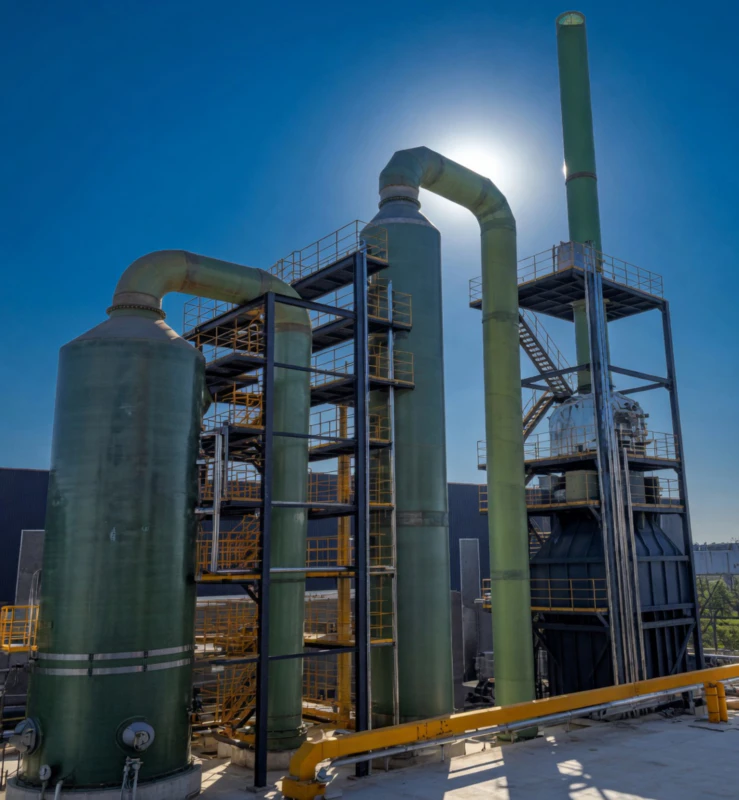
Stufe 2: SDS-Trockenentschwefelung (Natriumbicarbonat-Injektion)
Das gekühlte Gas gelangt anschließend in den SDS-Trockenentschwefelungsturm (Spray Dry Scrubbing / Natriumbicarbonat-Trockensorbens). SDS verwendet pulverisiertes Natriumbicarbonat (NaHCO₃) als Sorptionsmittel, das sich nach der Einspritzung in den Gasstrom thermisch zersetzt und Natriumcarbonat (Na₂CO₃) bildet. Dieses reagiert dann mit SO₂, HCl und HF zu Natriumsulfit/-sulfat und Natriumchlorid/-fluorid. Wichtige SDS-Parameter: Rauchgasvolumenstrom 78.000 m³/h; Rauchgastemperatur 250 °C; SO₂-Einlass 250 mg/Nm³ (Auslegung) / 500–600 mg/Nm³ (tatsächlich); SO₂-Auslass 80 mg/Nm³ (Auslegung) / 50 mg/Nm³ (tatsächlich); Calcium-Schwefel-Verhältnis 1,1; Kalksteinspeicherkapazität 5 m³. Dreitägige Autonomie. Hocheffizientes, calciumhaltiges Entschwefelungsmittel mit einem Verbrauch von 0,03 t/h; jährliche Kosten für das Entschwefelungsmittel ca. 21,6 Zehntausend RMB. Das SDS-Verfahren entfernt gleichzeitig HCl und HF sowie SO₂ und erreicht so die erforderliche Entfernung mehrerer Säuregase in einem einzigen Injektionsschritt ohne die Entstehung flüssiger Abfälle.
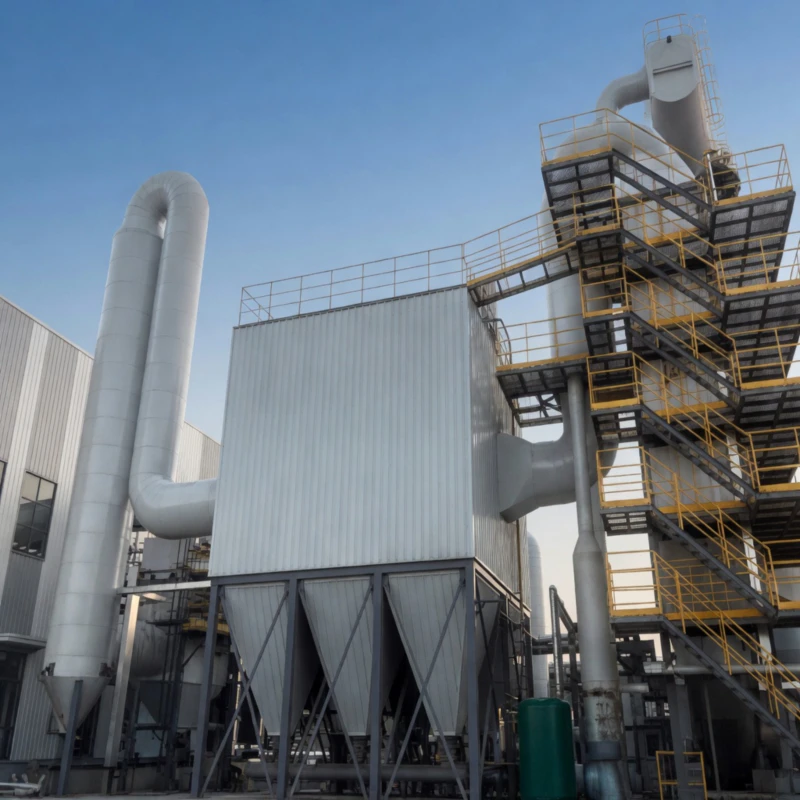
Stufe 3: Impulsstrahl-Schlauchfilter (2.712 m² Filterfläche)
Nach der SDS-Einspritzung gelangen das Gas und die SDS-Reaktionsprodukte in den Impulsstrahl-Schlauchfilter zur Partikelabscheidung. Der Schlauchfilter erfasst sowohl die ursprünglichen Abgaspartikel des Ofens als auch die Natriumsalz-Reaktionsprodukte aus der SDS-Stufe und erreicht so eine effektive gleichzeitige Entfernung von Feinstaub und sauren Gassalzen. Wichtige Parameter: Filterfläche 2.712 m²; Anzahl der Schläuche 900; Schlauchdurchmesser φ160 mm; Filtrationsgeschwindigkeit ≤0,7 m/min; Feinstaubkonzentration am Auslass ≤10 mg/Nm³ (Auslegung) / 3 mg/Nm³ (tatsächlich); Gehäusewiderstand 300 Pa; Rauchgastemperatur ≤260 °C; Geräteabmessungen 8.300 × 7.140 × 13.360 mm; Gerätehöhe 13.360 mm. Auslegungsdruck ±5.000 Pa. Gesamtstaubabscheidung des Systems: 98,41 TP3T (Auslegung) / 901 TP3T (Ist-Wert) (der Ist-Wert spiegelt den überlasteten Betrieb aufgrund höherer als erwarteter Schadstoffkonzentrationen am Einlass wider). Der Schlauchfilter ist die kritische Komponente zur Einhaltung der Feinstaubgrenzwerte – die Gewährleistung der Einhaltung der Temperaturgrenzen der Filterschläuche und die Aufrechterhaltung der Wirksamkeit der Impulsstrahlreinigung haben höchste Priorität.
Stufe 4: Niedertemperatur-SCR-Denitrifikation (220 °C → 200 °C)
Das nach dem Schlauchfilter weitgehend von Partikeln und sauren Gasen gereinigte Gas tritt mit ca. 220 °C in den Niedertemperatur-SCR-Reaktor zur NOx-Reduktion ein. Der SCR-Reaktor ist nach dem Schlauchfilter angeordnet (kaltseitige SCR-Anlage), um den Katalysator vor der hohen Staubbelastung des Ofenabgases zu schützen, die andernfalls zu einer schnellen Verschmutzung und mechanischem Abrieb der Katalysatoroberfläche führen würde. Wichtige SCR-Parameter: Außendurchmesser 85.000 mm (Plan); Außenhöhe 1.308 mm; 15 Katalysatormodule; Katalysatorvolumen 17 m³; Druckverlust 500 Pa; SCR-Eintrittstemperatur 220 °C; SCR-Austrittstemperatur 200 °C. Die kaltseitige SCR-Konfiguration erfordert eine Katalysatorzusammensetzung, die für den Betrieb bei 200–260 °C ausgelegt ist und damit außerhalb des typischen Temperaturbereichs von 350–400 °C für Standard-SCR-Katalysatoren liegt. Niedertemperatur-SCR-Katalysatoren verwenden modifizierte Formulierungen, die eine ausreichende NOx-Reduktionsaktivität bei 200–260 °C gewährleisten und gleichzeitig der Deaktivierung durch Natrium- und Calciumsalzrückstände aus der SDS-Stufe widerstehen, die in sehr feiner Form den Schlauchfilter passieren. Denitrifikationseffizienz: 50% (Auslegungs- und Istwert).
380–450 °C
→260°C
NaHCO₃
SO₂/HCl/HF
2.712 m²
98.4% PM
220 °C
50% NOx
→ Stapel
.webp)
.webp)
Zusammenfassung der wichtigsten Ausrüstung und Reagenzien
| Artikel | Spezifikation |
|---|---|
| Kühlwärmetauscher | 48.000 m³/h; 284 m² Fläche; 429 Pa Druckabfall; 350→250 °C; 1.989 × 2.170 × 3.150 mm |
| SDS-Trockenentschwefelung | 78.000 m³/h; 250 °C; SO₂-Einlass 250 mg/Nm³; Auslass 80 mg/Nm³; Ca/S-Verhältnis 1,1; Kalksteinspeicher 5 m³ (3 Tage) |
| Beutelfilter | Fläche: 2.712 m²; 900 Säcke; φ160 mm; ≤0,7 m/min; ≤10 mg/Nm³ Auslass; 300 Pa; 8.300 × 7.140 × 13.360 mm |
| Niedertemperatur-SCR | 85.000 mm (Plan); 15 Katalysatormodule; 17 m³ Katalysatorvolumen; 500 Pa; 220→200 °C; 50% NOx-Effizienz |
| Fans, die durch einen induzierten Draft dazu gebracht wurden | 90.000 m³/h pro Einheit; 6.000 Pa; Betriebstemperatur 200–250 °C; 200 kW pro Einheit; 1 Betriebs- + 1 Standby-Phase |
| Hocheffizientes Calcium-Entschwefelungsmittel | 0,03 t/h; 900 RMB/t; jährliche Kosten ca. 21,6 Zehntausend RMB (umgerechnet) |
| Ammoniakwasser (SCR-Reduktionsmittel) | 0,06 t/h; 600 RMB/t; jährliche Kosten ca. 28,8 Zehntausend RMB (umgerechnet) |
| Maximale Systemleistung | 326,21 kW (Istwert); 534,46 kW (installierte Gesamtleistung) |
| Jährliche Stromkosten (8.000 h) | Ungefähr 93,9 Zehntausend RMB (bei 0,36 RMB/kWh) |
04 — Kernvorteile
Warum die Kombination aus Trockenverfahren (SDS), Schlauchfilter und Niedertemperatur-SCR die richtige Architektur für gemischte Feststoffabgase darstellt
- ✓
Das SDS-Trockenverfahren vermeidet sekundäre flüssige Abfälle aus einem Gasstrom, der Verunreinigungen unbekannter Herkunft enthält: Bei der Aufbereitung kontaminierter Böden und gemischter Feststoffe ist die chemische Zusammensetzung des Abgases naturgemäß unvorhersehbar. Eine Nasswäsche dieses Abgases würde stark kontaminiertes Abwasser erzeugen, das Schwermetalle, organische Mikroverunreinigungen und alle Absorptionsprodukte saurer Gase in einem einzigen Flüssigkeitsstrom enthält. Dessen Behandlung und Entsorgung wären äußerst schwierig. Das SDS-Trockenverfahren wandelt alle sauren Gase (SO₂, HCl, HF) in feste Natriumsalz-Reaktionsprodukte um, die vom Schlauchfilter als trockener Feststoff aufgefangen, klassifiziert und über die bestehende Abfallentsorgungskette des Betriebs entsorgt werden. Im Aufbereitungsprozess selbst entsteht kein flüssiger Abfall. - ✓
SDS-Natriumbicarbonat entfernt SO₂, HCl und HF gleichzeitig in einem einzigen Injektionsschritt: Im Gegensatz zur Kalkstein-Rauchgasentschwefelung (die primär SO₂ entfernt) reagiert SDS-Natriumhydrogencarbonat effektiv mit allen drei sauren Gasen gleichzeitig: SO₂ zu Natriumsulfit/Sulfat, HCl zu Natriumchlorid und HF zu Natriumfluorid. Bei einem Gasstrom mit gleichzeitig hohen Konzentrationen aller drei sauren Gase – wie sie beispielsweise im Abgas von Drehrohröfen für feste Abfälle vorkommen – ermöglicht SDS die Entfernung aller drei Schadstoffe in einer einzigen Injektionsstufe, anstatt separate Entschwefelungs- und Säuregasbehandlungsstufen zu erfordern. Diese simultane Abscheidung mehrerer Schadstoffe ist eine wesentliche betriebliche Vereinfachung für Abgasströme mit variabler Zusammensetzung. - ✓
Der Kaltseiten-SCR-Nachfilter schützt den Katalysator vor der extremen Staubbelastung durch kontaminierte Bodenabgase: Bei einer anfänglichen Partikelbelastung von 20 g/Nm³ würde die Platzierung des SCR-Reaktors vor dem Schlauchfilter (Heißseiten-SCR) zu einer schnellen Verstopfung der Katalysatorkanäle und mechanischer Erosion durch die abrasiven Staubpartikel führen. Die Platzierung des Kaltseiten-SCR (nachdem der Schlauchfilter die PM-Konzentration auf ≤10 mg/Nm³ reduziert hat) schützt den Katalysator vor diesen Mechanismen und ermöglicht es ihm, seine Nenn-NOx-Abscheideleistung gemäß 50% ohne die beschleunigte Degradation zu erreichen, die in einer staubreichen Umgebung auftreten würde. Der Nachteil der erforderlichen Niedertemperatur-Katalysatorformulierung für den Betrieb bei 200–260 °C wird durch den Katalysatorschutzvorteil für diese spezifische Anwendung aufgewogen. - ✓
Vorteile von Reagenzien auf Kalksteinbasis: Weit verbreitet, kostengünstig, keine Sekundärverschmutzung: Die SDS-Prozessspezifikation für diese Anlage beinhaltet mehrere Konstruktionsprinzipien, die aus der Praxis der Rauchgasentschwefelung mit Kalkstein-Gips-Verfahren abgeleitet sind: (1) geringer Energieverbrauch und niedrige Betriebskosten; (2) ordnungsgemäße Entsorgung von Nebenprodukten (Natriumsalzen) ohne Sekundärverschmutzung; (3) geringer Platzbedarf und optimierte Strömungsführung; (4) Systemauslegung mittels Computersimulation für optimale Leistung; (5) geeignete Gasströmungsgeschwindigkeit; (6) Verwendung eines Absorptionsmittels (kalziumbasiertes, hocheffizientes Entschwefelungsmittel), das weit verbreitet und preisgünstig ist. Diese Prinzipien sind direkt von der Kalkstein-Rauchgasentschwefelung auf SDS-Anwendungen übertragbar und stellen etablierte Konstruktionspraxis für Trockenentschwefelungsanlagen für saure Gase dar. - ✓
Modulare Architektur ermöglicht zukünftige Entschwefelungs-Upgrades ohne Systemaustausch: Die dokumentierten Projekterfahrungen beinhalten die ehrliche Einschätzung, dass die anfänglichen Daten zur Rohstoffcharakterisierung ungenau waren. Dies führte zu einer unterdimensionierten Entschwefelungsanlage, die von Beginn an überlastet war. Dank der modularen Architektur des SDS-Einspritzsystems konnte die Anlage dieses Problem beheben, indem sie auf ein effizienteres, calciumhaltiges Entschwefelungsmittel umstieg und die Kapazität des SDS-Systems innerhalb der bestehenden Infrastruktur erhöhte, ohne dass der Schlauchfilter, die SCR-Anlage oder der Wärmetauscher ausgetauscht werden mussten. Modulares Design ist nicht nur eine Maßnahme zur Einhaltung von Umweltauflagen, sondern auch eine Absicherung gegen die unvermeidliche Unsicherheit bei der Rohstoffcharakterisierung für Anwendungen mit variablen Mischabfällen.
05 — Betriebsergebnisse
Konformitätsdaten nach der Systemmodernisierung nach der Inbetriebnahme
Nach der Modernisierung der Entschwefelungsanlage nach der Inbetriebnahme (hocheffizienteres Reagenz auf Kalziumbasis und verbesserte Systemkapazität) wurden für die Aufbereitungsanlage folgende Konformitätsdaten erreicht:
Jährliche Betriebskosten: Strom bei einer tatsächlichen Laufzeit von 326,21 kW (0,36 RMB/kWh-Äquivalent, 8.000 h/Jahr) = ca. 93,9 Zehntausend RMB-Äquivalent; Wasser (Kühlwasser, Systemnachspeisung, Wärmetauscherkühlung) ca. 4,8 Zehntausend RMB-Äquivalent; hocheffizientes Entschwefelungsmittel ca. 21,6 Zehntausend RMB-Äquivalent; Ammoniakwasser (SCR-Reduktionsmittel) ca. 28,8 Zehntausend RMB-Äquivalent.
06 — Hinweise zur Umsetzung
Wichtige Erkenntnisse aus diesem Projekt – einschließlich der Fehler und ihrer Behebung
- 🚫
WICHTIGE LEHRE: Die anfänglichen Daten zur Charakterisierung des Einsatzmaterials waren ungenau – die tatsächlichen HF-, HCl- und SO₂-Konzentrationen waren deutlich höher als die Auslegungsgrundlage, was zu einer sofortigen Systemüberlastung und starkem Geräteverschleiß führte: Die Projektzusammenfassung dokumentiert ausdrücklich, dass die bereitgestellten Ausgangsdaten ungenau waren. Die tatsächlichen HF-, HCl- und SO₂-Konzentrationen erwiesen sich als deutlich höher als in der Auslegungscharakterisierung angegeben. Dies führte dazu, dass die Entschwefelungsanlage von Beginn an überlastet war, mit starken Schwankungen der Schadstoffkonzentrationen und erheblichem Verschleiß der Anlagenteile. Bei der Verarbeitung kontaminierter Böden, gemischter Industrieabfälle oder fester Abfälle mit variabler Zusammensetzung muss bei der Auslegung der SO₂- und Säuregaskonzentrationen ein konservativer Sicherheitszuschlag (mindestens 501 µg/l über dem Messwert der Charakterisierung) berücksichtigt werden, um die Variabilität des Einsatzmaterials auszugleichen. Eine einzelne Messung der Zusammensetzung des Einsatzmaterials ist nicht repräsentativ für den Betriebsbereich; eine statistische Charakterisierung über mindestens 30 Batch-Zyklen ist erforderlich, bevor die Auslegungsgrundlage festgelegt wird. - ⚠️
Instabilität der Rohstoffquellen und komplexe Zusammensetzung führen zu chronisch instabilen Systemabflüssen – die Quellenkontrolle muss verstärkt werden, bevor in zusätzliche Behandlungskapazitäten investiert wird: Das Hauptrisiko besteht darin, dass Schwankungen der Systemausbringung aufgrund von Instabilität und komplexer Zusammensetzung der Rohstoffquellen auftreten. Die erste Maßnahme ist die strikte Kontrolle der Rohstoffquellen und die Sicherstellung eines stabilen Systembetriebs. Vor der Modernisierung der Aufbereitungsanlage muss die Anlage eine Rohstoffannahmeprüfung durchführen, die die wichtigsten Schadstoffquellen (Schwefel, Chlorid, Fluorid) jeder Charge vor Eintritt in den Drehrohrofen charakterisiert. Chargen, die die Auslegungskriterien überschreiten, sind zurückzuweisen oder mit Rohstoffen geringerer Konzentration zu vermischen, um die Gesamtzusammensetzung innerhalb der Nennkapazität der Aufbereitungsanlage zu halten. - ⚠️
Hochkorrosive Gase verursachen vorzeitigen Verschleiß der Anlagen – die Entschwefelungsanlage muss modernisiert und verbessert werden, um die Entschwefelungsleistung zu erhöhen: Das zweite dokumentierte Risiko besteht darin, dass das hochkorrosive Gas vorzeitigen Verschleiß der Anlagen verursacht und deren Lebensdauer unter die Spezifikation sinkt. Folgende Maßnahmen werden ergriffen: (1) Modernisierung und Verbesserung der Entschwefelungsanlage zur Steigerung der Entschwefelungsleistung (durch Umstellung auf ein hocheffizientes, kalziumbasiertes Reagenz); (2) Verwendung eines hocheffizienten, kalziumbasierten Entschwefelungsmittels zur Verbesserung der Entschwefelungseffizienz und Ersatz des bisherigen Reagenz; (3) Intensivierung der Personalkontrollen und Aufrechterhaltung des normalen Anlagenbetriebs; (4) Kontinuierliche Verbesserung des Sicherheitsbewusstseins und der technischen Fähigkeiten des Personals. Bei zukünftigen Installationen dieser Anwendungskategorie wird die Verschleißrate durch die Verwendung korrosionsbeständiger Werkstoffe im gesamten SDS-Einspritzbereich und im Beutelfiltergehäuse (anstelle von blankem Kohlenstoffstahl) deutlich reduziert. - ⚠️
Die Betriebstemperatur von Beutelfiltern muss aktiv überwacht werden – Temperaturabweichungen über die Nenntemperatur des Beutelgewebes hinaus sind die Hauptursache für Beutelversagen: Bei einer Ofenaustrittstemperatur von 380–450 °C führt jede Störung des Vorkühlwärmetauschers (reduzierter Kühlwasserdurchfluss, Verschmutzung des Wärmetauschers oder Ventilausfall) zu einer erhöhten Gastemperatur am Eintritt in den Schlauchfilter. Die Temperaturgrenze des Schlauchfilters (≤ 260 °C) bietet nur einen geringen Sicherheitsspielraum über der normalen Betriebstemperatur von 250 °C. Um Beschädigungen des Schlauchfiltergewebes bei Störungen des Kühlsystems zu vermeiden, ist eine kontinuierliche Temperaturüberwachung am Schlauchfiltereinlass mit einem Hochtemperaturalarm bei 250 °C und automatischer Ofenabschaltung oder Bypass bei 270 °C erforderlich. - ⚠️
Der SCR-Katalysator für niedrige Temperaturen ist anfällig für eine Vergiftung durch Natriumsalze des SDS-Reaktionsprodukts, die in sehr feiner Form aus dem Beutelfilter übertragen werden: Natriumverbindungen aus dem SDS-Prozess (Natriumsulfit, Natriumchlorid, Natriumfluorid), die als submikronäre Partikel den Schlauchfilter passieren, lagern sich mit der Zeit auf der Oberfläche des Niedertemperatur-SCR-Katalysators ab. Dies führt zu einer zunehmenden Verstopfung der Katalysatorporen und verringert die NOx-Umwandlungseffizienz. Der SCR-Druckabfall muss kontinuierlich überwacht werden – ein steigender Druckabfall bei konstantem Gasvolumen ist der Hauptindikator für Katalysatorverschmutzung. Das SCR-Katalysatorbett sollte regelmäßig von Ruß befreit werden (die Häufigkeit wird anhand der Betriebsdaten des ersten Jahres festgelegt). Die Prüfung der Katalysatoraktivität ist Bestandteil der jährlichen Wartung. - ⚠️
Sämtliche feste Abfälle aus der Aufbereitungsanlage müssen als potenziell gefährlich eingestuft werden, bevor ein Entsorgungsweg festgelegt wird: Beim SDS-Verfahren entstehen Natriumsalz-Reaktionsprodukte (Natriumsulfat, Natriumchlorid, Natriumfluorid), die in den Beutelfiltertrichtern aufgefangen werden. Diese festen Abfälle müssen mittels Labortests (TCLP-Sickerwasserprüfung gemäß EN 12457) klassifiziert werden, um festzustellen, ob sie die Kriterien für nicht gefährliche industrielle Feststoffabfälle erfüllen oder als gefährliche Abfälle behandelt werden müssen. Bei der Sanierung kontaminierter Böden können die Reaktionsprodukte auch absorbierte Schwermetalle und organische Mikroverunreinigungen aus dem Ausgangsmaterial enthalten, wodurch sie unter Umständen gemäß den Kategoriencodes der EU-Abfallrahmenrichtlinie als gefährliche Abfälle eingestuft werden. Die Bestätigung der Abfallklassifizierung und des genehmigten Entsorgungswegs muss vor der Inbetriebnahme eingeholt werden.
07 — Wichtigste Erkenntnisse aus dem Ingenieurwesen
Vier hart erkämpfte Erkenntnisse aus diesem Projekt zur Abgasanalyse eines Drehrohrofens für feste Abfälle
- !
Eine Charakterisierung des Ausgangsmaterials allein reicht nicht als Grundlage für die Auslegung eines Systems zur Behandlung gemischter fester Abfälle aus. Das gesamte technische Versagen dieses Projekts – überlastete Entschwefelungsanlage, starker Verschleiß der Anlagen, notfallmäßige Nachrüstung nach der Inbetriebnahme – resultierte direkt aus der Verwendung ungenauer Ausgangscharakterisierungsdaten als Auslegungsgrundlage ohne jegliche Sicherheitsmarge. Das minimal akzeptable Charakterisierungsprogramm für eine variable Mischabfallbehandlung umfasst: 30 repräsentative Chargenproben, vollständige Säuregasanalyse (SO₂, HCl, HF, NO, NO₂) für jede Probe und eine Auslegungsgrundlage, die auf dem 95. Perzentil der Konzentration und nicht auf dem Mittelwert basiert. Die Kosten dieses Charakterisierungsprogramms sind im Vergleich zu den Kosten einer notfallmäßigen Nachrüstung nach der Inbetriebnahme verschwindend gering. - 2
Die SDS-Trockenentschwefelung ist die richtige Technologie für kontaminierte Böden und gemischte Feststoffabfälle, erfordert jedoch eine genaue Einlasscharakteristik, um die Anlage richtig zu dimensionieren. Die Vorteile des SDS-Verfahrens – kein Sekundärabwasser, simultane SO₂/HCl/HF-Entfernung, trockene Feststoffabfälle, kein flüssiges Abwasser – sind für diese Anwendung vollumfänglich anwendbar und geeignet. Der Fehler lag nicht in der Technologieauswahl, sondern in der Systemdimensionierung. Hätte die Auslegungsgrundlage den tatsächlichen SO₂-Bereich von 500–600 mg/Nm³ anstelle der zu niedrig angesetzten anfänglichen Charakterisierung berücksichtigt, wäre das SDS-System von Anfang an richtig dimensioniert gewesen und die Überlastung nach der Inbetriebnahme wäre vermieden worden. - 3
Für stark staubbelastetes Abgas aus Drehrohröfen ist die Kaltseiten-SCR-Anlage mit niedriger Temperatur (nach dem Schlauchfilter) die richtige SCR-Architektur – die SCR-Anlage darf nicht vor dem Schlauchfilter platziert werden. Die anfängliche PM-Beladung von 20 g/Nm³ entspricht dem 100-Fachen der typischen Staubbelastung am SCR-Einlass eines Kraftwerks. Bei dieser Staubkonzentration würde die Heißseiten-SCR den Katalysator innerhalb weniger Wochen verstopfen und erodieren. Die Kaltseiten-SCR bei 200–260 °C nach dem Schlauchfilter reduziert die PM-Konzentration auf ≤10 mg/Nm³ vor dem Katalysatorkontakt und erreicht so das NOx-Effizienzziel gemäß 50% bei überschaubarem Wartungsaufwand für den Katalysator. Die niedrigere Betriebstemperatur erfordert einen speziell entwickelten Niedertemperatur-SCR-Katalysator. Diese Technologie ist jedoch kommerziell erhältlich, und die Kosten für die Spezifikation sind durch den Katalysatorschutz bei extremer Staubbelastung vollauf gerechtfertigt. - 4
Die Erfahrungen aus diesem Projekt – einschließlich des Scheiterns nach der Inbetriebnahme und der anschließenden Wiederherstellung – sind wertvoller als ein Projekt, das vom ersten Tag an erfolgreich war. Die offene Dokumentation der unzureichenden Charakterisierungsdaten, der überlasteten Entschwefelungsanlage, des starken Verschleißes der Anlagen und des Sanierungsansatzes bietet Ingenieurteams anderer Anlagen zur Feststoffabfallverarbeitung eine direkte Vorlage, um zu verhindern, was zu tun ist und wie im Ernstfall reagiert werden sollte. Projekte, die nur ihre Erfolge dokumentieren, berauben die Branche der Erkenntnisse, die aus dokumentierten Fehlern gewonnen werden können. Dieses Projekt ist gerade deshalb eine wertvolle Referenz, weil seine Ingenieure transparent darlegten, was schiefgelaufen ist und wie es behoben wurde.
08 — Häufig gestellte Fragen
Abgasbehandlung von Drehrohrofenanlagen für feste Abfälle: Zehn Fragen beantwortet
Fragen von Umweltgenehmigungsmanagern, Sanierungsingenieuren und Compliance-Teams in Anlagen zur Behandlung kontaminierter Böden, zur Entsorgung gefährlicher Abfälle und zur Rückgewinnung fester Abfallstoffe, die Modernisierungen der Abgasreinigung gemäß den Anforderungen der EU-Verordnung über industrielle Nutzung (IED) / der niederländischen Verordnung über Aktivitäten (Niederlande Activities Decree) planen.
Bereit für die Entwicklung eines zuverlässigen Systems zur Abgasbehandlung fester Abfälle?
Entdecken Sie das gesamte Spektrum an Lösungen zur industriellen Emissionskontrolle
Von der SDS-Trockenentschwefelung und der Niedertemperatur-SCR für Drehrohröfen für feste Abfälle bis hin zu Regenerative thermische Oxidationssysteme zur industriellen VOC-MinderungUnser Ingenieurteam liefert EU-IED-konforme Lösungen mit den konservativen Auslegungsmargen, die komplexe Abfallanwendungen erfordern.