Case Study · Industrial Emission Control
How a leading specialist lead recycling and aluminium alloy manufacturer achieved 97% SCR denitrification efficiency, SO₂ outlet at 35 mg/Nm³, and PM outlet at 10 mg/Nm³ from two oxidation furnaces — deploying an innovative ESP + heat exchanger + bag filter + ionic liquid desulfurization + wet ESP process chain with low-temperature ceramic tile heat recovery to minimise operating cost.
Ionic Liquid Desulfurization
Low-Temperature SCR Denitrification
湿式電気集塵機
Ceramic Tile Heat Exchanger
01 — Industry Background
Solid Waste Resource Recovery: Lead-Acid Battery Recycling and the Case for Ionic Liquid Desulfurization
Solid waste resource utilization sits at the intersection of circular economy policy and industrial emission control. The recovery and re-smelting of lead from spent lead-acid batteries is one of the most economically significant and technically challenging sectors within the solid waste resource recovery industry. Spent lead-acid batteries contain residual sulfuric acid electrolyte, lead sulfate paste, and metallic lead plates that, when processed in oxidation furnaces, generate off-gas carrying high concentrations of SO₂ (from the sulfate and acid compounds), NOx (from high-temperature combustion air reactions), fine lead-bearing particulates, and other acid gas species. These pollutants must all be controlled to stringent limits before the off-gas is discharged.
The enterprise in this case study is a leading specialist company in the lead recycling and re-smelting sector, with principal operations encompassing spent lead-acid battery recovery, re-smelting to produce recycled lead, and aluminium alloy manufacture. With an annual processing capacity of approximately 200,000 t of spent batteries and annual production of recycled lead and aluminium alloy at around 100,000 t, it ranks among the leading enterprises in the secondary lead recovery industry. The facility operates two oxidation furnaces (oxidation-reduction furnace), generating a combined total flue gas volume of 40,000 m³/h at 180°C.
The defining feature of oxidation furnace off-gas from lead recycling is the combination of high SO₂ concentration (600–1,500 mg/Nm³), high NOx (600–1,500 mg/Nm³), high oxygen content (8–16%), and high PM loading — all simultaneously in a corrosive gas environment carrying lead particulates and acid mist. The conventional wet scrubbing and limestone FGD approaches used in power plant and steel industry applications face significant challenges in this environment because the ionic liquid chemistry of lead recycling off-gas creates conditions that impair standard sorbent performance and generate complex liquid effluents. This project deploys ionic liquid desulfurization — a technology specifically selected for this application’s chemistry — combined with SCR and a multi-stage electrostatic and bag filter dust removal chain.
.webp)
“The key engineering decision in this project was to position the ionic liquid desulfurization stage downstream of a comprehensive ESP and bag filter dust removal pre-treatment chain — deeply reducing the particulate load before the gas contacts the ionic liquid absorbent. This upstream dust management protects the ionic liquid recirculation service conditions, reduces catalyst blockage risk in the SCR stage, and significantly lowers the overall system operating cost through the use of low-temperature ceramic tile heat exchanger waste heat recovery.”
— Engineering Experience Summary, Solid Waste Resource Utilization Industry Dust Removal / Desulfurization / Denitrification Project
02 — Pollution Profile
Oxidation Furnace Off-Gas: High SO₂, High NOx, High PM and High O₂ in a Corrosive Lead-Bearing Gas Stream
The two oxidation furnaces together generate 40,000 m³/h of process flue gas at 180°C. Oxygen content is high at 8–16%, which is characteristic of oxidation furnace off-gas and has implications for both desulfurization chemistry (favoring SO₂ oxidation to SO₃ in wet scrubbers) and for SCR catalyst design (requiring oxygen-tolerant catalyst formulations). The high O₂ content also means that the desulfurization inlet temperature control and the SCR inlet temperature management must account for the oxidative environment at elevated temperatures.
The pollutant profile requires treatment of five simultaneous parameters: NOx at 600–1,500 mg/Nm³, SO₂ at 600–1,500 mg/Nm³, PM at 10 mg/Nm³ at the desulfurization inlet (after pre-treatment), NOx at the SCR denitrification inlet at 10 mg/Nm³ after the denitrification pre-treatment, and NOx at the oxidation furnace exit entering the SCR in the range of 600–1,500 mg/Nm³. All limits must be achieved simultaneously at the stack.
| パラメータ | Inlet (Raw Gas) | Designed Outlet | Actual Outlet | EU IED / NER Limit |
|---|---|---|---|---|
| NOx | 600–1,500 mg/Nm³ | ≤50 mg/Nm³ | 50 mg/Nm³ | IED 2010/75/EU ≤200 mg/Nm³ |
| SO₂ | 600–1,500 mg/Nm³ | ≤35 mg/Nm³ | 35 mg/Nm³ | Dutch Activities Decree NER |
| PM (at desulfurization inlet) | 10 mg/Nm³ (after pre-treatment) | ≤10 mg/Nm³ | 10 mg/Nm³ | IED 2010/75/EU ≤5 mg/Nm³ |
| HF | — | ≤50 mg/Nm³ | ≤50 mg/Nm³ | IED BAT |
| Ammonia slip (NH₃) | — | ≤5 ppm | 3 ppm | Permit condition |
| Oxygen content (O₂) | 8–16% | — | — | — |
| Process flue gas volume | 40,000 m³/h (2 furnaces combined) | — | — | — |
| Flue gas temperature (furnace exit) | 180°C | — | — | — |
| Desulfurization inlet temperature | 180°C (entering system) | — | — | — |
| SCR denitrification inlet temperature | 180–220°C (after heat exchange reheating) | — | — | — |
03 — Treatment Solution
Five-Stage Process: Dry ESP → Heat Exchange → Bag Filter → Ionic Liquid FGD → SCR → Wet ESP
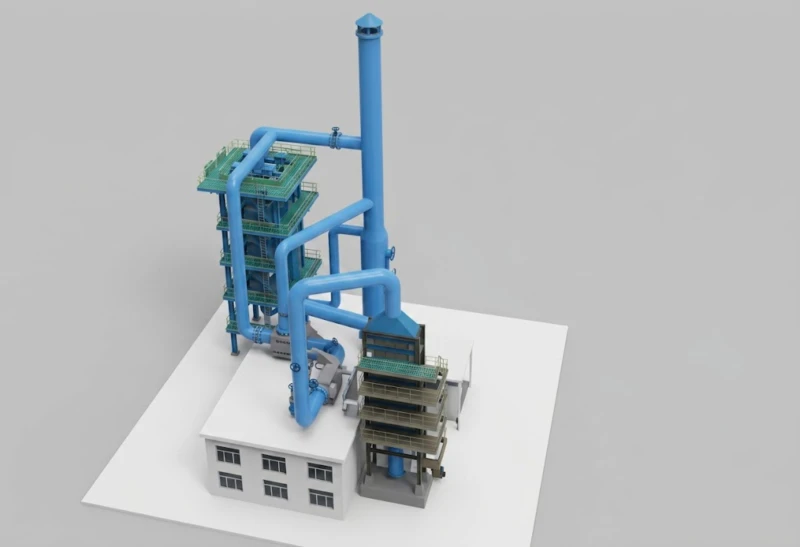
The treatment system is built on the existing oxidation furnace infrastructure, adding a newly constructed SCR denitrification system to the existing ESP + ionic liquid desulfurization + wet ESP equipment combination. The fundamental design insight is that the ionic liquid desulfurization stage requires a deeply pre-cleaned gas stream to function effectively: dust particles in the gas stream absorb and deactivate the ionic liquid absorbent, reducing its capacity for SO₂ capture over time. By placing a comprehensive dry ESP + heat exchanger + bag filter pre-treatment chain upstream of the ionic liquid stage, the gas entering the ionic liquid absorber is reduced to ≤10 mg/Nm³ PM — a level at which the ionic liquid service conditions are adequate and the recirculation lifetime is acceptable.
The second key design decision is the positioning of the SCR reactor downstream of the ionic liquid desulfurization stage. This cold-side SCR configuration is necessary because the ionic liquid desulfurization reduces SO₂ to very low levels before the gas contacts the SCR catalyst, eliminating the risk of ammonium bisulfate deposition on the catalyst that would occur at low temperatures in high-SO₂ gas. By placing the SCR after the ionic liquid FGD, the catalyst operates in a substantially SO₂-free environment at 180–220°C, enabling the low-temperature SCR catalyst to deliver the target 97% denitrification efficiency without the SO₂ poisoning that would occur in a hot-side position upstream of the FGD.
Stage 1: Dry Electrostatic Precipitator (ESP) — Coarse Particulate Pre-Removal
Oxidation furnace off-gas at 180°C first passes through the existing dry electrostatic precipitator (ESP), which removes the bulk of the coarse lead-bearing particulates from the gas stream. This stage protects the downstream heat exchanger from abrasive dust erosion and reduces the PM loading to a level manageable by the heat exchanger and bag filter stages. The ESP operates at high voltage under the corrosive high-O₂ conditions of oxidation furnace off-gas and must be specified with corrosion-resistant electrode materials.
Stage 2: Ceramic Tile Heat Exchanger (220°C → 40°C, then 40°C → 130°C)
The pre-dedusted gas passes through the low-temperature ceramic tile heat exchanger (model HB-565; flue gas volume 40,000 m³/h each side; hot side inlet 220°C, outlet approximately 128°C; cold side inlet 40°C, outlet approximately 130°C; heat exchange area approximately 563 m²; heat load approximately 1,344 kW; design pressure 5 kPa; body material S31603 stainless steel at 0.7 mm wall thickness; pipe flange material S30408; dimensions approximately 3,300×2,200×2,700 mm). The hot gas pre-cools before entering the bag filter, while the cool post-FGD gas is reheated before entering the SCR reactor. This waste heat recovery loop eliminates the need for external gas heating for the SCR, converting what would otherwise be a significant energy cost into a self-contained heat recovery system using the facility’s own waste gas thermal energy.
Stage 3: Bag Filter — Fine Particulate Polishing
After heat exchange cooling, the gas enters the bag filter for fine particulate removal. The bag filter reduces PM to ≤10 mg/Nm³ — the key threshold for ionic liquid desulfurization viability. The PM at the desulfurization stage inlet is reported as 10 mg/Nm³, confirming the bag filter is achieving the target pre-treatment level. The bag filter also provides a secondary capture for any lead-bearing particulates that passed through the ESP stage, ensuring the ionic liquid stage is not exposed to the heavy-metal-bearing dust that would progressively contaminate the ionic liquid absorbent.
.webp)
Stage 4: Ionic Liquid Desulfurization
The pre-cleaned gas at approximately 40°C (cooled by the heat exchanger) enters the ionic liquid desulfurization system. Ionic liquid desulfurization uses a specially formulated ionic liquid absorbent that selectively captures SO₂ from the gas stream through physical absorption. The key advantages over conventional limestone-gypsum FGD for this application are: (1) no solid waste generation — the SO₂-loaded ionic liquid is regenerated and recycled, producing concentrated SO₂ that can be used to manufacture sulfuric acid rather than generating gypsum requiring disposal; (2) no wastewater generation from the FGD process itself; (3) the SO₂ captured can be reconcentrated and sold as a by-product or processed into sulfuric acid, turning a compliance cost into a revenue item; (4) lower reagent consumption since the ionic liquid is recirculated and regenerated rather than consumed stoichiometrically. The desulfurization outlet concentration is ≤35 mg/Nm³ as designed, with actual measured values confirming compliance. The key operational control is pH management of the ionic liquid circulation loop: monitoring the liquid pH and controlling HF (from the oxidation furnace off-gas) and SO₂ loading in the ionic liquid to maintain absorption efficiency and prevent precipitate formation that would block the circulation system.
Stage 5: SCR Denitrification (180–220°C Low-Temperature)
After ionic liquid desulfurization, the clean gas (low SO₂, low PM) is reheated from approximately 40°C to 180–220°C by the ceramic tile heat exchanger using the incoming hot raw gas waste heat. The reheated gas enters the low-temperature SCR denitrification reactor. The SCR system achieves 97% NOx reduction. Key catalyst parameters: catalyst holes 30; element size 150×150 mm (cross-section), 580 mm height; pitch 4.93 mm; hole spacing 4.23 mm; wall thickness 0.70 mm; porosity 70.1%; catalyst specific surface area 678 m²/m³; active component V₂O₅ on TiO₂ carrier (75–85% carrier content); design temperature 220°C; maximum operating temperature 420°C; minimum operating temperature 220°C; single-layer pressure drop ≤135 Pa (clean catalyst); chemical life: 24,000 h from first gas contact; denitrification efficiency ≥96.66% at 16,000 h; SCR inlet catalyst channel velocity 4.33 m/s; theoretical urea consumption 20.38 kg/h; volume space velocity 2,661 h⁻¹. The SCR system is mounted downstream of the ionic liquid stage, exploiting the SO₂-free gas condition to enable low-temperature operation without ammonium sulfate catalyst poisoning. Ammonia water is used as the reducing agent at 0.02 t/h; ammonia slip guarantee ≤5 ppm (actual: 3 ppm).
Stage 6: Wet Electrostatic Precipitator (WESP) — Final Polishing
The post-SCR gas enters the wet electrostatic precipitator for final acid mist and fine particulate polishing before stack discharge. The WESP captures any residual acid aerosol and sub-micron particles not removed by the earlier treatment stages, ensuring the PM outlet target of ≤10 mg/Nm³ is met with adequate compliance margin.
Furnaces
180°C
(existing)
HX Pre-Cool
→40°C
(existing)
FGD (existing)
→180–220°C
97% NOx
(existing)
→ Stack
⭐ New equipment added in this upgrade project
Key Equipment Parameters
| Item | 仕様 |
|---|---|
| Ceramic tile heat exchanger | Model HB-565; 40,000 m³/h; hot side 220→128°C; cold side 40→130°C; 563 m²; 1,344 kW; S31603 body |
| SCR catalyst element | 150×150 mm cross-section; 580 mm H; pore 30; porosity 70.1%; V₂O₅/TiO₂; 220°C design; 24,000 h life |
| SCR denitrification efficiency | 97% actual; ≥96.66% guaranteed at 16,000 h; ≤135 Pa single-layer pressure drop |
| Ammonia water (reductant) | 0.02 t/h; ammonia slip guarantee ≤5 ppm; actual 3 ppm |
| Main induced draft fan | 110 kW; 1 unit (operating) |
| Total installed power | 124.5 kW installed; 123 kW actual running |
| Annual electricity cost (8,000 h) | Approx. 39.36 ten-thousand RMB equivalent (0.4 RMB/kWh) |
| Annual natural gas cost (SCR heating) | 75 m³/h; approx. 192 ten-thousand RMB/year (3.2 RMB/m³) |
| Annual ammonia water cost | Approx. 8 ten-thousand RMB/year (0.02 t/h, 500 RMB/t) |
04 — Core Advantages
Six Reasons Why This Process Architecture Is Optimal for Lead Recycling Oxidation Furnace Off-Gas
- ✓
Deep Upstream Dust Removal Protects the Ionic Liquid and the SCR Catalyst Simultaneously: The fundamental architectural decision in this project is to treat the PM problem thoroughly before the gas contacts either the ionic liquid absorbent or the SCR catalyst. The combined dry ESP + heat exchanger + bag filter chain reduces PM from the raw furnace exit level to ≤10 mg/Nm³ before the ionic liquid stage and to an even lower level before the SCR stage. This deep pre-dedusting serves two purposes: it maintains the ionic liquid recirculation service conditions by preventing particulate contamination of the absorbent, and it protects the SCR catalyst from the accelerated blockage and chemical poisoning that would result from exposure to lead-bearing dust at elevated concentrations. Both benefits contribute directly to system longevity and reduced maintenance frequency. - ✓
Cold-Side SCR After Ionic Liquid FGD Eliminates Ammonium Bisulfate Catalyst Poisoning: Low-temperature SCR at 180–220°C is susceptible to ammonium bisulfate (ABS) deposition when SO₂ is present at the catalyst surface, because ABS formation rate is highest at 180–280°C. By positioning the SCR downstream of the ionic liquid desulfurization stage, the SO₂ concentration at the SCR inlet is reduced from 600–1,500 mg/Nm³ to approximately 35 mg/Nm³ or below. At this low SO₂ concentration, the ABS formation rate is dramatically reduced, enabling the low-temperature SCR catalyst to deliver the 97% denitrification efficiency without the progressive catalyst deactivation from ABS fouling that would occur in a hot-side SCR position upstream of the FGD. - ✓
Ceramic Tile Heat Exchanger Waste Heat Recovery Eliminates External SCR Reheating Cost: The SCR requires its inlet gas to be at 180–220°C for effective catalytic reaction. The post-ionic-liquid-FGD gas exits at approximately 40°C. Without heat recovery, this would require heating 40,000 m³/h of gas from 40°C to 180°C — an energy cost equivalent to approximately 75 m³/h of natural gas. The ceramic tile heat exchanger recovers this energy from the incoming hot raw gas (which must be cooled for the bag filter and ionic liquid stages anyway), converting a coincident energy surplus into the reheating duty at zero incremental fuel cost. The 75 m³/h natural gas consumption is needed to top up the heat exchanger to maintain the SCR inlet temperature, but this is far less than would be required without the heat recovery system. - ✓
Ionic Liquid Desulfurization Generates No Gypsum Waste and Enables SO₂ by-Product Recovery: Unlike limestone-gypsum FGD (which generates gypsum as a solid by-product requiring handling and disposal or sale), ionic liquid desulfurization regenerates the absorbent and concentrates the captured SO₂ as a recoverable product stream. In the lead recycling industry context, the recovered concentrated SO₂ can be processed into sulfuric acid for reuse in battery manufacturing or industrial chemical production, creating a circular economy loop that turns a compliance cost into a revenue-generating by-product. The absence of gypsum also eliminates the dewatering, storage, and logistics infrastructure that wet FGD requires. - ✓
Upgrade of Existing Infrastructure Minimises Capital Cost and Site Disruption: The project adds the ceramic tile heat exchanger and the SCR denitrification system to the facility’s existing ESP, bag filter, ionic liquid desulfurization, and wet ESP equipment combination. By building on the existing infrastructure rather than designing a complete new treatment system, the capital cost of the upgrade is limited to the new components only (heat exchanger and SCR reactor), while the compliance benefit covers all regulated parameters. This approach is directly applicable to any facility where conventional emission control equipment is already in place but NOx compliance cannot be achieved without an additional denitrification stage. - ✓
24,000-Hour SCR Catalyst Chemical Life Covers Three Years of Continuous Operation: The SCR catalyst chemical life guarantee of 24,000 hours from first gas contact, combined with the 16,000-hour ≥96.66% efficiency guarantee, means the catalyst can operate for approximately 3 years of 8,000-h/year operation before chemical life is reached. The V₂O₅/TiO₂ low-temperature catalyst formulation used in this installation is specifically designed for the SO₂-depleted, high-O₂ environment of the post-ionic-liquid-FGD gas stream. Single-layer pressure drop is guaranteed at ≤135 Pa (clean catalyst), enabling the SCR system to operate within the existing induced draft fan capacity without requiring fan upgrades.
05 — Operational Results
Verified Compliance Data: All Parameters at or Below Permit Limits
.webp)
Annual operating costs: electricity at 123 kW actual running power (0.4 RMB/kWh, 8,000 h/year) = approximately 39.36 ten-thousand RMB equivalent; natural gas for SCR reheating at 75 m³/h (3.2 RMB/m³, 8,000 h) = approximately 192 ten-thousand RMB equivalent; ammonia water at 0.02 t/h (500 RMB/t, 8,000 h) = approximately 8 ten-thousand RMB equivalent. Natural gas for SCR temperature maintenance is the dominant operating cost item, reinforcing the value of the ceramic tile heat exchanger in reducing the supplementary heating requirement.
06 — Implementation Cautions
Critical Engineering and Operational Lessons for Lead Recycling Off-Gas Treatment
- ⚠️
Poor upstream dust removal causes downstream ionic liquid desulfurization efficiency to decline — add PM concentration monitoring at the system inlet and respond immediately when efficiency falls: The primary documented risk is that poor upstream (pre-treatment) dust removal causes the ionic liquid desulfurization efficiency to decrease. Lead-bearing and other particulates from the oxidation furnace are absorbed into the ionic liquid circulation loop, progressively contaminating the absorbent and reducing its SO₂ absorption capacity. Install a continuous PM concentration monitor at the inlet to the ionic liquid stage. When inlet PM rises above the design threshold (≤10 mg/Nm³), initiate immediate investigation of the upstream ESP and bag filter performance. If dust removal efficiency has fallen, address the cause before the ionic liquid system’s SO₂ capture capacity is impaired. Upgrade the desulfurization system capacity if the ionic liquid SO₂ loading cannot be maintained within acceptable limits, using a higher-capacity absorbent or an enhanced regeneration rate. - ⚠️
SCR denitrification front-end SO₂ concentration not controlled at a rational level increases the probability of ammonium sulfate generation and catalyst blockage: Even after the ionic liquid desulfurization, some residual SO₂ (≤35 mg/Nm³ at design) reaches the SCR catalyst. At 180–220°C operating temperature, ammonium bisulfate (ABS) can still form if the SO₂ concentration at the catalyst surface is higher than expected — for example, if the ionic liquid desulfurization efficiency falls below design levels during an absorbent contamination event. Monitor the SCR system pressure drop continuously. If pressure drop rises beyond the design value (indicating ABS or dust deposition), raise the SCR inlet temperature above 280°C to volatilise the ABS deposits. If the pressure drop cannot be reduced by cleaning to acceptable levels at normal operation, conduct thermal analysis of the catalyst bed to determine whether irreversible contamination has occurred. - ⚠️
SCR denitrification temperature control instability makes it difficult to guarantee denitrification efficiency — always monitor the denitrification inlet temperature and stop ammonia injection if temperature falls below the design minimum: The third documented risk is that unstable temperature control at the SCR denitrification system inlet makes it difficult to guarantee denitrification efficiency. The SCR catalyst operates within a specific temperature window (220–420°C design range; minimum 220°C). If the ceramic tile heat exchanger performance degrades (from fouling), or if the supplementary natural gas heating system malfunctions, the SCR inlet temperature can fall below the 220°C minimum. Below this temperature, the catalyst activity is insufficient and unreacted ammonia creates ammonium salt deposits rather than reducing NOx. Install a continuous temperature monitor at the SCR inlet with an automatic ammonia injection cut-off interlock at 210°C (10°C below the minimum design temperature). Continuing ammonia injection at sub-minimum temperature wastes reagent, causes ammonia slip exceedances, and deposits ammonium salts in the catalyst channels. - ⚠️
The ceramic tile heat exchanger is the system’s most corrosion-sensitive component — avoid the problems of plate replacement, leakage, and corrosion velocity with the right material grade and gas velocity: The heat exchanger processes raw furnace gas (high SO₂, high O₂, high PM, lead-bearing particulates) on the hot side and clean post-FGD gas on the cold side. This creates a demanding dual-corrosion environment. Selecting the appropriate heat exchanger material grade (S31603 specified for this installation), setting the gas velocity within the design range to minimise erosion-corrosion from residual dust, and optimising the duct channel geometry to reduce sludge deposition rate are the key design disciplines. Periodic inspection of the heat exchanger tube surfaces (at least annually from year 2 onward) for wall thickness reduction should be included in the planned maintenance schedule. - ⚠️
Lead-bearing particulates from the oxidation furnace must be managed as hazardous waste at every solid waste collection point in the treatment system: Lead is a hazardous substance under EU REACH regulation and the Hazardous Waste Directive at any concentration above the relevant threshold. Solid waste collected at the ESP hopper, the bag filter hoppers, and the wet ESP collection sump all contain lead-bearing particulates at concentrations that will typically classify the waste as hazardous. Each solid waste stream must be individually characterized by TCLP leachate testing (EN 12457) before any disposal route is confirmed, and transfer must be accompanied by a Hazardous Waste Consignment Note under Dutch hazardous waste transport regulations. The ionic liquid contaminated with lead particulates must similarly be characterized when it is eventually replaced at end-of-life, as it will contain absorbed lead compounds. - ⚠️
Increase supplementary heating (natural gas) if SCR inlet temperature is below the 220°C minimum — and vent through sidelining during start-up and shutdown to prevent catalyst exposure to cold high-humidity gas: During start-up and shutdown of the oxidation furnaces, the off-gas composition and temperature will be outside normal operating parameters. Wet or low-temperature gas containing high moisture content should be bypassed around the SCR reactor during these transient periods: moisture condensation on the catalyst at sub-minimum temperatures can cause irreversible catalyst damage. Ensure the sidelining bypass duct and valve are functional before commissioning and include the start-up bypass procedure in the operator training programme.
07 — Engineering Takeaways
Four Lessons from This Lead Recycling Off-Gas Treatment Project
- 1
The sequence of treatment stages determines whether each technology performs at its rated efficiency — sequence matters more than individual equipment specification. In this project, the SCR achieves 97% denitrification not because of an exceptionally high-specification catalyst, but because the treatment sequence (deep PM removal before ionic liquid FGD, ionic liquid FGD before SCR) delivers the SCR a clean, low-SO₂ gas stream at the correct temperature. The same catalyst in a different position — for example, upstream of the ionic liquid FGD in a high-SO₂ gas stream — would fail within months due to ABS fouling. Treatment system architecture (sequence, temperature, gas conditions at each stage inlet) is the primary engineering design decision for complex multi-pollutant applications. - 2
Ionic liquid desulfurization is a superior alternative to limestone-gypsum FGD for lead recycling off-gas applications specifically because it generates no solid or liquid waste streams from the FGD process itself. In a facility already managing lead-contaminated solid waste from the ESP and bag filter, adding a limestone-gypsum FGD stage would generate a further stream of potentially lead-contaminated gypsum requiring hazardous waste classification and disposal. The ionic liquid process avoids this additional waste stream and simultaneously produces a recoverable concentrated SO₂ by-product with commercial value. For any lead, zinc, or other heavy-metal-bearing off-gas application where the FGD waste stream would be classified as hazardous, ionic liquid desulfurization should be evaluated as the primary desulfurization technology before limestone-gypsum FGD is specified. - 3
Waste heat recovery through the ceramic tile heat exchanger converts an energy liability into the primary heating source for the SCR reactor. The raw hot off-gas (220°C) must be cooled before the bag filter and ionic liquid stages; the post-FGD gas (40°C) must be reheated before the SCR. These two temperature management duties are directly complementary: the heat extracted from the hot side is exactly what is needed on the cold side. The ceramic tile heat exchanger exploits this thermal complementarity, eliminating the need for a steam or electric gas heater that would add approximately 192 ten-thousand RMB per year in energy cost. This is the largest single operating cost saving in the project and demonstrates that waste heat identification and recovery should be an explicit step in the system design process, not an afterthought. - 4
Upgrading existing infrastructure by adding the two new components (heat exchanger and SCR) delivers full NOx compliance at a fraction of the cost of a complete system replacement. This project demonstrates the value of accurate existing equipment inventory and capability assessment before any compliance upgrade design begins. The existing ESP, bag filter, ionic liquid FGD, and wet ESP were all confirmed as capable of meeting their individual performance targets within the upgrade system architecture. Only the heat exchanger (providing temperature management for SCR operation) and the SCR reactor itself were new additions. The capital cost ratio of this incremental upgrade to a complete new system replacement would typically be in the range of 15–25% — a compelling argument for existing infrastructure assessment before any greenfield treatment system is specified.
08 — Frequently Asked Questions
Lead-Acid Battery Recycling Off-Gas Treatment: Ten Questions Answered
Questions from environmental permit managers, process engineers, and HSE teams at secondary lead production, aluminium alloy recycling, and solid waste resource recovery facilities planning SCR denitrification and ionic liquid desulfurization upgrades under EU IED / Dutch Activities Decree requirements.
Ready to Achieve Ultra-Low Emission Compliance for Your Recycling Facility?
Explore the Full Range of Industrial Emission Control Solutions
From ionic liquid desulfurization and low-temperature SCR for lead-acid battery recycling facilities to regenerative thermal oxidation systems for industrial VOC abatement, our engineering team delivers EU IED–compliant solutions for the most demanding non-ferrous metal recycling emission control requirements.