In the modern era of ultra-low emission standards, industrial operators are seeking desulfurization solutions that balance extreme chemical efficiency with operational simplicity. For facilities dealing with flue gas volumes up to 1,000,000 cubic meters per hour, the Single Alkali process (sodium-based method) has established itself as the premier choice. Unlike traditional calcium systems that are prone to mechanical scaling and clogging, the sodium alkali method utilizes the hyper-reactivity of NaOH or Na2CO3 to neutralize SO2 in the liquid phase. This technical deep-dive explores how the BAOLAN BL-Series integrates advanced fluid dynamics and material science to drive outlet emissions below 35 mg/Nm3, even when faced with high-sulfur and complex gas compositions.
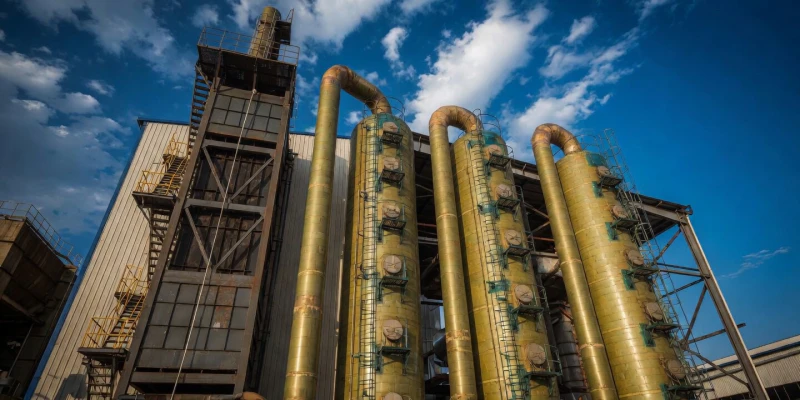
Industrial-Scale Deployment of the BL-Series Desulfurization Complex
1. Strategic Scenarios: Conquering Space and Complexity
Single Alkali Desulfurization is not a “one-size-fits-all” filter; it is a precision instrument designed for specific industrial pain points. It is predominantly selected for medium and small-sized units where physical site constraints prevent the installation of massive gypsum-dewatering complexes. Because sodium-based absorbents are highly soluble, the absorber tower can be engineered with a much higher liquid-to-gas ratio in a more compact vessel.
Targeted Industrial Benefits
This process is ideal for handling high-sulfur flue gas or gas with fluctuating, complex compositions common in the coking, metallurgy, and chemical sectors. Key technical parameters include the ability to tolerate inlet temperatures up to 180°C and a shell design pressure that withstands extreme fluctuations (-6000 to +6000 Pa). Most importantly, for enterprises seeking to circularize their waste, the single alkali method facilitates by-product recovery, such as sodium sulfate, which can be reclaimed as a valuable industrial chemical.
By maintaining a stable operating resistance of 800-1300 Pa, the system minimizes the electrical load on the primary induced draft fans, ensuring that environmental compliance does not come at the cost of excessive energy consumption.
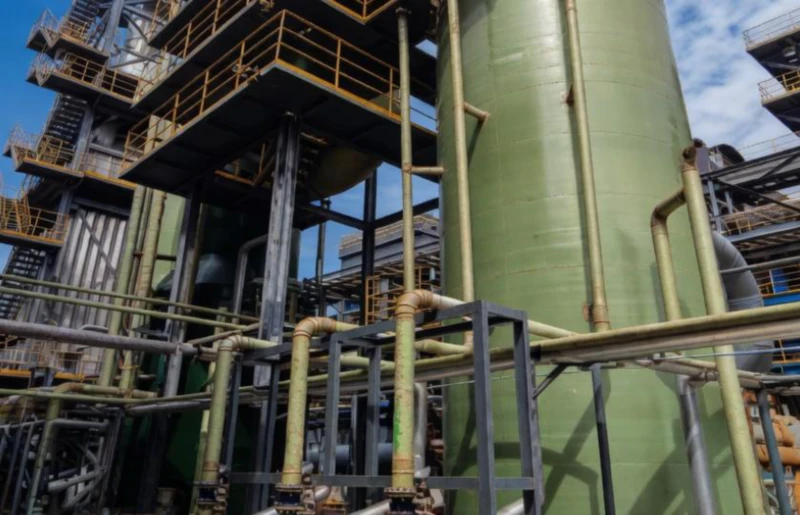
Fig 2: Vertical Integration of a Single Alkali Scrubber in a Space-Constrained Project
2. The Molecular Mechanism: High-Speed Liquid-Phase Capture
The Process Dynamics
The core of the Single Alkali method is the instant neutralization that occurs when SO2 molecules collide with atomized NaOH droplets. In the absorption zone, SO2 first reacts with water to form sulfurous acid (H2SO3), which is immediately neutralized by NaOH to form sodium sulfite (Na2SO3). In high-load scenarios, this sodium sulfite further reacts with excess SO2 to form sodium bisulfite (NaHSO3), providing a robust chemical buffer that prevents sulfur “breakthrough.”
Because the resulting sodium salts are highly soluble in water, the system operates as a “Scale-Free” environment. This eliminates the catastrophic plugging of spray nozzles and internal tower packing that often plagues calcium-based systems, ensuring 99%+ availability and zero unplanned maintenance for scale removal.
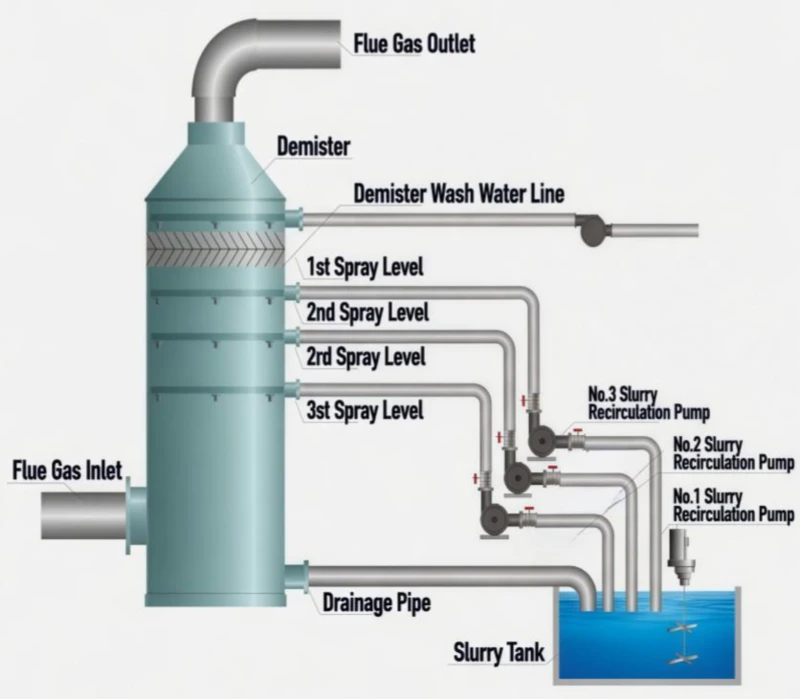
Fig 3: Holistic Process Topology from Inlet Scrubbing to Circulation Recycling
3. Core Subsystems: Engineering for Longevity
The Agitator: Preventing Sedimentation
The absorber agitator is a critical component of the slurry tank zone. To maintain the uniformity of the desulfurization agent and prevent the settling of absorbed dust and reaction products, BAOLAN utilizes side-entry agitators. These units are designed to operate 24/7 in a highly corrosive and abrasive liquid environment. By creating intense mechanical turbulence, the agitator ensures that the slurry remains a homogeneous mixture, facilitating efficient pumping and guaranteeing that the oxidation reactions (converting sulfites to stable sulfates) proceed to completion.
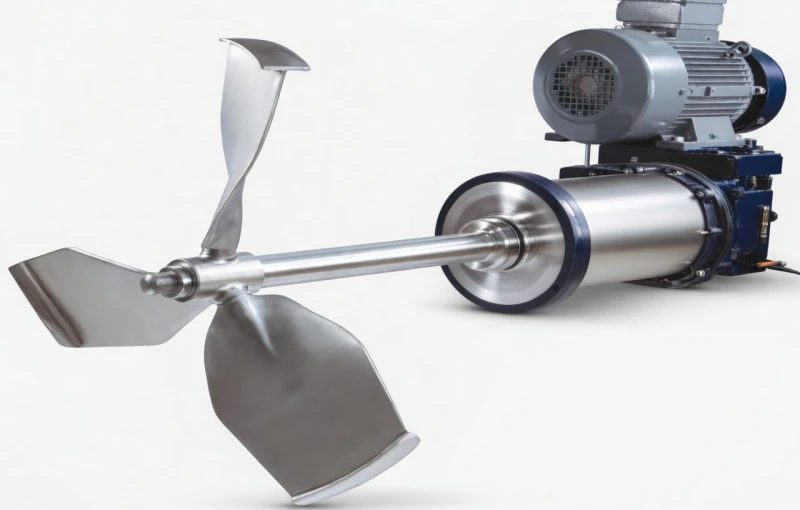
Heavy-Duty Side-Entry Agitator Module
The Demister: Protecting the Stack
The final stage of the tower is the two-stage demisting system. As the purified gas ascends, it carries microscopic liquid droplets that are heavily laden with dissolved salts. If released, these droplets cause downstream duct corrosion and plume opacity. The demister utilizes corrugated blades to force the gas stream to change direction rapidly and repeatedly. While the gas easily navigates these turns, the heavier liquid droplets collide with the blades due to inertia, coalesce into larger sheets, and fall back into the reaction pool.
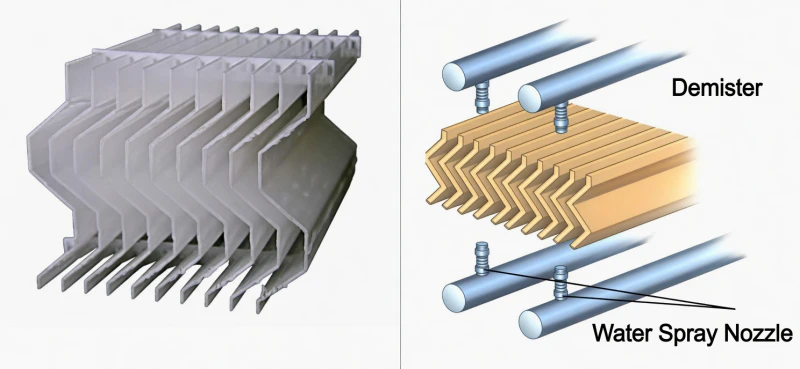
High-Efficiency Corrugated Plate Demister Module
Operational Verdict: Safety Meets Sustainability
The BL-Series Single Alkali Desulfurization system represents a mature, internationally advanced technology benchmark. By integrating R&D, precision manufacturing, and intelligent commissioning, BAOLAN ensures that every tower body—fabricated from heavy carbon steel with a specialized glass flake anti-corrosion lining—delivers decades of reliable service. The unit-system pump configuration (one pump per spray layer) ensures redundant spray coverage, maximizing the desulfurizing agent’s efficacy and ensuring that fluctuations in production load never compromise environmental safety.
By adhering to ISO9001 quality management and leveraging state-of-the-art material science, industrial facilities can now achieve “Near-Zero” emission standards. Whether you are treating high-dust flue gas or sulfur-intensive chemical exhaust, the Single Alkali process offers the most robust, low-maintenance, and economically viable pathway to sustainable industrial growth.
Architect Your Compliance Strategy Today
Don’t let complex flue gas profiles or high sulfur loads threaten your operational permit. Implement the power of Single Alkali Desulfurization to ensure safe, stable, and economically superior flue gas purification. Contact BAOLAN EP INC. today to design a bespoke desulfurization facility custom-tailored to your facility’s exact solvent profile and sustainability goals.