
Case Study · VOC Abatement
How one of the world’s largest dry cargo container manufacturers achieved >97% VOC removal from 400,000 m³/h of spray painting and drying off-gas — combining zeolite molecular sieve rotary concentrators (40× concentration ratio) with a three-bed RTO to overcome the core challenge of large-volume low-concentration coating VOC: making thermal oxidation economically viable through concentration, while achieving fully autothermal RTO operation at zero natural gas cost during normal production.
Zeolite Concentrator
Three-Bed RTO
Container Manufacturing
Zero Fuel at Full Load
01 — Industry Background
Coating Industry VOC: The Large-Volume Low-Concentration Problem That Makes Direct RTO Economically Unviable
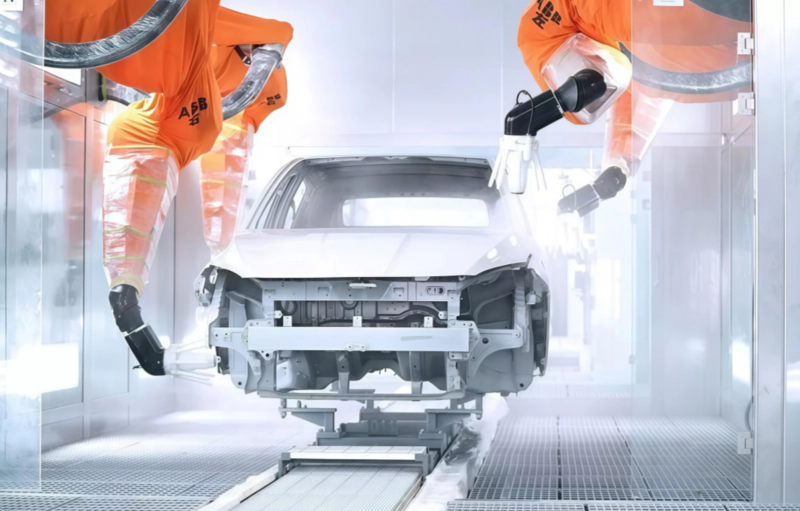
The coating and painting industry encompasses surface protection and decoration applied across automotive manufacturing, container and transport equipment production, industrial equipment coating, furniture finishing, and consumer goods painting. Coating operations generate VOC emissions during the spray application, flow coating, and oven drying stages: organic solvents in the paint formulation (esters, alcohols, ketones, aromatic hydrocarbons, glycol ethers) evaporate during application and drying, producing large volumes of dilute VOC-laden air that must be captured and treated before discharge.
The fundamental challenge of coating industry VOC treatment is the combination of:
- Very large gas volumes: Spray painting enclosures and drying ovens require high dilution airflows to maintain safe working concentrations below the LEL, producing large volumes of exhaust air at low VOC concentration. This installation generates 400,000 m³/h — equivalent to the entire air volume of a large sports stadium being processed every 36 seconds.
- Low VOC concentration: The inlet NMHC is only 300–1,200 mg/Nm³ — far below the autothermal threshold for a direct RTO. At this concentration, a direct RTO would consume large volumes of natural gas supplementary fuel continuously to maintain the 760°C combustion temperature, making operating costs prohibitive.
- High variability: Paint product type, colour changes, line speed, and box size all affect the VOC concentration in the exhaust air. The treatment system must maintain >97% efficiency across the full range of operating conditions.
The enterprise in this case study is a global leader in dry cargo container manufacturing, occupying a 680-acre (approximately 4.5 km²) production site. Its production lines cover 20–53 ft dry goods container manufacturing, refrigerated container manufacturing, and specialised containers, with annual production capacity of 2.6 million TEU (twenty-foot equivalent units). Annual revenue is approximately 4.6 billion RMB with annual profit of approximately 300 million RMB and 2,500 employees. Container manufacturing involves extensive spray painting operations (primer, intermediate coats, and topcoats applied both internally and externally to steel container structures), generating the large-volume low-concentration VOC stream that this treatment system addresses.
02 — Pollution Profile
Spray Painting and Drying Off-Gas: 400,000 m³/h at 300–1,200 mg/Nm³ NMHC, With Paint Overspray Mist Requiring Pre-Treatment
The off-gas originates from spray painting enclosures (where liquid paint is atomised and applied to container surfaces) and associated drying ovens. The standard flue gas volume is 360,396 Nm³/h; the industrial process volume is 400,000 Nm³/h at 30°C. Fan power is 630 kW; fan pressure 4,000 Pa; main duct diameter φ3,100 mm. O₂ content: 21% (ambient air with solvent vapour). Humidity: 70%.
The VOC mixture reflects the diverse paint formulations used across multiple production lines: ethyl acetate, isopropanol, butyl acetate, methyl ethyl ketone (MEK), methyl isobutyl ketone (MIBK), ethylene glycol monobutyl ether, dimethyl benzene (xylene), toluene, methanol, isopropanol, ethyl glycol acetate, diacetone alcohol, and fragrance-type solvents. Benzene-series compounds (toluene, xylene) are present at 100 mg/Nm³ in the raw gas.
A critical distinguishing feature is the presence of paint overspray mist in the exhaust air from spray painting booths. Paint overspray consists of fine droplets of solvent-borne or water-borne paint that did not adhere to the container surface. These droplets carry pigment particles, resin solids, and paint additives. If paint overspray reaches the zeolite molecular sieve rotor or the RTO ceramic heat storage beds without pre-removal, the resin and pigment components will deposit in the adsorption channels, permanently blocking them and rapidly degrading system performance. Pre-treatment of the overspray is therefore an essential first stage before any concentration or oxidation system.
| Parameter | Initial Concentration | Outlet (Actual) | EU IED / NER Limit |
|---|---|---|---|
| NMHC (total VOCs) | 300–1,200 mg/Nm³ | ≤20 mg/Nm³ | IED 2010/75/EU ≤70 mg/Nm³ |
| Benzene | Present in mixture | ≤0.5 mg/Nm³ | IED ≤1 mg/Nm³ |
| Toluene | 100 mg/Nm³ (benzene-series) | ≤5 mg/Nm³ | IED ≤5 mg/Nm³ |
| Xylene | Present | ≤15 mg/Nm³ | IED ≤20 mg/Nm³ |
| Standard gas volume | 360,396 Nm³/h | — | — |
| Process gas volume | 400,000 Nm³/h at 30°C | — | — |
| Humidity | 70% | — | — |
| Paint overspray mist | Present; must be pre-removed | Removed by pre-treatment chain | — |
| Annual VOC reduction | ~432 t/year | Verified | — |
03 — Treatment Solution
Four-Stage Chain: Pre-Treatment → Zeolite Concentrator (40×) → Three-Bed RTO → Discharge
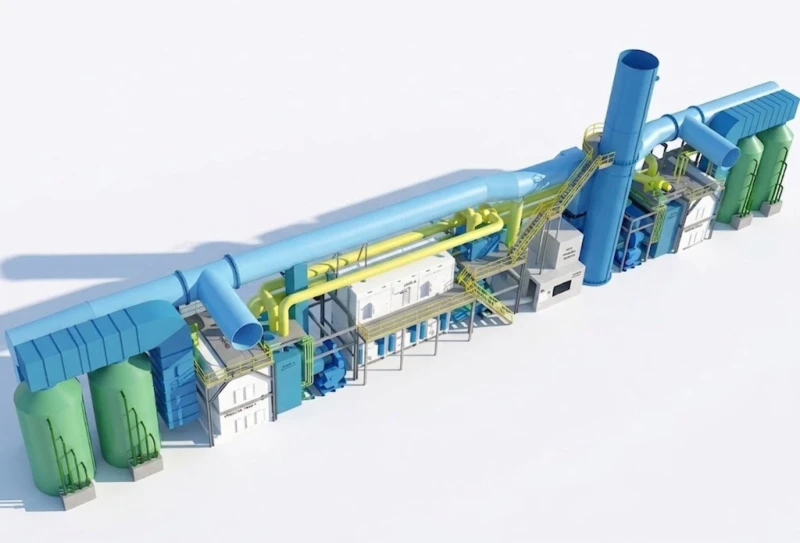
The treatment system solves the large-volume low-concentration problem by using the zeolite concentrator as an intermediate stage between the large-volume low-concentration raw gas and the small-volume high-concentration gas that the RTO handles efficiently. The concentrator takes 400,000 m³/h in and outputs approximately 20,000 m³/h to the RTO — a 20:1 volume reduction at approximately 40:1 concentration increase. The RTO then handles a much smaller, much richer gas stream that is above the autothermal threshold, eliminating natural gas fuel cost at normal production loads.
Stage 1: Pre-Treatment (Paint Overspray Removal)
The raw exhaust air from spray painting booths passes first through a pipe-flow spray wash stage and a four-stage dry filter (G4 → F5 → F9 → H10 progressive filtration, using bag-type filters of 595×595×600 mm, rated to 350°C structural temperature). This pre-treatment removes paint overspray droplets and airborne particulates before the gas contacts the zeolite rotor. The four-stage progressive filtration is a key design feature: it extends the service life of the final H10 HEPA-equivalent filter by protecting it from the high loading that would occur without upstream stages. Front-end self-cleaning continuous filters reduce the frequency of downstream filter replacement; paint filtration within the recirculation loop settles paint deposits and improves water loop quality. The pre-treatment also removes water-borne paint aerosol, protecting the zeolite rotor from moisture-related channel blockage.
Stage 2: Zeolite Molecular Sieve Concentrator (180,000×2 m³/h; 40× Concentration)
The pre-cleaned exhaust air enters the zeolite molecular sieve rotary concentrators (two units, each 180,000 m³/h). The zeolite rotor continuously rotates through three functional zones: (1) adsorption zone (large sector, processing the full inlet gas volume): VOCs adsorb onto the hydrophobic zeolite channels; clean air exits and is discharged; (2) desorption zone (small sector, approximately 1/20 to 1/40 of the rotor area, corresponding to the 40× concentration ratio): a small volume of hot recirculation air (approximately 200°C, heated by heat exchange with the RTO outlet) strips the adsorbed VOCs from the zeolite, producing a small-volume high-concentration gas stream; (3) cooling zone (small sector): the just-regenerated zeolite section is cooled by ambient air before returning to the adsorption zone, restoring its adsorption capacity.
The concentration mechanism: inlet area S₁ = adsorption sector; desorption area S₂ = desorption sector. Concentration factor n = (S₁ × V₁)/(S₂ × V₂) = 40, where V₁ = inlet face velocity and V₂ = desorption face velocity (approximately 0.6–2). The concentrated stream exits at approximately 5 g/m³ NMHC — the RTO inlet concentration.
Zeolite rotor key parameters: two units; each 180,000 m³/h; inlet temperature ≤40°C; inlet VOC (NMHC) <500 mg/m³; concentration ratio 40×; desorption outlet temperature ≤50°C; rotation speed 6 r/h; body material carbon steel ≥2 mm; inlet/outlet direction horizontal; electrical protection rating IP55; no explosion-proof requirement (non-hazardous zone).
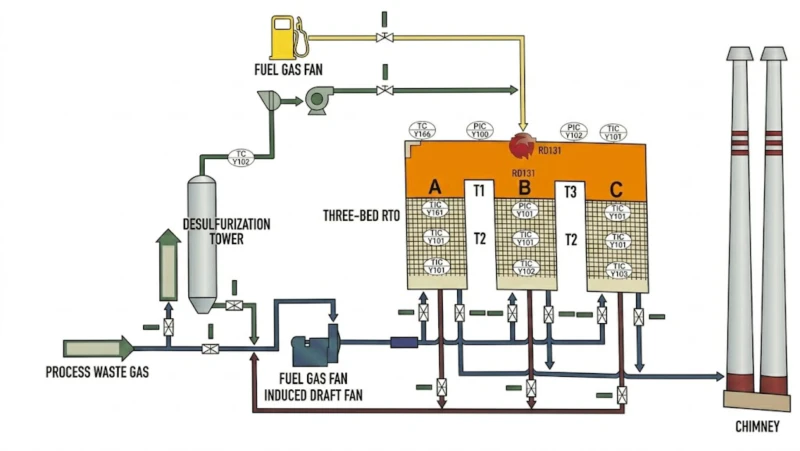
Stage 3: Three-Bed RTO (Model 3TRTO-20K; 20,000 m³/h)
The concentrated 20,000 m³/h gas stream (approximately 5 g/m³ NMHC) enters the three-bed RTO. At this concentration, the VOC combustion heat is sufficient to maintain the 800°C combustion chamber temperature without supplementary natural gas during normal production. RTO key parameters: model 3TRTO-20K; design flow 20,000 m³/h; inlet temperature 50–80°C; VOC removal ≥99%; ceramic heat storage thermal efficiency 95%; oxidation temperature 800°C; residence time ≥1.2 s; combustion chamber exit approximately 100°C (varies with VOC concentration); system pressure drop approximately 2,500 Pa; combustor rating 800,000 kcal/h; cold start natural gas 109 m³ (average); startup time 1–2 h; idle operation approximately 80 m³ natural gas; 50% load operation 0 m³/h natural gas (at VOC >5 g/m³); 100% load operation 0 m³/h natural gas (at VOC >5 g/m³).
The three-bed valve switching sequence follows the standard A-inlet/B-outlet/C-purge rotation. The RTO outlet hot gas is routed through a heat exchanger to provide the approximately 200°C hot air for zeolite rotor desorption, coupling the two systems thermally.
Process Flow Summary
Booths + Ovens
400,000 m³/h
+4-Stage
Dry Filters
180,000 m³/h
40× conc.
20,000 m³/h
800°C; 0 gas
≤20 mg/Nm³
>97%
⭐ Equipment installed or specified in this project
Key Parameters Summary
| Item | Specification |
|---|---|
| Total system gas volume | 400,000 Nm³/h (pre-zeolite); 20,000 m³/h (RTO) |
| Zeolite rotors | 2 units; 180,000 m³/h each; 40× concentration; 6 r/h rotation |
| RTO model | 3TRTO-20K; 20,000 m³/h; 800°C; 95% thermal recovery; ≥99% VOC |
| Total electrical power | 1,173.6 kW installed; 938 kW actual (IDF fans + adsorption fans + RTO) |
| Natural gas (at >50% load) | 0 m³/h (fully autothermal when VOC concentration >5 g/m³ at RTO inlet) |
| Natural gas (idle) | ~80 m³ (idle running) |
| Annual operating hours | 3,200 h/year |
| Annual electricity cost | 2.4 million RMB (938 kW at 0.8 RMB/kWh, 3,200 h) |
| Annual natural gas cost | zero RMB (fully autothermal during production) |
| Annual compressed air cost | 80,000 RMB (10 m³/h at 0.2 RMB/m³) |
| Total annual operating cost | 2480,000 RMB/year (electricity dominant; zero fuel) |
| Annual VOC reduction | ~432 t/year |
04 — Core Advantages
Five Reasons Why Zeolite Concentrator + RTO Is Optimal for Large-Volume Low-Concentration Coating VOC
- ✓
40× Concentration Converts Economically Unviable Direct RTO Into Fully Autothermal Operation: At the raw gas concentration of 300–1,200 mg/Nm³, a direct RTO on the full 400,000 m³/h stream would consume enormous natural gas quantities to maintain 800°C. The autothermal concentration threshold for a standard RTO is approximately 2,500–3,000 mg/Nm³. After 40× concentration by the zeolite rotor, the RTO inlet concentration is approximately 5,000 mg/Nm³ — above the autothermal threshold. This is why the 100% load natural gas consumption is 0 m³/h: the concentrated VOC chemistry provides all the heat needed to maintain 800°C. The zeolite concentrator converts the large-volume low-concentration problem from “economically unviable” to “self-sustaining fuel-free operation.” - ✓
Zeolite Adsorbent Is Superior to Activated Carbon for Coating Industry Applications in Every Performance Dimension: The comparison documented explicitly: (1) service life: zeolite 3–5 years vs activated carbon approximately 1–3 months; (2) no fire hazard: zeolite is an inorganic material with no self-ignition risk; activated carbon is organic and has fire risks at elevated temperature; (3) high-boiling-point solvent handling: zeolite can desorb at 100°C maximum, but cannot handle high-boiling solvents that adsorb too strongly; this is less of an issue for typical coating solvent mixtures (esters, ketones, alcohols) where boiling points are generally below 150°C; (4) no hazardous waste generation: replaced zeolite is not classified as hazardous waste; replaced activated carbon may be; (5) desorption completeness: zeolite desorbs more completely, maintaining consistent adsorption capacity between cycles. - ✓
Four-Stage Dry Filtration Pre-Treatment Extends Zeolite Rotor Service Life and Reduces Long-Term Maintenance Cost: The G4→F5→F9→H10 progressive dry filter sequence removes progressively finer paint particles and overspray droplets from the raw gas before it contacts the zeolite rotor. This pre-treatment investment directly extends zeolite rotor service life (from approximately 1–2 years to 3–5 years) by preventing paint resin and pigment deposition in the zeolite adsorption channels. The filter is also equipped with continuous self-cleaning capability and recirculation loop sedimentation, which reduces maintenance frequency and improves water quality in the wet pre-treatment loop. - ✓
Variable-Frequency Drive (VFD) on the Suction Fans Matches Treatment Capacity to Actual VOC Load in Real Time: The suction fans on the zeolite rotor system are equipped with variable-frequency drives. The DCS monitors VOC inlet concentration to the RTO and adjusts the suction fan speed to control the concentration entering the RTO at the optimal level for autothermal operation. When VOC concentration is higher than needed for autothermal RTO, the fan speed is reduced, passing less concentrated gas through the desorption zone per unit time and maintaining the RTO inlet at the target concentration. This VFD control converts the highly variable VOC concentration of coating production (driven by paint type, colour change, and line speed) from an operational challenge into a managed operating variable. - ✓
PLC-Controlled System With Flow-Chart-Driven Logic Enables Unattended Dual-Adsorber Operation: The RTO system uses PLC control with a dedicated flow diagram display. The dual-adsorber configuration operates automatically, with the DCS controlling adsorber switching, steam regeneration timing, and temperature management without requiring continuous on-site operator supervision. Data can be retrieved remotely from the DCS central control room, and the system’s automatic control is designed to keep operation at the optimal DCS set-points regardless of inlet concentration variations, maximising VOC removal efficiency while minimising natural gas consumption.
05 — Operational Results
Verified Performance: VOCs Online at ≤20 mg/Nm³, 432 t/yr Reduction, Zero Natural Gas Cost
After commissioning, the online VOC monitoring data consistently reads below 20 mg/Nm³ NMHC at the stack, satisfying the applicable local permit requirement of 70 mg/Nm³ with a large compliance margin. Annual VOC reduction is 432 t/year. Total annual operating cost is approximately 2.4 million RMB, consisting entirely of electricity for the IDF fans, adsorption fans, and RTO fan. Natural gas cost is zero during production operation at both 50% and 100% load when VOC concentration at the RTO inlet exceeds 5 g/m³ — which is the normal production condition with the 40× concentrator.
06 — Implementation Cautions
Critical Engineering and Operational Lessons for Coating Industry Zeolite + RTO Systems
- ⚠️
Paint overspray pre-treatment quality directly determines zeolite rotor service life — do not accept a simplified pre-treatment design to reduce capital cost: The four-stage dry filter (G4→F5→F9→H10) is not over-specification; it is the correct specification for protecting the zeolite rotor from paint resin deposition. If the final-stage H10 filter becomes overloaded because the upstream G4/F5/F9 stages are undersized, the H10 will require very frequent replacement, and paint particles will progressively deposit in the zeolite rotor channels. Zeolite rotor channel blockage is progressive and eventually irreversible without chemical cleaning; in the worst case, blocked zeolite requires full rotor replacement at high cost. The pre-treatment capital investment pays for itself through extended zeolite service life within the first 18–24 months of operation. - ⚠️
Gas volume is large (400,000 m³/h) and VOC concentration is variable — the VFD fan control and online concentration monitoring are essential for maintaining autothermal RTO operation: The autothermal operation of the RTO (zero natural gas at load) depends on the RTO inlet concentration being maintained above approximately 5 g/m³. If the zeolite desorption air volume or temperature is not correctly managed, the RTO inlet concentration may fall below this threshold, requiring supplementary natural gas. The VFD control on the suction fans is the primary tool for maintaining the correct concentration. Install continuous VOC concentration monitoring at the RTO inlet (not just the stack) as an operational control instrument, and set appropriate alarm thresholds for the VFD control system. - ⚠️
The zeolite rotor desorption zone hot air temperature (~200°C) must be maintained within specification — if RTO outlet temperature falls, desorption completeness is reduced and breakthrough occurs: The zeolite rotor desorption zone relies on hot air at approximately 200°C (supplied from the RTO outlet via the heat exchanger) to strip VOCs from the zeolite channels. If the RTO combustion chamber temperature falls (for example, during low-VOC periods when the inlet concentration drops below the autothermal threshold), the RTO outlet temperature also falls, reducing the desorption zone temperature below the minimum for effective regeneration. When this occurs, adsorbed VOCs are not completely removed from the zeolite during the desorption cycle, reducing the effective adsorption capacity of that rotor section in the next adsorption cycle. Monitor desorption zone inlet temperature continuously and trigger supplementary natural gas ignition whenever it falls below 180°C. - ⚠️
Water-borne paint overspray requires different pre-treatment management than solvent-borne paint: As container manufacturing transitions from solvent-borne to water-borne paint systems (driven by regulatory and supply chain requirements), the paint overspray characteristics change. Water-borne paint overspray contains more water, less solvent, and different resin chemistry. The pre-treatment wet spray wash and dry filter system must be reviewed when paint formulation changes from solvent-borne to water-borne systems, as the water-borne overspray may not be captured as effectively by the same pre-treatment configuration. Additionally, water-borne solvents (primarily propylene glycol and propylene glycol ethers) have different adsorption affinity on the zeolite rotor compared with solvent-borne solvents (esters, ketones), potentially affecting the concentration ratio and RTO inlet concentration. Any change to paint formulation type requires an advance engineering assessment of the impact on the zeolite + RTO system performance before implementation. - ⚠️
Zeolite rotor rotation speed must be optimised for the actual inlet concentration, not a fixed design value: The zeolite rotor rotation speed of 6 r/h is the nominal design value. The actual optimal speed depends on the inlet VOC concentration: at higher concentrations, slower rotation gives each sector more adsorption dwell time before reaching the desorption zone, improving adsorption efficiency; at lower concentrations, faster rotation increases the number of concentration cycles per unit time. The VFD control system should include a rotation speed optimisation loop that adjusts rotor speed based on the actual inlet concentration and the desired outlet concentration, rather than maintaining a fixed 6 r/h regardless of conditions.
07 — Engineering Takeaways
Four Lessons from This Coating Industry Zeolite + RTO Project
- 1
Zeolite concentrator + RTO is the standard architecture for large-volume low-concentration coating VOC applications — it is the only economically viable approach for gas volumes above approximately 50,000 m³/h at concentrations below approximately 2,000 mg/Nm³. At 400,000 m³/h and 300–1,200 mg/Nm³, a direct RTO would require approximately 40× more combustion chamber volume than the 20,000 m³/h RTO in this installation, plus continuous natural gas consumption at enormous annual cost. The zeolite concentrator adds capital cost (approximately 30–40% of RTO cost) but delivers a fundamental economic improvement by enabling zero-fuel RTO operation. For any coating VOC application above 50,000 m³/h and below 3,000 mg/Nm³, the zeolite + RTO combination should be the default technology selection, not one option among several. - 2
The concentration ratio (here 40×) is the critical design parameter that determines whether the RTO can operate autothermally — and it must be verified against the actual minimum VOC concentration in the production cycle, not the average. The 40× concentration ratio at 300 mg/Nm³ minimum inlet gives 12,000 mg/Nm³ (approximately 5 g/m³) at the RTO inlet — above the autothermal threshold. But if the production line runs a period with VOC inlet below the minimum expected concentration (e.g. paint line shutdown while ventilation continues), the RTO inlet may fall below the autothermal threshold and require supplementary fuel. The VFD fan control must address this by reducing the desorption air volume during low-concentration periods to maintain the RTO inlet at the target concentration. Design the concentration ratio and control system for the minimum production VOC concentration, not the average. - 3
Paint overspray mist management is as important as VOC abatement in coating industry installations — the pre-treatment chain is not optional infrastructure. The four-stage progressive dry filter system is not a peripheral accessory to the zeolite + RTO system: it is the critical enabler of long-term zeolite rotor performance and extended system service life. In coating industry RTO projects where the pre-treatment is simplified or omitted to reduce initial capital cost, the zeolite rotor typically requires replacement or chemical cleaning within 12–18 months, at a cost that exceeds the initial pre-treatment savings many times over. Specify adequate pre-treatment at the design stage, not as a later retrofit after the zeolite performance has degraded. - 4
At 2.4 million RMB/year total cost (electricity only) for 400,000 m³/h at >97% VOC removal, this system demonstrates that large-volume coating VOC abatement can be achieved at low unit cost when the zeolite concentrator enables autothermal RTO operation. The cost-per-unit-volume treated is approximately 6 RMB per thousand m³ at 3,200 operating hours per year. This is exceptionally low for a >97% efficiency treatment system at this scale. The zero natural gas cost is the key economic driver: natural gas would represent the largest single operating cost item in a direct RTO system, but is entirely eliminated by the zeolite concentrator. The economic case for zeolite + RTO over direct RTO is most compelling in applications where gas prices are high (EU energy cost environment), making the zero-fuel operating cost advantage most valuable.
08 — Frequently Asked Questions
Coating Industry Zeolite + RTO VOC Abatement: Ten Questions Answered
Questions from environmental permit managers, production engineers, and EHS teams at automotive coating, container manufacturing, industrial painting, and surface finishing facilities planning zeolite concentrator + RTO VOC abatement systems under EU IED / Dutch Activities Decree requirements.
Ready for Zero-Fuel VOC Abatement at Scale?
Explore Zeolite Concentrator and RTO Solutions for Coating Industry VOC
From three-bed RTO systems combined with zeolite molecular sieve concentrators for large-volume low-concentration coating VOC to the full range of industrial emission control solutions, our engineering team delivers EU IED–compliant systems that achieve zero natural gas operating cost at full production load.