
Case Study · Industrial Emission Control
How a German-owned specialist high-performance refractory materials producer achieved simultaneous CO abatement and NOx outlet at ≤30 mg/Nm³ from its LNG-fired tunnel kiln — deploying an RTO (Regenerative Thermal Oxidizer) for CO oxidation combined with a high-efficiency heat exchanger and mid-temperature SCR denitrification, using 20% ammonia as reducing agent, in a compact configuration matched to an existing 25,000 Nm³/h process flue gas stream.
RTO CO Abatement
Mid-Temperature SCR
High-Performance Ceramic Production
Ultra-Low NOx Compliance
01 — Industry Background
High-End Refractory Materials: A Technically Demanding Sector Facing Tightening NOx and CO Limits
Refractory materials are high-temperature-resistant ceramics that are indispensable in metallurgy, construction, chemical production, glassmaking, and increasingly in aerospace and new energy applications. Shaped refractory products (dense, precision-formed refractories) serve the steel, cement, glass, and metallurgical industries as furnace linings, kiln furniture, and high-temperature structural elements. Unshaped refractory materials (castables, gunning mixes, coatings) serve the dynamic maintenance requirements of high-temperature industrial equipment.
The enterprise in this case study is a German-owned foreign-invested specialist company occupying a 100,000 m² site, focused on high-end refractory material research, development, and production. Its product range spans two main categories: (1) alkaline (magnesia) refractory bricks produced in LNG-fired tunnel kilns, with annual capacity of 40,000 t and potential capacity extension to 120,000 t, serving the steel, cement, and metallurgical smelting sectors; (2) unshaped refractory materials including castables, spray coatings, and other products, with annual capacity of 15,000 t and design capacity of 30,000 t, serving high-temperature industrial equipment maintenance. The enterprise has also developed low-chromium and environmentally friendly refractory products since 2012 to reduce environmental pollution from conventional chromium-bearing refractories.
The refractory materials sector faces growing environmental compliance pressure as the downstream steel, cement, and glass industries — themselves subject to tightening EU Industrial Emissions Directive (IED) requirements — increasingly mandate that their material suppliers also operate to high environmental standards. For EU-owned or EU-headquartered enterprises operating in any jurisdiction, internal ESG policy commitments typically require global operational standards consistent with EU norms, creating compliance obligations beyond the locally mandated minimum. The deployment of RTO + mid-temperature SCR for this German-owned facility reflects both local regulatory compliance and corporate environmental performance standards.
.webp)
02 — Pollution Profile
LNG-Fired Tunnel Kiln Off-Gas: High CO, High NOx, and Variable Dust — Three Simultaneous Compliance Challenges
The tunnel kiln is fired on LNG (liquefied natural gas). Process flue gas exits at 115–120°C (at standard conditions: 17,500 Nm³/h; at process conditions: 25,000 Nm³/h). The oxygen content is 12–13% actual (baseline 8.6%). The facility already has one existing tunnel kiln off-gas treatment system; this project adds a new treatment system to serve an additional kiln line.
Three simultaneous pollutant compliance challenges define this project:
- NOx at 500 mg/Nm³ initial: High-temperature combustion of LNG in the tunnel kiln generates significant thermal NOx. Target outlet: ≤30 mg/Nm³. Required denitrification efficiency: ≥94%. The 500 mg/Nm³ inlet with ≤30 mg/Nm³ target is a demanding mid-temperature SCR specification; achieving ≥94% efficiency requires careful catalyst design and temperature management. Actual NOx outlet confirmed as ≤30 mg/Nm³.
- CO at 5,000 mg/Nm³ initial: Incomplete combustion in the tunnel kiln zones produces significant CO. This is the primary driver for the RTO (Regenerative Thermal Oxidizer) stage: the RTO thermally oxidises CO to CO₂ at temperatures above 760°C, reducing outlet CO to ≤100 mg/Nm³. CO compliance is non-negotiable under EU IED and Dutch permit conditions for fuel-burning installations. The 5,000 mg/Nm³ initial CO concentration indicates significant combustion inefficiency zones in the tunnel kiln that the treatment system must address.
- PM at 30 g/Nm³ initial: Very high dust loading from the refractory material sintering process (magnesia and other ceramic dust). Dust removal efficiency required: ≥80%. Bag filter achieves this target. The PM outlet target is ≤10 mg/Nm³.
In addition, the gas carries SO₂ at 35 mg/Nm³ from the LNG combustion and refractory raw material decomposition, requiring minor acid gas abatement consideration. HF at ≤6 mg/Nm³ is also present from fluoride-bearing raw material components.
| Parameter | Initial Concentration | Designed Outlet | EU IED / NER Limit |
|---|---|---|---|
| NOx | 500 mg/Nm³ | ≤30 mg/Nm³ | IED 2010/75/EU ≤100 mg/Nm³ |
| CO | 5,000 mg/Nm³ | ≤100 mg/Nm³ | IED 2010/75/EU ≤100 mg/Nm³ |
| Particulate matter (PM) | 30 g/Nm³ | ≤10 mg/Nm³ | Dutch NER ≤5 mg/Nm³ |
| SO₂ | 35 mg/Nm³ | ≤35 mg/Nm³ | Dutch Activities Decree |
| Standard flue gas volume | 17,500 Nm³/h | — | — |
| Process flue gas volume | 25,000 Nm³/h at 115–120°C | — | — |
| O₂ content (actual) | 12–13% | — | — |
| Kiln exit temperature | 115–120°C (at standard conditions) | — | — |
| Flue gas moisture content | 8% | — | — |
Dual-pollutant challenge: The simultaneous presence of CO at 5,000 mg/Nm³ and NOx at 500 mg/Nm³ requires two separate abatement technologies operating in sequence. The RTO (thermal oxidation at ≥760°C) addresses CO; the mid-temperature SCR (at 320–350°C) addresses NOx. The heat exchanger between the two stages is the engineering key: it must raise the post-RTO gas temperature from the kiln exit level to the SCR operating window, using the RTO combustion heat as the energy source.
03 — Treatment Solution
RTO → High-Efficiency Heat Exchanger → Mid-Temperature SCR: Thermal Integration for Minimum Operating Cost
The treatment system was designed against the principle of minimising investment and operating cost while achieving emission compliance and process reliability. Five design principles guided the technology selection: (1) advanced technology at economically viable operating cost; (2) compliance with all emission standards and regulatory requirements; (3) no secondary pollution from by-products; (4) small footprint with rational flow design; (5) full energy conservation with automated control feedback.
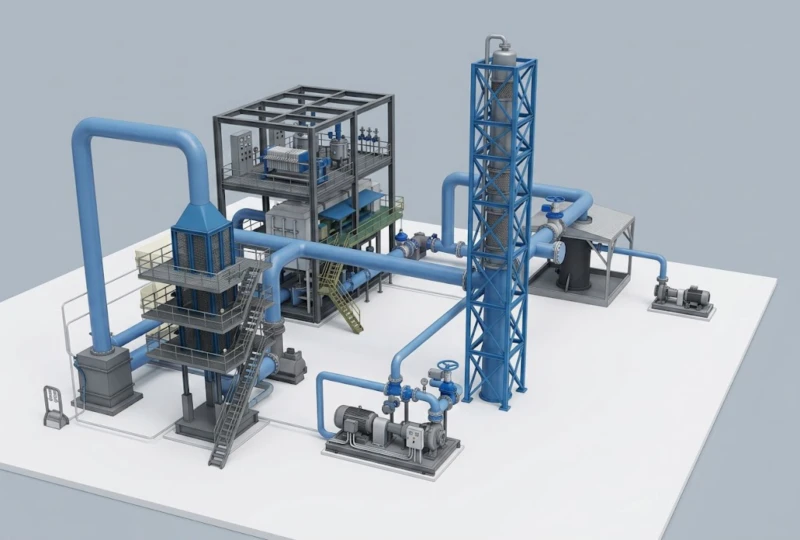
The resulting process architecture exploits the RTO’s inherent function as both a CO oxidation system and a gas heating system — the RTO raises the post-kiln gas temperature above 760°C for CO destruction, and the high-efficiency heat exchanger then transfers this heat to the clean post-SCR gas stream to reheat the denitrified gas, while simultaneously providing the 320°C inlet temperature required by the mid-temperature SCR catalyst. This thermal coupling eliminates the need for any external gas heating for the SCR stage.
Stage 1: Tunnel Kiln Flue Gas Collection
The LNG-fired tunnel kiln generates off-gas at 115–120°C carrying CO at 5,000 mg/Nm³, NOx at 500 mg/Nm³, and PM at 30 g/Nm³. The RTO induced draft fan (single unit; flow 40,000–50,000 m³/h; pressure 3,500–4,000 Pa; temperature 200–250°C; power 75 kW) draws the kiln off-gas through the system. A bag filter pre-treatment stage captures the bulk of the 30 g/Nm³ PM loading before the gas enters the RTO, protecting the RTO ceramic heat storage bed from dust blockage.
Stage 2: RTO (Regenerative Thermal Oxidizer) — CO Abatement
The pre-dedusted gas enters the RTO (flue gas volume 20,000 m³/h; 3-chamber configuration; ceramic heat storage bed). The RTO thermally oxidises CO to CO₂ at combustion chamber temperatures above 760°C, achieving CO outlet ≤100 mg/Nm³ against the 5,000 mg/Nm³ inlet. The RTO also raises the gas temperature significantly, providing the thermal energy needed for the downstream SCR stage. The RTO ceramic heat storage bed recovers thermal energy from the outgoing treated gas to pre-heat the incoming raw gas, achieving the high thermal efficiency characteristic of regenerative thermal oxidation. The RTO SCR induced draft fan (single unit; flow 30,000–35,000 m³/h; pressure 4,000–6,000 Pa; temperature 120–150°C; power 75 kW) handles the post-RTO gas flow.
.webp)
Stage 3: High-Efficiency Heat Exchanger (223°C → 320°C)
The post-RTO gas, which has been thermally treated and exits the RTO at elevated temperature, is directed through the high-efficiency heat exchanger (flue gas volume 17,500 Nm³/h; heat transfer area 380 m²; device pressure drop 1,050 Pa; hot side inlet 223°C; hot side outlet reduced; cold side outlet raised; device dimensions 4,270×2,240×1,973 mm) to raise the gas temperature to approximately 320°C before the SCR reactor. The 320°C SCR inlet temperature is within the optimal operating window for the mid-temperature vanadium-tungsten-titanium catalyst used in this installation. The heat exchanger simultaneously uses the SCR outlet gas (which has been reduced in temperature by the catalytic reaction) to pre-heat the SCR inlet gas, creating an internal thermal efficiency loop.
Stage 4: Mid-Temperature SCR Denitrification (320–350°C)
The pre-heated gas at 320°C enters the mid-temperature SCR denitrification system. Key SCR reactor parameters: device outer dimensions 2,200×2,290×10,160 mm; device outer height 10,160 mm; 4 catalyst modules; catalyst volume 5.2 m³; device pressure drop 500 Pa; SCR inlet temperature 320°C; SCR outlet temperature 309°C. The SCR achieves ≥94% denitrification efficiency, reducing NOx from 500 mg/Nm³ to ≤30 mg/Nm³. The reducing agent is 20% ammonia water solution, delivered by ammonia water delivery pump (0.75 kW, 0.015 t/h, 8,000 h/year). After SCR denitrification, the treated gas returns through the high-efficiency heat exchanger (using the SCR outlet gas to pre-heat the SCR inlet gas as described above), and is then transported by the SCR induced draft fan to the stack for discharge.
Kiln
LNG
≥80% PM
≤10 mg/Nm³
≥760°C
≤100 CO
→320°C
SCR inlet
320°C
≥94% NOx
Pre-heat
→ Stack
⭐ New or upgraded equipment in this project
Key Equipment Parameters
| Equipment / Item | Specification |
|---|---|
| High-efficiency heat exchanger | 17,500 Nm³/h; 380 m² area; 1,050 Pa pressure drop; hot inlet 223°C; 4,270×2,240×1,973 mm |
| RTO induced draft fan | 40,000–50,000 m³/h; 3,500–4,000 Pa; 200–250°C; 75 kW |
| SCR induced draft fan | 30,000–35,000 m³/h; 4,000–6,000 Pa; 120–150°C; 75 kW |
| RTO | 20,000 m³/h; 3-chamber; ceramic heat storage bed |
| SCR reactor | 2,200×2,290×10,160 mm; 4 catalyst modules; 5.2 m³ catalyst; 500 Pa; 320→309°C |
| SCR denitrification efficiency | ≥94%; NOx 500→≤30 mg/Nm³; 20% ammonia water reductant |
| Blower fan | 7.5 kW (1 unit) |
| Total installed power | 162 kW installed; 161.25 kW actual running |
| Annual electricity cost (8,000 h) | Approx. 46.44 ten-thousand RMB equivalent (0.36 RMB/kWh) |
| Annual ammonia water cost | Approx. 7.2 ten-thousand RMB equivalent (0.015 t/h, 600 RMB/t) |
04 — Core Advantages
Why RTO + Mid-Temperature SCR Is the Right Architecture for Refractory Tunnel Kiln Off-Gas with Dual CO and NOx Challenges
- ✓
RTO Addresses Both CO Abatement and Gas Pre-Heating in a Single Unit: The RTO performs two functions simultaneously: it thermally oxidises CO at ≥760°C (meeting the ≤100 mg/Nm³ CO outlet requirement), and it raises the gas temperature to a level from which the high-efficiency heat exchanger can deliver the 320°C SCR inlet condition. Without the RTO, an external gas heater would be required to bring the 115–120°C kiln exit gas to the 320°C SCR inlet requirement — consuming substantial additional fuel. The RTO makes this heating available as an inherent consequence of the CO oxidation chemistry, at no additional fuel cost beyond what is needed for CO compliance. - ✓
Mid-Temperature SCR Achieves ≥94% NOx Removal From 500 mg/Nm³ to ≤30 mg/Nm³ — Well Below the IED 100 mg/Nm³ Limit: The ≤30 mg/Nm³ NOx outlet achieved in this installation is 70% below the EU IED 100 mg/Nm³ limit for combustion installations — a substantial compliance margin that provides buffer against future standard tightening and against measurement uncertainty in the CEMS readings. The mid-temperature SCR catalyst at 320°C delivers this efficiency at a catalyst volume of only 5.2 m³ (4 modules), making the SCR reactor compact enough to integrate within the existing site footprint alongside the RTO. - ✓
High-Efficiency Heat Exchanger Couples RTO Heat Output to SCR Inlet Temperature Without External Energy: The 380 m² high-efficiency heat exchanger transfers the thermal energy available from the post-RTO gas stream to the SCR inlet gas, raising it from the post-RTO temperature to approximately 320°C. The heat exchanger simultaneously uses the SCR outlet gas to pre-heat the SCR inlet gas. This internal thermal coupling eliminates the need for any steam or electric heater for the SCR temperature management, reducing both capital cost (no heater equipment) and operating cost (no additional energy consumption). The supplementary natural gas consumption (if any) for top-up heating is minimal compared with a system without heat recovery. - ✓
The Natural Gas (LNG) Fuel Eliminates SO₂ as a Significant Pollutant and Enables Mid-Temperature SCR Without ABS Risk: Because the kiln is fired on LNG (which contains essentially no sulfur), the SO₂ concentration in the off-gas is minimal (only 35 mg/Nm³, primarily from the refractory raw material decomposition). This low SO₂ means that mid-temperature SCR at 320°C can be deployed without the ammonium bisulfate (ABS) catalyst poisoning risk that would arise at this temperature in a high-SO₂ application. The LNG fuel choice is the enabling technical condition for mid-temperature SCR placement, and represents a significant difference from coal or fuel oil-fired refractory kilns where SCR placement must be managed much more carefully. - ✓
Compact Design Principles Respected: Small Footprint, Rational Flow, Full Automation: The system design follows five principles specifically tailored for the existing manufacturing site: advanced technology at low operating cost, compliance with all standards, no secondary pollution, minimal footprint with rational flow layout, and full automation with soot blowing and temperature control feedback. The automated control system feeds real-time flue gas temperature monitoring back to the ammonia injection rate and the soot blowing cycle, and includes one-button restart capability. This level of automation is particularly important for a manufacturing site where the air quality treatment team may not have dedicated round-the-clock operators.
05 — Operational Results and Documented Challenges
Verified Emission Compliance — With an Important Caveat on System Integration
The system achieved the following verified compliance data: NOx outlet ≤30 mg/Nm³ (design target met); CO outlet ≤100 mg/Nm³ (design target met); PM outlet ≤10 mg/Nm³ (design target met). Denitrification efficiency: ≥94%. Dust removal efficiency: ≥80%.
The experience summary explicitly documents an important post-commissioning finding: although overall system performance met emission targets, CO content instability and flue gas fluctuations exceeded design limits at certain operating periods, fan pressure in the extended gas flow path became unstable, the retrofit modification was not as stable as originally assessed, CO content in the gas was unstable, fluctuations exceeded design values, and the RTO experienced over-temperature trips. The documented root causes were: (1) CO content instability; (2) flue gas moisture content and dust loading fluctuations with peaks exceeding design values. The documented response measures are: (1) strictly control raw material sources to ensure system operating stability; (2) control the furnace operation to ensure stable flue gas composition.
.webp)
06 — Implementation Cautions
Six Critical Lessons from This RTO + SCR Refractory Kiln Off-Gas Project
- 🚫
CO content instability caused RTO over-temperature trips — raw material quality control and furnace operation stability are prerequisites, not optional: The experience summary documents that CO content in the flue gas was unstable, with fluctuations exceeding design values, and that this caused the RTO to experience over-temperature trips. The root cause is the tunnel kiln’s combustion chemistry: when raw material composition varies, the organic content and combustion behaviour changes, producing CO spikes that can cause the RTO combustion chamber to exceed its temperature design limit when multiple simultaneous CO spikes arrive from different kiln zones. Strictly controlling the raw material composition, maintaining consistent raw material moisture content, and ensuring stable furnace operation are the operational prerequisites for reliable RTO performance — these are kiln management disciplines, not treatment system engineering issues. - ⚠️
Flue gas path pressure stability must be verified across the full gas flow range after any retrofit modification — extended path lengths increase fan pressure sensitivity: After adding the RTO and SCR to the existing system, the gas flow path length increased significantly, raising the total pressure drop that the induced draft fans must overcome. The documented risk is that fan pressure in the extended gas flow path becomes unstable during certain operating conditions. Before any retrofit treatment system is commissioned, pressure drop calculations must be performed for the full flow path from kiln to stack under maximum, minimum, and transient flow conditions. Fan operating curves must be verified to have adequate surge margin at all operating points in the extended flow path. A pressure monitoring system with alarms at upper and lower limits should be installed at representative points along the treatment train. - ⚠️
RTO over-temperature protection must be designed for the maximum plausible CO spike, not the average CO concentration: The RTO design temperature limit must be set considering not just the average 5,000 mg/Nm³ CO inlet but the maximum instantaneous CO concentration that can arise during kiln start-up, raw material change-over, or burner adjustment. If the maximum CO spike is significantly higher than the average (which is typical for tunnel kiln combustion chemistry), the RTO combustion chamber temperature during a spike event can substantially exceed the steady-state design temperature. Install a CO analyser at the RTO inlet with an automatic emergency bypass activated when CO exceeds the design maximum, diverting excess gas around the RTO combustion chamber to prevent over-temperature damage to the ceramic heat storage bed. - ⚠️
SCR temperature management is critical — soot blowing and temperature control feedback must be calibrated from real operating data in the first 30 days: The SCR inlet temperature must be maintained within the 320–350°C operating window to ensure ≥94% NOx efficiency. Temperature variations arise from: variability in the kiln off-gas temperature, variability in the heat exchanger performance as dust deposits accumulate, and variability in the RTO outlet temperature during CO load changes. The automated control system must respond dynamically to these variations, adjusting supplementary gas heating (if present) and soot blowing frequency. The control set-points should be calibrated from actual operating data during the first 30 days of commissioning rather than from the design calculations, as the actual thermal mass and heat transfer characteristics of the installed system may differ from the design model. - ⚠️
Very high initial PM loading (30 g/Nm³) requires reliable bag filter pre-treatment to protect the RTO ceramic bed from blockage — bag filter performance is safety-critical, not optional: The 30 g/Nm³ initial PM loading is approximately 3,000× the PM concentration that most industrial SCR and RTO systems are designed for. This exceptional dust loading makes the bag filter pre-treatment stage the most operationally critical piece of equipment in the entire system. Any bag filter performance degradation — broken bags, pulse-jet cleaning failure, or filter bypass — immediately exposes the RTO ceramic heat storage bed to refractory dust loading that can cause channel blockage within hours. Implement real-time pressure drop monitoring across the bag filter with high-alarm at the maximum specification level, and establish an automatic kiln throughput reduction response when filter pressure drop alarm activates, to protect the downstream RTO from overloading. - ⚠️
Close operational integration between the kiln team and the treatment system control team is non-negotiable: The documented experience that “the retrofit modification was not as stable as originally assessed” reflects the fundamental challenge of adding treatment system equipment to an existing manufacturing process without full integration of the process control philosophy. The kiln operators must be trained to understand how their operating decisions (raw material loading rate, burner settings, kiln zone temperature profile) affect the CO concentration and PM loading entering the treatment system. A formal communication protocol must be established before commissioning, including: advance notification of planned kiln operating changes, procedures for safe treatment system bypass during maintenance, and escalation path for compliance exceedance events.
07 — Engineering Takeaways
Four Hard Lessons from This RTO + SCR Refractory Kiln Project
- !
An RTO designed for average CO loading will experience over-temperature trips if CO spikes are not characterised and managed at the source. The experience summary explicitly documents RTO over-temperature trips caused by CO concentration spikes above the design value. The core lesson is that designing the RTO for the measured average CO concentration (5,000 mg/Nm³) is insufficient when the process produces episodic CO spikes that are multiples of the average. A proper CO concentration characterisation for any tunnel kiln application must include statistical analysis of the peak CO events (frequency, magnitude, duration) to determine whether the RTO design temperature limit will be exceeded during representative peak events. If it will, either the design limit must be raised, a CO bypass must be installed, or the kiln combustion must be stabilised to prevent the spikes occurring. - 2
RTO + heat exchanger + mid-temperature SCR is the right architecture for LNG-fired refractory kilns with simultaneous CO and NOx compliance obligations — the thermal coupling between RTO and SCR is the key economic advantage. The system’s fundamental efficiency advantage is that the RTO provides the CO abatement and the gas heating in a single unit, and the heat exchanger captures the RTO heat output to provide the SCR inlet temperature at near-zero marginal energy cost. This thermal integration is not incidental — it is the primary reason the RTO+SCR combination is economically viable for a process gas volume of 17,500 Nm³/h where external gas reheating would cost more to operate than the SCR denitrification saves in compliance penalties. - 3
Mid-temperature SCR at 320°C with ≥94% efficiency is achievable for LNG-fired applications because the absence of SO₂ eliminates the ABS catalyst poisoning constraint. In a coal-fired refractory kiln application, placing the SCR at 320°C upstream of a desulfurization stage would result in rapid ammonium bisulfate catalyst deactivation. In an LNG-fired application with only 35 mg/Nm³ of SO₂ (from raw material decomposition, not fuel combustion), this ABS risk is minimal and mid-temperature SCR placement is viable. Engineers specifying SCR for refractory kiln applications must determine whether the kiln fuel is LNG or a sulfur-bearing fuel before selecting SCR placement and temperature. This is not a detail — it determines whether mid-temperature SCR is technically feasible. - 4
Retrofit treatment systems for existing manufacturing facilities require more extensive systems integration work than greenfield installations — the “not as stable as assessed” assessment in the experience summary is a direct consequence of underestimating the integration complexity. Adding an RTO + heat exchanger + SCR to an existing tunnel kiln production line changes the gas flow path, the fan operating points, and the response requirements of the kiln operators in ways that cannot be fully characterized before commissioning. A minimum 3-month commissioning and tuning period must be built into the project schedule (not just 2–3 weeks), during which the control system set-points are calibrated from real operating data, the fan operating curves are verified under actual loading conditions, and the kiln operations team is fully trained in the integrated operation protocol.
08 — Frequently Asked Questions
Refractory Kiln Off-Gas RTO + SCR Treatment: Ten Questions Answered
Questions from environmental permit managers, kiln engineers, and HSE teams at refractory materials, advanced ceramics, and high-temperature materials manufacturing facilities planning RTO and SCR emission control upgrades under EU IED / Dutch Activities Decree requirements.
Ready to Solve Your Refractory Kiln CO and NOx Challenge?
Explore the Full Range of Regenerative Thermal Oxidation Solutions
From regenerative thermal oxidation (RTO) for CO abatement and combined SCR denitrification in ceramic and refractory kiln applications to the full range of industrial emission control solutions, our engineering team delivers EU IED–compliant systems for high-temperature manufacturing facilities.